2019-05-01 · PDF · tparents.org
Some ethical considerations around HyoJeong CheonBo ancestor liberation
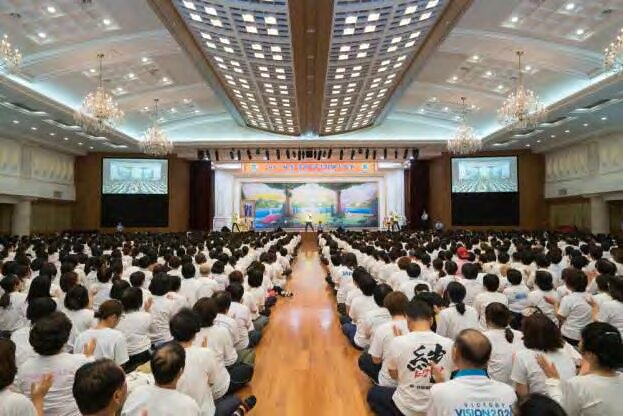
As many people in our community make plans to attend the HyoJeong CheonBo workshop, and maybe to liberate and bless their ancestors and other people special to them, it is good to consider some spiritual and ethical dimensions. All religions regard it as a blessing to make donations or go on a pilgrimage as part of their spiritual path and many believe that this can also bring blessings to those in the spiritual world. Such faiths also have teachings about things to consider when making financial contributions. It is worth reviewing them to inform one's own decisions.
Within the Christian church there has long been a tradition of saying prayers, making donations and offering Masses (Eucharist, Holy Communion) for the dead. Since the Reformation this practice has generally only been observed in the Roman Catholic and Orthodox churches. The Roman Catholic Catechism asserts, "From the beginning the Church has honoured the memory of the dead and offered prayers in suffrage for them, above all the Eucharistic Sacrifice, so that, thus purified, they may attain the beatific vision of God" (No. 1032). Therefore, just as we pray for each other and share each other's burdens now, the faithful on earth can offer prayers and sacrifices to help the departed souls undergoing purification, and no better prayer could be offered than that of the Holy Sacrifice of the Mass. It is common for such a Requiem Mass to be the first Eucharist offered in church each day. Members of a parish commonly, especially in the past, offer a donation to the priest (a Mass stipend) to perform the Mass for a deceased relative.
Pope Leo XIII in his encyclical Mirae Caritatis (1902) beautifully elaborated this point and emphasized the connection between the communion of saints with the Mass: "The grace of mutual love among 'The living, strengthened and increased by the Sacrament of the Eucharist, flows' especially by virtue of the Sacrifice [of the Mass]' to all who belong to the communion of saints For the communion of saints is simply . . . the mutual sharing of help, atonement, prayers, and benefits among the faithful, those already in the heavenly fatherland, those consigned to the purifying fire, and those still making their pilgrim way here on earth. These all form one city, whose head is Christ, and whose vital principle is love. Faith teaches that although the august Sacrifice can be offered to God alone, it can nevertheless be celebrated in honour of the saints now reigning in heaven with God, who has crowned them, to obtain their intercession for us, and also, according to apostolic tradition, to wash away the stains of those brethren who died in the Lord but without yet being wholly purified." Straight Answers: Why Do We Offer Mass for the Dead?
This is not unlike the Principle interpretation of Hebrews 11:39-40:
All these [saints of the Old Testament Age], though well attested by their faith, did not receive what was promised [permission to enter the Kingdom of Heaven], since God had foreseen something better [the Kingdom of Heaven] for us [earthly people], that apart from us they [spirits] should not be made perfect [citizens of the Kingdom of Heaven].
"With this explanation, we can understand that this verse accurately depicts returning resurrection. It illustrates that spirits living in the spirit world cannot attain perfection apart from the cooperation of earthly people. Furthermore, it is written, "Whatever you bind on earth shall be bound in heaven, and whatever you loose on earth shall be loosed in heaven." This verse teaches that unless the believers on earth first loose what is bound, the spirits also cannot loose what is bound in them. Since spirits can be resurrected only by cooperating with believers on earth to whom they descend, Jesus gave the keys of the Kingdom of Heaven to Peter, representing earthly believers, in order that he might unlock the gates to the Kingdom of Heaven here on earth." Exposition of the Principle p.127
The problem came when Christians began to look at the Mass as a thing instead of an action. It became a commodity and like all commodities, it could be bought and sold. This was Luther's objection to such a mechanical view of indulgences. People came to think that offering money was in itself a sufficient condition when what was more important was the change of heart and purification of one's own soul that should accompany offering and participating in the Mass. Also, priests misused it as it was a way of earning money and so would mechanically 'rush through' the service so they could be paid.
During the war of independence in 165 BC, the Bible records that Judas Maccabees offered prayers and sacrifices for the Jewish soldiers who had died wearing pagan amulets, which were forbidden by the Law. II Maccabees reads, "Turning to supplication, they prayed that the sinful deed might be fully blotted out" (12:43) and "Thus, [Judas Maccabees] made atonement for the deed that they might be freed from sin" (12:46). Again people in this world can do things to liberate and support the spiritual development of people in the next world.
The rabbis also thought about the ethics of good deeds and concluded:
"A poor person who is a relative takes precedence over anyone else. The poor of one's household take precedence over the poor of one's city. The poor of one's city take precedence over the poor of another city."
The reason for this is that if one does not take care of oneself one becomes a burden on one's family. If a family does not take care of itself it becomes a burden on the community. If a community does not take care of itself it becomes a burden on the town. If a town does not take care of itself it becomes a burden on neighbouring towns and cities. Charles Dickens illustrated the result of a person not observing this precept in his character Mrs. Jellyby in the novel Bleak House. Mrs. Jellyby was a philanthropist who is so obsessed with setting up settlements in Africa that she neglects her own home, spouse, and children. Wrapped up in her project, she is callous and heartless even when her daughter pleads for her attention.
The same principle could be applied to ancestor liberation. One should view the care of one's own children, including their education and blessing, as a priority.
In Islam it is obligatory for Muslims to go on Hajj or pilgrimage to Makkah. However, Hajj is only obligatory if: A person is a Muslim A person is an adult A person is of sound mind A person is free A person is physically and financially able to do it
To be physically able means to be in good health so as to be able to go there and back and not to be a burden on others. If a person is not physically able then they can finance someone else to go on their behalf.
To be financially able means to be able to cover all the travel and other expenses with money to spare for contingencies. The money spent should be surplus to what one needs. Before going a person must have paid off all his or her debts:
If the debtor who did not go for Hajj because of his debt dies, then he will meet Allah with his Islam complete and not lacking, because Hajj was not obligatory for him, just as zakaah (charity) and also Hajj are not obligatory for one who is poor.
But if he does Hajj before paying off his debt and then dies before paying it off, then he is in danger, because even the martyr is forgiven for everything except debt, so what about anyone else?
A person must also be able to fulfil any obligations to family and others and also be able to continue to support himself when he or she returns. Going on pilgrimage should not badly affect his or her business or employment.
Prayers to the Deity accompanied by monetary gifts secured by injustice are sure not to be granted. Pray in all righteousness and the Deity will be pleased to listen to your supplication. Foolish is he who, in impatient eagerness and without following the path of righteousness, hopes to obtain divine protection.
What is injustice? To donate money that has been stolen or borrowed or which should have been spent on obligations to one's family for example. If one borrows money and goes into debt to liberate one's ancestors who has paid for them to be liberated? It is also better to do something properly than to do it quickly.
As we have seen the understanding that people alive today can and should do something to support the spiritual development of their ancestors is common to many religions. This is in accord with our understanding that it is good, noble and one's duty to liberate and bless one's ancestors. "Spirits living in the spirit world cannot attain perfection apart from the cooperation of earthly people." At the same time these religions have good guidance about the ethics associated with such religious practices. It is easy for people to neglect their duties in this world and so these religions provide guidance as to the extent of such obligations to the deceased. It is important to make sure one has first fulfilled all one's obligations to people in this world.
I find it sad to sometimes hear stories of parents who have spent money to liberate their ancestors which should have gone towards their family and their children's education. Sometimes this affects the faith of their children who may then drift away.