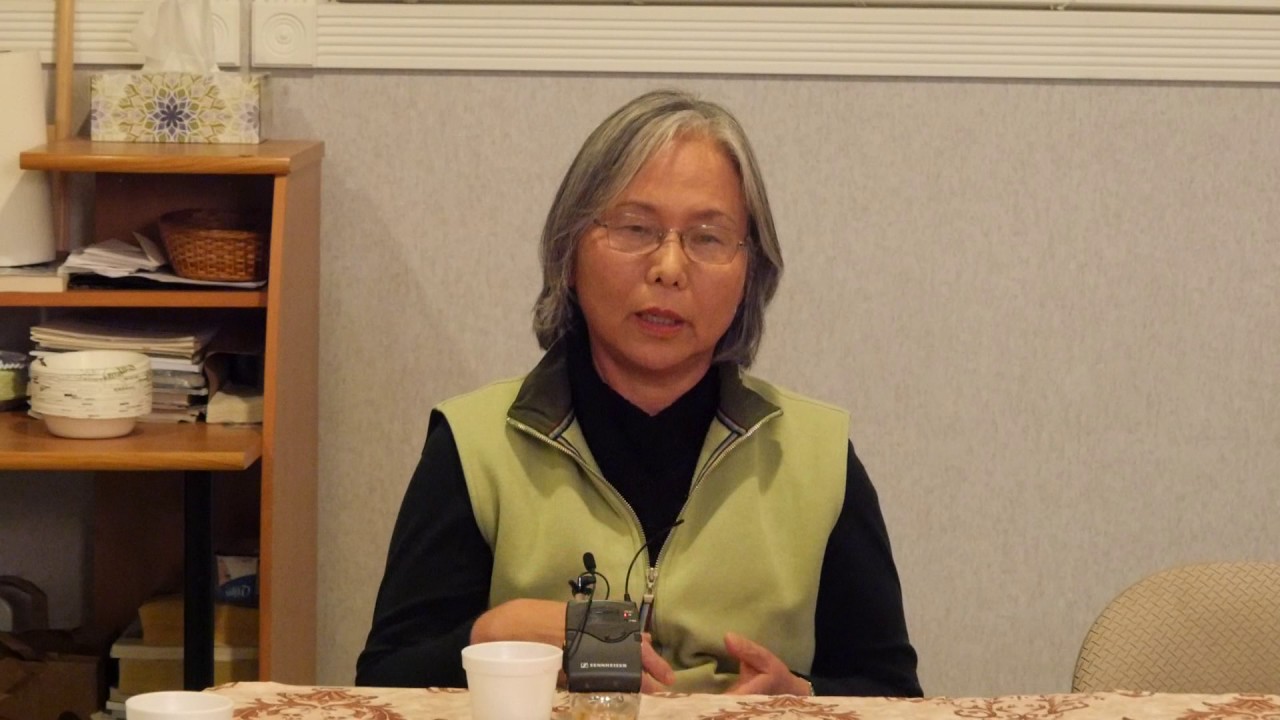
Yasuko Oberg
Mrs. Yasuko Oberg's testimony of her life of faith
YouTube · LVFC Office · 45:44 · Japan
Testimony video on LVFC Office channel.
My name is Yasuko. I was born in Japan, in Kyushu Island in Fukuoka Prefecture. I have nine brothers and sisters, but two passed away before I was born, so I never knew them — they died when they were young, five or seven years old. It was during the Second World War; they got sick and there was not enough medicine, so they couldn't survive. I am the youngest daughter. I have one younger brother, and altogether four brothers and three sisters, including me.
I would say my parents were quite religious. They practiced Confucianism and Buddhism, but they believed in God. My mother especially used to say to me: even if you don't see me, God — the Heavenly Father — is always watching over you, so don't do anything wrong. She also said that if you steal something, you are going to be crippled, and if you lie, you will be dumb. As you know, when you are a child it is easy to believe whatever your parents say. I don't know about these days, because there is so much internet and media, so maybe it doesn't work like that anymore — kids, I guess. But when you are young, your parents are almost like God.
My family lived in the countryside, and I needed to walk ten minutes just to see a friend. So most of the time I spent with my brothers and sisters, especially the three who were closest in age to me. I had lots of questions, and my father also liked to talk about ethics and morals — I was quite fortunate in my parents. When I entered high school, I had a wonderful friend, my best friend. Even during our high school years we used to talk about what is a purposeful life, what is true love, and why there is so much conflict in the world. Those were the years of the Vietnam War, and after we graduated and both had our own jobs, we always met at least once a month at a cafeteria just to catch up on what was happening in our lives.
One time we were having coffee and cake when someone came and wanted us to buy flowers. It was almost the end of the month, so we didn't have enough money — we told her we couldn't afford to buy. But she just insisted. She said there were so many children dying of hunger, and so many problems in the world, and that the funds would go to help make world peace. She was not going to move until we bought flowers. So we put our money all together, bought the flowers, and I took mine home since the three of us had shared the cost.
What I noticed was that when I looked at that flower at home, it was so vibrant — somehow beautiful in a way that felt different, even though it was just a simple flower. Normally, when I was in a shopping mall or in a crowd and I saw someone selling flowers, I would take a different direction to avoid them, because I knew that once they caught me I would not be able to get away without buying. So without knowing it, I had unknowingly made a donation to the Unification Church — at the time I had no idea who had been asking for the donation.
While I was working, I still had many questions: what is the purpose of life, what is the meaning of life after death, is there a God? This was especially on my mind during the Vietnam War years. In Japan at that time, the Communist movement had also become quite strong — the Red Army wanted to destroy universities and institutions, and college students were not attending class; they were destroying school buildings instead. I just couldn't figure out why they were doing something like that. I had so many questions about life and about society.
One time, when I was at the bus station on my way home, some church members — I didn't know who they were at the time — gave me a pamphlet. That pamphlet addressed all the questions I had been carrying. It announced an evening lecture series, so I went and attended three lectures. The pamphlet also had a person's name on it, and that person became what I would call my spiritual mother, even though she never came directly to witness to me. She was part of a group called the One World Crusaders — like COP members — who came to different cities to do witnessing.
I joined the church in March of 1972. After attending the lectures, I was invited — as everyone who was interested was — to the local church, and from then on I went every Sunday after work to listen to more lectures, have conversations, and ask all my questions. My spiritual mother was able to answer every one of them. Even so, I told her I was not going to join the church — my life was not that bad — but that I was interested. Somehow, though, my spirit had changed, and I felt I needed to go to the Seven Days Workshop.
Before I joined the church, I had some recurring dreams. In one, there were three steps and some kind of chaos, but when I reached the top of a rock I was saved — I was able to escape the danger. In another dream I often had, there was a big study hall filled with lots of young people, and if you could just reach out and connect with a tree at the edge of the building, you would be free to go outside. After I received the Divine Principle and understood that the rock is a symbol of Christ, I was amazed — those dreams had come to me before I ever received the Principle.
I kept telling my spiritual mother I was not going to join the church; she said I needed to join, and I said no, I was not interested. But somehow, I joined anyway — my spiritual mother never even came to my home, and I was living with my parents. I packed my luggage myself, went to the 21 Days Workshop, and joined the church. After I joined, I understood that the people who had been selling us flowers at the cafeteria were church members. I had tried to avoid selling flowers myself — I knew how it felt — but no matter what, I ended up going door-to-door to sell them as part of the church fundraising. Then I was sent to MFT, which was focused entirely on fundraising, and I — who had grown up deep in the countryside — was now sent to Tokyo, a place as busy as New York.
The goal was to sell at least 100 flowers a day, and one package was 300 yen. My parents had always told me never to beg money from anyone, and selling flowers is essentially doing exactly that — it was so difficult. So I really prayed to God, and I constantly kept in my mind why I was selling: I am not doing this for myself, I am selling for saving the world. I also came to understand that when that person had forcefully sold us a flower at the cafeteria, that must have made a spiritual condition that allowed me to join the church. I had made donations at different times — and as you know, every time you read the Divine Principle, we need to offer a symbolic, substantial offering. That must have been the condition that allowed me to meet the church.
So I prayed: even though I need to sell forcefully, just as that person sold a flower to me, that becomes a condition for the person who buys — so please bless him or her, even though it feels horrible. How we thought about it was this: we are simply giving a flower. No matter what you give, no matter what you receive in return, there is a reaction. Some situations on those busy streets were truly difficult — once someone took the flower, I still needed to get the money, and some things were really horrible. But I kept saying to myself: I am not going to sell this flower for myself. I am selling it for world peace, for True Parents, for True Father, and to make a condition for that person. I had never been in such a busy place before in my life, but I came to feel it was really good practice for me.
I just needed to deny myself and hold myself completely, and it was a really good training to develop my faith. In those days we lived in a van, moving place to place — we never slept in a house. In Japan, we usually take a bath, but we weren't taking one every day. I don't know what we ate, but I know we didn't eat any hot meals. In the city, when we needed to wash our face and brush our teeth, we went to a train station where there was water; that was the place we used to go.
I don't really remember what we ate, but I remember we got tapeworm, because the food wasn't sanitized and the vegetables weren't properly washed. When we needed to move to the next city, after we finished in the evening we slept in the van — they put down a board and we slept like sardines. When we woke up, we were in a different city. We had a captain who dropped each of us off at different places.
I didn't have so many complaints. But sometimes I felt sad — especially when you go in the evening door-to-door to sell your flowers, and everyone is gathering at home, and there's a nice smell of dinner and warmth in the house and families all together. I sometimes felt homesick, thinking of when I lived in my hometown with my parents. But at the same time, there is a Bible quotation where Jesus said that birds and all creatures have a nest where they can go back — but he doesn't have a home to go back to. I thought, that must be something Jesus felt. So I connected my difficult circumstances with the Bible.
Every morning, no matter what, we had a morning service or evening service, and the captain gave us a short way-of-life talk with quotations. He said, "When you get some difficulties, just remember those quotations — or just sing a holy song, a Christian hymn." And so, whenever I got into difficult situations, I needed to think about God, or about True Father's speech, or the quotations, or to sing a holy song. From the outside our life may have looked like a burden — the things we wore, the way we lived. But actually, life was so simple: I didn't need make-up, I didn't need to change my clothes so often, I didn't need to think about finding a spouse. Overall, I think it made a really good foundation for my faith.
I think I was traveling in the van for maybe one year, but at least I was able to go all over Japan — that was something good. Being in MFT, going from city to city, I got to see different people and different places, and that experience kept strengthening my faith. After I graduated from MFT, I went to a ginseng project — Jinsen — selling ginseng door to door. Then in 1974, I came to the United States, on February 5th or 6th.
During 1974, there was Madison Square Garden and the Washington Monument, with fundraising and witnessing, and I had really wonderful experiences there. I have lots of other experiences with God and in different situations, but I'll jump to Alaska. James and I were matched in March 1979 and received the Blessing in 1982, as one of the 2,075 couples. Then in 1984, James and I moved to Alaska.
That was a great blessing, because in the late 1980s, True Parents used to come to Alaska very often, and we were able to meet them very closely. It was Anchorage, Alaska — not Korea — so sometimes it was maybe ten or fifteen people. When True Parents came to Anchorage, they sometimes stayed at the Anchorage church. There was a Korean sister whose husband had been a president of the Kodiak fishing business and church activities; they had moved to Anchorage, and True Mother knew her well. When True Parents came, she prepared their meals, and she asked me to help serve them — it was a wonderful blessing.
I would say True Parents — True Father — are very spiritual. When you don't have the right attitude, he doesn't touch your food. I remember one time I served coffee and he didn't drink it, and I realized it was because I was serving the coffee just like a waitress, without the right heart. So I repented, and after I repented, he sipped his coffee. We got many opportunities to see True Parents so closely, and he spoke to us — though actually, he spoke mostly Divine Principle: from the Principle of Creation to the coming of the Messiah, maybe one topic at a time, for about an hour. It seemed he was not really talking to us — he was talking to the spirits of Anchorage, or of Alaska. That's what I felt, because he didn't need to keep repeating those things just for the few of us there.
Sometimes it is really difficult to have the right state of mind when True Parents are coming. One time before their visit to Alaska, I wanted to make some conditions. I watched a video about True Father's life at Danbury — his time in prison — and the next day we welcomed True Parents. It was just an incredible feeling, because True Father had gone through such a hard life, to the point of nearly dying, yet when we saw him, he had no resentment or sadness — he was just so happy to see us.
As a Japanese person, I knew that the Japanese had tortured True Parents and caused so much trouble in Korea — and it was not only Japanese, but Western and Korean members who had made things difficult for him too. I thought, how could he be like this? Because I saw no trace of agony or suffering — he just stood so straight, with dignity and pride, giving us hope, even though he had gone through such a horrible course. I was so happy, and felt so fortunate to find myself in those circumstances and to witness the difficult life he had gone through. I could see True Father right there, just like Reverend Lew standing there, and seeing him was such a great blessing — to know True Parents so closely. We were also able to interact with True Children and the leaders, who always took time to stop and encourage us.
Later, James and I moved back to James's hometown in Washington State, and I wanted to find a job. I didn't pray in a formal way — I just asked Heavenly Parents the way you'd talk to your own parents: "I want to have a job; could you find me something?" A couple of weeks later, I was looking through the Help Wanted section of the newspaper, and the school district was looking for a person who speaks Japanese and English. I don't know how many Japanese speakers there were, but I applied, and I was hired as a teacher's aide.
I worked there for about twenty years, and it was a really wonderful experience because I interacted with so many different people, especially students. There were students from drug-abused families, neglected children, homeless kids, children from families affected by alcoholism — so many children carrying so much trauma. There were also students with autism or Down syndrome who had so many difficulties. But overall, I felt that all those students are so precious, and that they each want to live their lives to the best of their ability.
I also felt very sorry for those students from families where parents were alcoholic or drug-abusing and not really caring for their children — that is the reason some students were so out of order, so defiant, living such a horrible life they didn't choose. They didn't choose that way; that was simply the household they grew up in. The school offered many in-service workshops on how to deal with those students, about their mentalities and how to relate to them, and it was really good training. In a school setting, adults are held to a high moral standard; if you want to be a teacher, you need a lot of patience and you need to truly love your kids. I saw so many different situations working in that school district.
It was an agricultural city, so we had lots of migrant students. Those parents wanted to do the best for their children — to learn, to get educated. I have seen some students where I thought, if they had stayed in their home country, they would not have gotten a good education, so their potential would have been wasted. They couldn't speak any English at first, but after a while they were able to speak English and do well academically — because of what the United States provides, and also because of the parents' wish, and their own desire to have a better life than their parents. So they really made such an effort.
We got people from so many different countries — from Ukraine, for instance. They could not speak much English, but after one year they really exceeded, much better than native-born students academically, because they knew about their country's situation and made a lot of effort to study so they could have a better life. The parents were quite supportive as well. If parents are supportive, the children behave better and are able to excel academically, and I could see that the involvement of family is very important. I saw so many different students, and I came to learn that all children — all kids — are so precious, and even those with physical or mental difficulties want to live the best they can.
But there was one category of student I didn't admire — the student who was so spoiled by their parents. Some parents, even when a child did something wrong, would come in and say, "My kid wouldn't do something like that" — they simply didn't believe their child was capable of doing wrong. It became so difficult, because the parents became so defiant, and it was hard to convince them or work with those students. If parents cannot see their own children's weaknesses or accept that they are doing something wrong, the students become so defiant and just don't want to listen. Those kids are so difficult.
When we did a door-to-door Blessing, one of the principals received the holy wine at her door. After that, she became the Superintendent of the Moses Lake School District. I don't really know the full story — we just gave the Blessing. But when you have a workplace, it is not easy to talk about religion, because the Unification Church in particular carries a kind of controversy. You cannot talk about it the way a Christian might — you need a particular time and setting. I didn't want people to misunderstand our church and then not be able to have a real conversation. Even with wonderful friends and co-workers, I couldn't say too much.
But outside of school, with a friend of mine, I was able to say who I am and what my religion is. I was very fortunate. In the beginning of my church life, I came to the United States. I got a lot of missions — fundraising, selling ginseng, the fish business, and the Washington Monument campaign. James wanted to move to Las Vegas, so that is how we ended up here. We've been here about two and a half years, and I skipped over about ten years when I was single — there's a lot there.
Reflections about this person
Reflections are anonymous unless you put your name in. Every submission is reviewed before it appears.
Loading reflections…