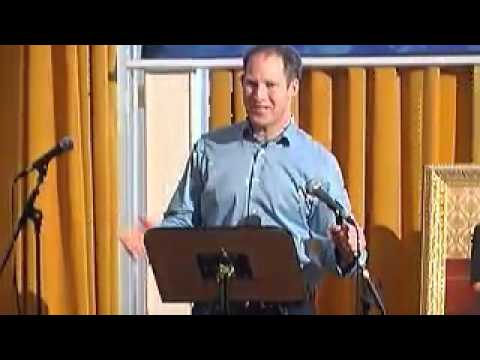
Various UK members
Testimonies from 2012 (compilation)
YouTube · FFWPU UK · 1:29:39 · UK
An emcee at FFWPU UK welcomes the congregation to the 30 December 2012 Sunday service at 43 Lancaster Gate, where year-end testimonies will be shared looking ahead to Foundation Day.
We're getting to that time where we're about to go into a new year, and I think we all know and feel in our life that we're not living in a vacuum. We all have a sense not only of our own time moving forward, but we see very much in the world around us that time is always moving forward, and there's always, in that sense, a direction that's being taken. The world is going in one direction or another, and either we feel or we sense that it's the right direction, and sometimes we sense the world's going in the wrong direction.
Likewise we feel that in our own life as well. Sometimes we feel like we're veering off a bit, or we come to that point where we think, "I've really found my direction — I'm sure, I'm confident of the place that I'm going to, that I want to reach, and in my heart of hearts that's where I want to get to," and we see the path in front of us, and that's of course a great feeling to have when we have it. But certainly we're not just standing still — we're never just standing still, are we? There are always going to be consequences in respect of our thoughts and feelings and actions and motivations in our life.
I just want to read you some words from our True Father, our founder, Reverend Sun Myung Moon. These are some words that he shared in 1971, on the 7th of February, and I think they're good words for this time of year when we're starting to reflect about the year that's gone by — the things that I've done, the things that I've said, what we've done in our work, what we've done in our relationships. "Usually, what percentage of your feelings turn out to be true?" — it's an unusual question, isn't it? — "You should analyse the process of your life and gauge the results. You cannot assess whether God or the devil is with you unless you can connect with your internal environment and analyse what percentage of your feelings are right and what percentage are wrong. Develop the mindfulness" — there's a Buddhist concept there — "develop the mindfulness in your life of faith."
I myself just started taking up some of my old meditation practices — the breathing, focusing on the breathing, and trying to get into that meditative, mindful state — in the last week or so. And he says: "If you develop such mindfulness, your feelings will accurately disclose what is coming your way when you go out for a certain purpose" — and I'm thinking he's not just talking about when you go out of the door in the morning; more metaphorically, when we go out to do something in our life — "without even praying, you will sense at your first step whether your journey will lead to something good or something bad. You will sense immediately whether it will make God happy or sad. You will be able to sense, 'this pleases God' or 'this pains God.' Develop your faith through experiencing the feelings of God in your inner self."
Those are nice words; maybe I'll email those to all of us. If you've got the World Scripture — one of our eight sacred texts, the New World Scripture — you'll find it in there under "sincerity." This year certainly is a year we'll never forget, probably mostly because collectively we will always remember this is the year our founder, Reverend Sun Myung Moon, our True Father, passed on into the spirit world, and all that that means for the future of our movement and God's providence, and all the taking stock that has been going on in our movement this year.
Today we're going to allow some of our community members to share with us how God has worked in their life over the last year — what significant things have happened in their life in 2012. They've each got just a brief time, between five to ten minutes each, and because there are five of them we need to keep it relatively brief. But I hope that in that time they can impart something to you — it's often nice to learn just through people's personal life experience, not always being taught a lesson through a sermon, but just listening to people sharing about something that they've come to realise through something that they did in their life, and to benefit from the wisdom that they've gained.
Veronica: Dawn and I are recently back from Cheongpyeong — Dawn was there for 80 days and I was there for 40 — and we just wanted to share a little bit about our experience there, our motivations for why we went, and also what we learned and what we gained while we were there. I'll start off. I've been wanting to go to Cheongpyeong for a long time. I'd been to Korea once before and passed through Cheongpyeong for three days at the end of some people's 40-day workshop, and it was quite an eye-opening experience for me at that time. It's been about 10 or 11 years since then, and I had a real desire to go back and get the full experience.
This year — actually in the summer, in July — I got a phone call from a friend and she was like, 'Oh, I'm in LG, I heard you live here now,' so she came up to see me and said, 'Do you want to come to Cheongpyeong with me?' I really wanted to go, but I just wasn't in the financial position, or things with work — it was just too soon, I just couldn't do it. But at that point I was like: okay, I actually really need to go, because I've had quite an up-and-down year and I just really needed to get back on track with my spiritual life and try and find my next step, my new direction.
So eventually I started really working every hour that I possibly could to try and raise the money to go to Cheongpyeong. And then just as I raised the money for my ticket, True Father passed away, and my dad called and said he really wanted to go to Cheongpyeong — to go to Korea for the Seonghwa. So actually the money that I'd raised for my ticket, I gave it to my dad so he could go. But I was like: okay, I've done this so that my dad can represent my family, and I knew that I would be able to make it back if I just had that same determination.
Then I actually didn't get my ticket until the day before — actually the very day that I went to Cheongpyeong. I went to the airport that day and bought my ticket; I was just so determined to go, because I really knew that there was special grace in Cheongpyeong and I wanted some of that. Dawn had actually left on the same day as my dad — I saw her at the airport — and she said she might stay another 40 days, so I was looking forward to being able to see her there. Lizzy, who had gone in the summer, was still there and was saying she was staying until Foundation Day — well, she did 120 days and came back just after that — and Natalia was there too, so it was nice to go and see familiar faces.
That really helped me, because I was a little bit apprehensive about the whole Cheongpyeong experience — it's quite an intense schedule. Although as soon as I got there they relaxed the schedule: instead of waking up at 4.30 we woke up at 5.30. It was luxury, and we had to be in bed by 10.40, so it was great — I was just like, yay, this is amazing. When I arrived it was the day of their graduation, and the next day was 40 days after True Father's Seonghwa ceremony, so they had a special ceremony. We attended via video link, because I was really determined to be part of that as well — since I wasn't able to attend the Seonghwa, I really wanted to be able to attend that ceremony.
True Mother had so much seriousness about how we needed to repent, and I really took that on and felt: this is a great time to leave my past behind and really make a new determination in my life. There were so many things happening in the church just before I went, and for the first time my faith was really shaken. I think it was just grace that I had already planned to go to Cheongpyeong, so I was like: well, I'm going to go even though I'm feeling shaky — I'm still going to go.
There was a special workshop — it was really intense, there were around 15,000 people, it was crazy, quite crazy. All the 40-day members had to do extra cleaning, so I had to clean the toilets on the third floor five times a day, and it still was never enough. But there was also a True Parents' Holy Item Lottery, so we all got lottery tickets, and I was very fortunate to receive a top from True Mother — a top that she had worn. I won the True Parents' Holy Item Lottery, which I was very grateful for.
It really meant a lot to me, because I was struggling so much at that point. I really felt like that was God trying to tell me: you need to stop being silly, I love you, and that's the end of it. I really felt God's love through winning that, because I was really looking for a sign — and he was just like, SIGN! Even when I went up on the stage and Dae-mo-nim shook my hand, just the fact that she touched me — I must have some value. It was a really silly thing, but I just felt like: she's a really spiritual person, so if I was such a bad person she'd probably be like, 'No, go away.' But she's actually not like that at all — she has a very open heart, a very forgiving heart, and she's just full of love and wants to embrace everybody.
It's so important, because I think especially for me I have a tendency to be my own worst critic — I put myself down a lot. But then I realised that God loves us immensely, and that means we are valuable to him, and we need to keep remembering that. Even though we're not perfect, we're all striving for that perfection; we all want to have that eternal happiness, we all want to be better than we are. One thing we have to realise is that there's no quick fix, and we just need to be a lot more patient with ourselves. I think that's one of the things I really learnt at Cheongpyeong — I don't think I was expecting to be floating or levitating at the end of the 40 days, but growing is a process, it takes time, and you just have to be patient and not be so hard on yourself.
Dawn: I went to Korea for the Seonghwa ceremony and was supposed to leave, but I decided to do my first 40 days — my first time at Cheongpyeong as well — and it was really good for me. I completely embraced everything; I wasn't really scared or worried, I didn't miss home, I just completely embraced it and loved it all. We always hear three words — sincerity, devotion and dedication — and 'attitude' a lot at Cheongpyeong, and I think while I was there I really understood what those words meant to me. Personally I had a really good experience: I was on the Chanyang team, I was in the main for the Great Works — the first time True Father attended from the Spirit World. I knew what I was going to say, but I'm really nervous! I think everyone should go to Cheongpyeong — there are no words to describe it.
Then I did another 40 days, because I felt like for second generation especially it's important that we do 120 days. My first 40 days somehow felt like an introduction — like there was something more that I could gain from it. In my second 40 days I was used to the schedule — although they did change it — but I really knew what was going on. I was enjoying Heundeke — as second gen I didn't have a choice, I was just born into this — but now I really feel like I've made my faith my own, my own personal relationship with God and True Parents.
Especially learning about True Mother — I feel like as a woman, as a lady, it's really important for us to understand our value. True Father is True Father, but we have an ideal woman, and we should really be looking at True Mother as our example. I had my birthday at Cheongpyeong; I turned 19 there, and it was really good. We had a Chanyang party, everyone performed, I had a cake, and she got me a necklace. I received a lot of love at Cheongpyeong — and chocolate! I really would like to promote Cheongpyeong, because it's really great.
Mr Hashimoto: I've been in Japan for a period of time. After 30 years I had been in Europe — East Europe, Germany, Spain — but after 30 years to go back to Japan is a bit strange for me at the moment. I have a desk in the Japanese headquarters on the third floor. Do you know, at the age of 30 to go there, and then there's a report — a short report — and then after that there's exercise. Do you know, exercise everywhere in the headquarters. There are already 120 full-time staff, each in different departments — the education department, the witnessing department, and…
Also dealing with many legal matters like that, and accountants—in Japan the headquarters has 120 full-time staff and is very, very busy. At the moment they have 55 different districts and 285 churches, and those working full-time on a salary throughout Japan number more than 3,000. In December, Temonim came to Japan and had events in Tokyo, Yokohama, and Osaka—all together 40,000 participating. Japan is still a very strong movement. As you know already, 7,000 Japanese sisters are blessed with Koreans and are living in Korea—7,000. And I was very surprised: more than 1,000 are blessed with Filipinos, and more than 1,000 Filipino-Japanese couples are living in Japan. They are not belonging to the Japanese movement—they continue to support the Philippines.
Because I am working now in what they call the international ministry—a kind of overseas mission department—I am meeting many different national messiahs and missionaries. The other day I met a South American missionary and she explained all the events going on in South America; as you know, many thousands also went there. I also met a brother who is responsible for African missionaries, and it was very surprising: in the 1990s, 120 Japanese sisters blessed with Congolese nationals had been living in Congo. But war broke out, and all these couples had to come back to Japan—the Japanese embassy warned them that if they stayed in Congo they would be killed. They are hoping to go back to Africa someday.
In the United States, as you know, more than 1,500 Japanese are also working there. When I see the Japanese overseas mission working everywhere, they still feel they are not doing enough—Japan should have more organised support for the overseas mission. That is what I am now going to propose to the Japanese headquarters, but the organisation is so huge that I hope a better structure can be established. True Mother also wants to invest in the second generation. There are around 10,000 Japanese second-generation members who are 18 to 20 years old or above and eligible for the Blessing, and my hope is that all these young people will go abroad and do something.
My feeling in Japan is totally different from what I experienced in America or in Europe. I can see that the movement can do better, do more, for the worldwide providence. But recently I was also studying the formation of the Reformation—how Martin Luther started in Germany, Calvin in France—and actually it really started in England. His name is John Wycliffe, an Oxford University professor, and he said very clearly that Roman Catholic doctrine was far away from biblical teaching. His word went to the Czech Republic, where Jan Hus took all of Wycliffe's content and spread it, and ultimately the Czech Republic was reformed by Hus—a professor at Charles University in Prague—though in the end he was banned.
I was studying why Japan never became Christian. We have 120 million people and Christians are only 0.6%—almost no Christians. The first missionary came to Japan in 1549, exactly 400 years before I was born in 1949, and I was very surprised to discover that in that very same year, 1549, Henry VIII separated England from Rome and started the Anglican Church. For me it is really fascinating how Japan, Germany, and England are so deeply connected.
In Japan Christianity had only a very short period—38 years—and 20,000 followers. But when the Shogun decided to stop it, those believers were totally persecuted and many of them were murdered. That is why, after 400 years, Japan has somehow remained distant from Christianity. But now our movement has space to grow, because so many people are waiting for our teaching—I am sure of it.
I plan to come back here every three months or so and continue to help the Japanese headquarters. Just a couple of days ago, our president, Mr. Kajiguri, passed away. One month ago I was there and we had a meeting—around 20 people, with Mr. Kajiguri sitting with us—but he was suffering greatly from cancer and could not sit for long hours, so he went back to the hospital, and then he passed away. A new president has now been appointed: Mr. Tokuno, who had been the continental director in Russia—a much younger generation. I think Japan can do more, and I hope so. I am now based at the Japanese headquarters in Tokyo, Shibuya, so if anyone comes to Japan I would be very happy to have a cup of coffee with you—just let me know before you come.
Ann: It has been very difficult for me to decide what to talk about. Yesterday afternoon, as I was praying, I was really saying, "Heavenly Father, I don't want to say what I feel myself, but what you want to say to me — about me, about our life." I felt like Joanna in her testimony — she received a revelation, the word "student," if you remember — meaning she had to become a student; she was looking for a job. I had a feeling: talk about the Blessing. It would have been better if I could have talked after him. You will hear that he will be talking, I guess, about how his life has changed this year in many ways, and I am very grateful to all the efforts he has made to be honest — it brings for me a much more peaceful feeling. We have our differences still, of course — he likes hard chocolate and I like the creamy ones — but there are other differences, of course, which are more difficult.
I want to talk about the Blessing, as I felt God wanted that for another reason as well. I hope all the couples make it by Foundation Day — and some are struggling so much that you wonder if they are going to break up soon. So for this reason I want to talk about our life a little bit, not particularly this year, because since March and April we have Blessed 210 generations of father and mother — 210 generations are Blessed — and we have also Blessed many grandmothers already, but not 210 generations. From the time of the 210 generations, I almost felt immediately — within a week or two — a big change. I attribute the change to all the efforts he has made, and thank you to him and to Heavenly Father for that, but I attribute the change to our ancestors as well.
I want to talk about what our life has been in general. We have been Blessed for 34 years, and for the first 18 years we were going through very beautiful meadows — sometimes very beautiful meadows. For example, the birth of our son was an incredible time of joy. But we had also a lot of rocky paths and steep hills to go up and down. After going to Cheongpyeong in 1996 it became more difficult — after 40 days in Cheongpyeong — and we were told at the time that the most easily moved spirits had responded and left us and were liberated, but the most evil remained still with us. So we no longer have the help of the better spirits who have left us; we have the attacks and difficulties, the challenges given by the evil spirits.
From that time on, I tell you, I was in a cave. If you go in a cave, you know there is an entry and there is an exit, but in the cave you go down like this and up like that, and you have to turn, and you don't see the end — that is your faith. My faith was telling me there is an end; God is waiting for me at the end. And I have a stick, because in those hills and caves you have to walk with a stick — that is my prayer.
My son told me that he had been talking with some second generation, and they said, "You are first generation — you are together because you love God and True Parents, but you don't love each other." I was a bit shocked when I heard that. But I must tell you there is no difference — how can you love each other? If we still keep with God and True Parents, if we have a faith that there is an end to the tunnel, and if we go through the rocky cave — even if it takes 15 years — in my case, until the end of 2009 to the beginning of 2010, there was no great light coming at all. It has been really, sometimes, very much hell, and I am sure it was not hell just for me.
There was, however, God's love — very much — in the sense that sometimes when you are in a cave there is a hole in the ceiling, and you see the sky: a little hole, and light comes, very small. You carry on, and you see another light. God gives you light — He gave me light — that is how I see it. Without this faith in God and my prayer life, I don't think we would have ever made it, and without the help of people who could bear our pain — or my pain anyway — some friends and some leaders. I had leaders who always understood my situation, and I am grateful to Mr.
Speaker 1: Arashi, for example, has been witnessing many things of my life and he has been a great help, and I am so grateful to have met him on my path. My testimony is now a testimony of gratitude, because I know there is an end to the tunnel, and I think now I am out of the cave. We have still some rocky path — I am sure maybe not so steep — but we will have some mud to cross, some little river to cross; I cannot swim, by the way. But we will have few things to go through, and we can do it now.
I really feel, and I am honestly really grateful, that we have been able to persevere. You cannot reach a marriage alone — you need two people. When we break up we say it is Osbo's fault, but in fact there is one who is weaker and who left because he didn't have the faith, so I understand. To make a marriage work you need two people, and our life now is much more happy — so I want to let him talk now about what he wants to share with you. I hope I am not being too heavy.
Speaker 2: I feel that is very internal, and what I am going to say sounds quite conceptual and quite external, but since the age of 16 I have recognised that I need to make some changes in my life, and somehow all these changes that I have been trying to make these last 40–50 years have somehow come together in this last year or so. The Divine Principle has given me — how can I say — a map, a world view. My abiding question was: how does the Unification Principle relate to me and my life, to me and my ancestors, my history? The goal of True Parents is to make, in other words, a global village — so how does my family relate to the global village? True Parents wants to unite the whole world and make the world one family — what I would call the global family, the global village.
So then I thought to myself: even on a biological level, how does my family reflect the global family which True Parents wants to make? Let's look at our couple — my father is a Nigerian, my mother is an Indian. As part of the global providence, what does that represent? If you look at the globe of the world and draw a line vertically or horizontally, you get two different hemispheres — in our couple's case, if you cut the world in half horizontally, you have got the north, including Europe, America and other parts of the world, and in the south you have got India and Africa: what we call in politics the global north and the global south.
And what about Gabriel and his wife? His wife is Japanese — half Japanese and half Irish — and her name is O'Shea, which interestingly sounds almost like the Yoruba word O'Shea, which means 'thank you.' So in some way Gabriel's couple reflect, in miniature, the east and the west: she represents the east in some way, and he represents the combined north and south of our couple within him. So in some way we reflect the whole global family — north and south, east and west.
I can see that the Unification Principle, the unification goal of one world, is being somewhat reflected in our family — on the internal aspect that is another matter, that is just the biological aspect. But that is what True Parents have been trying to do all together through the Blessing: to make one world, and that is my understanding. It has helped me to find a certain value in our Blessing, a value in Gabriel's Blessing — because I had some questions about our Blessing and questions about Gabriel's Blessing. Oh my goodness me — Nigerian, Indian, European, now Japanese, America — is it getting too much?
As Japanese people say, itai atama itai — how do you call it — difficult. So in order to find some kind of harmony with all these different streams of cultures in our family, I have had to say to myself: how does my ancestors, how does my parents relate to all this global family business? I have had to ask myself: what is it? Mr Hashimoto used the word 'connections,' and that is the word I want to use as well — what is the connection between my ancestors on my Indian side, my African side, and Europe, what is the connection in history? That is what I have been wanting to know, and I have been researching for the last 40–50 years.
Some of the things that have been helpful to me: in recent years, scientists in America and different parts of the world have discovered the human genome — is that how you pronounce it, genome? — which says that all people are related and come from a common point of origin. They say that origin is in Africa, on the east coast of Africa near Kenya and Tanzania — so that is one point of connection, we are all related on a genetic and biological level. Our cultures and religions are very, very different on a superficial level, but if you look to the roots of it you will find they are quite similar — the world's scriptures will bear that out, and the Unification Principle bears that out. We know about Hinduism, and India some people say is 10,000 years old, some say it is older; there is no written record of it.
But the main point I want to make is what I have discovered in my research: in Africa, as far as they can prove, about 5,000 years ago in Egypt, written on one of the pyramid walls, was the name of a monotheistic god called Nebuchadnezzar. In the last 200 years many scholars did not understand or recognise that there was any such concept as monotheism in Africa in general, particularly in Egypt. This has been a struggling point for me, because how can we unite the different cultures if there is not that common base? The common base is God — in Africa as well as any other place.
Not just, as some books tell you, ancestral worship, the worship of spirits in trees, the worship of various different objects in nature — these are all true and part of it — but the essence of African religion is that they are monotheistic. If you do a little search for creator gods in North Africa, South Africa, East Africa, West Africa, you will find the names of creator gods, and that has helped me to come to terms with the relationship between my ancestral past and the Divine Principle of religions and cultures. Egypt more than 2,500 years ago was a pure African culture — it originally was — but 2,500 years ago it was gradually taken over by other peoples: the Persians, the Greeks, and so on. Although it was Africans who built the pyramids, within those pyramids is a religious concept of monotheism.
Reflections about this person
Reflections are anonymous unless you put your name in. Every submission is reviewed before it appears.
Loading reflections…