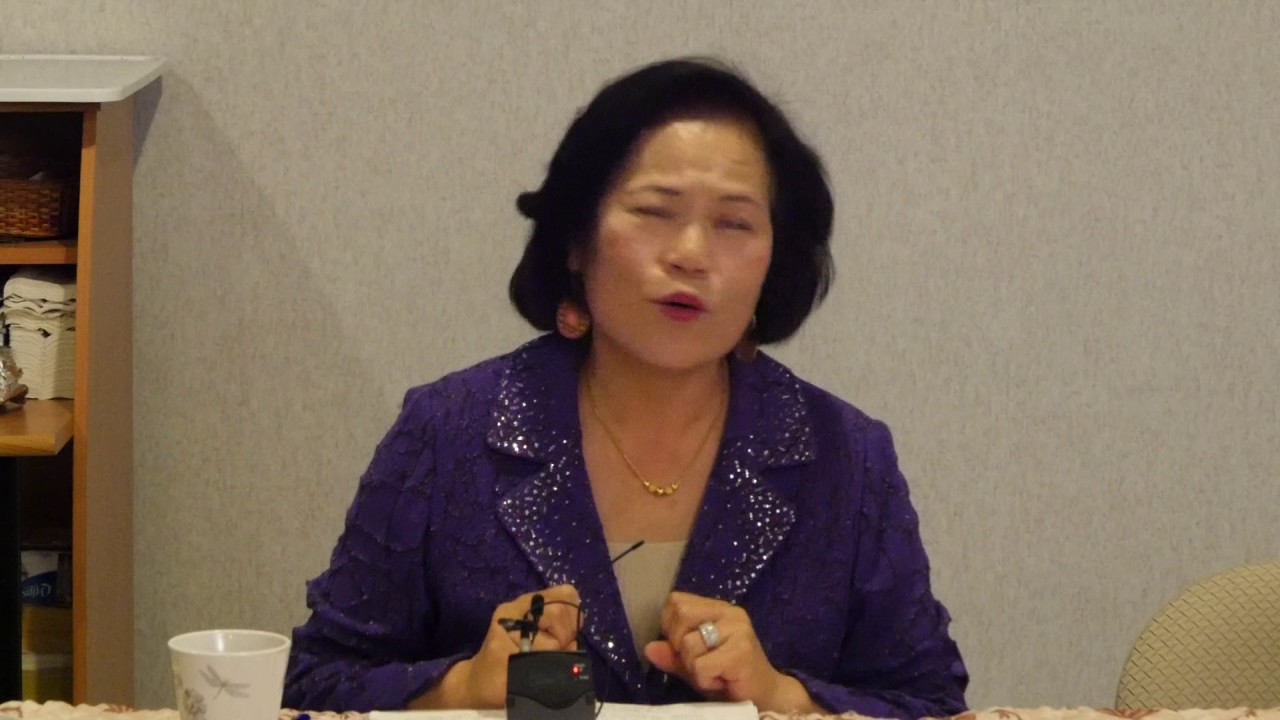
Sangmu Bornaman
The story of Mrs. Sangmu Bornaman's life of faith
YouTube · LVFC Office · 57:41 · South Korea
Testimony video on LVFC Office channel.
I came from Korea in September of 1979. I was born in South Korea, Chungnam Seosan Jigok. My daddy was a very diligent farmer. My mother was Confucian—very generous and kind. She used to make sincere offerings two times a year in the house, in each room. She usually cooked rice cake and put it in all the different rooms and the kitchen, and outside the house and inside the house. I grew up in that kind of environment. I have one brother and four sisters.
Luckily, my older sister joined the Unification Church very early, in 1960. She got a lot of persecution. My house was like a church, and my father and my brother persecuted my sister a lot, so we hated going to church. But I heard all the holy songs, so I still remember them now. My brother graduated from Korea University as a lawyer. My sister was a very pioneering member. When she had to attend the 430-couple Blessing, she needed three spiritual children, so she asked me, "Please come and attend a workshop after school"—I was in middle school at the time. So I went and attended a few lessons, which I still remember, and my sister got blessed.
After that, I didn't go to church at all. My brother-in-law was working with Reverend Clark in his early days, and by the time he got sick he came to work at an Iraq company and then came to America. I saw my sisters—one had joined the Unification Church, one was just married outside, and one was not married—and I thought my older sister was the happiest. So I decided to join the church to marry in the church. That time I had just graduated from college. I decided to go to the Blessing, but I hadn't gone to church or done anything.
Then one time my sister said, "True Father is coming to Cheongpyeong." So I went there. Father explained the international Blessing and how important it was. I thought maybe I could go. I went to the matching—at that time the folk ballet sisters got matched first. Father showed the pictures—oh, he was a lawyer, he was a reverend—and he looked so handsome and so nice, and I thought maybe I could go too. So I sat next to the other sisters.
The first day, Father only matched the folk ballet sisters. The second day I went back, and Father held up a picture and said, "Reverend Younghee Kim—find a good girl." I heard and stood up: "Me, me, me!" Father said, "Oh, you're too short." So I said, "Oh, I want to wear high heels!" and stood up tall. Father asked me, "Are your parents alive?" I said yes, and that my sister was an old Blessing couple.
Father looked at me and checked: "Oh, what did you study?" I said I studied craft—art and craft. "Did you work in a company, like a marble company?" No. Then I mentioned that my brother-in-law was in America, at the Iraq company, and Father remembered him and said, "Come, come, come!" So I got matched—I ran up to the stage. True Mother told me, "He looks more handsome in this picture." I didn't really care and just came out. My sister looked at my husband's picture and was not happy, because it was so red and sunburned—he had been fishing with Father in Boston—and she said, "No good!" and threw the flower down.
When I went home, my sister's persecution was intense. "Why are you marrying an American? They don't want to sleep with you." But I didn't doubt and just waited. The next day, my brother called my sister—"Don't cancel!"—because she had finally started thinking she could cancel, with my brother-in-law in America and me living with her at that time. My brothers convinced her not to cancel. Nowadays women with higher education can marry Western men, but back then the impression was not good—most Korean women who married Americans had married army men—and my mother and father said, "Don't come to my house." That was the kind of persecution we faced.
Maybe one week later we had to go to a 21-day workshop and then do home church. I did a three-day fast, then went to Wonju for home church. I was so excited—I'm very much like a baby—and I was so happy to live with the six sisters there. The reverend told everyone: "We have all different levels. Sangmu is like a kindergartener, but some are like a master's degree." Then exactly 21 days later, my sister called: "Your fiancé is in Korea!"
I was so shocked and was crying on the phone because I wasn't ready. For three days I went around to each house in my hometown telling myself I had to go back, and then I returned. My fiancé had come, and they liked me. I came to Seoul, where Peter Kim was with my husband at a Korean restaurant. My husband held one rose and was waiting for me. I met him, but I couldn't even say hello—Hyoil Kim was a translator, and Jinmoon Kim also translated all the time.
Father had told the helicopter support team to have Ken come because we were among the first who had to come to America. True Mother told Ken to go through the wedding and immigration process but not to say we were married in the church—so we made up a story, like a helicopter support wedding. We had to wear wedding dresses. Ken had been chosen from among the security team: about ten security members had been matched with Korean girls, and Father called them all together and asked who wanted to go get their fiancée first.
Everyone raised their hand—but Ken didn't, because he wanted to prepare more and study Korean. Father said, "Oh, Ken, your name is Ken—so you can do it." That is why he was the chosen one. So he came to Korea—Inji-nim, Eunji-nim, Heungji-nim, and Peter also came—and Father told Ken, "You have to pray a lot." So Ken and I went to Cheongpyeong in those early days, for a seven-day fast with overnight prayer, and Ken was cold showering outside. Then we passed.
Then I came to America. Because my mother didn't want to see me, I just continued attending the 21-day workshop three times in a row—21 days, then another 21 days, then another. I learned a great deal. Johan Lee taught us how to pray. I remember we had to wear kyungbae socks and a kyungbae dress—I basically learned the tradition from the ground up.
At the last 21-day workshop, we all went to Cheongpyeong together—all who had attended the workshop. I saw a vision: the numbers three, four, and seven floating in the air. I didn't know what that meant. The next day I saw something like a calendar—one, two, three, exactly like a calendar. I was holding a rug and doing like this, and at the last position the number thirty was placed in like that. I didn't know the meaning.
Then I came to America and stayed at the main house. Ken and I went to East Garden and greeted the True Parents at breakfast. True Father said, "Oh, you are the one whose parents don't like Ken." And Father said, "You are the first lady to come to America, so you have to set a sample. But you don't know the true heavenly tradition. So learn two months at East Garden, and then you have to go out and fundraise and carpool and do everything on the front line." Okay—I thought, two months.
I was waiting, and actually it was when Hyongji-nim was born that a woman called me: "You can come to East Garden." I came, and True Mother told the sisters I was the laundry sister. So I started the laundry from that day. I knew I had to leave two months later, so I did laundry until midnight, one o'clock—I cleaned everything, leaving nothing, because I thought I had to leave.
Then I realized I was so lonely. Nobody really cared about me, and I felt like I was dying. I thought, "Oh my gosh—my trees were moved from Korea to New York, and I'm dying. How can I do this?" Then I thought: I have to pray. So I went to Holy Rock four times a day—morning, lunch, evening, and dinner—and brought the Bible to read.
One day I realized: wow, I had become like a rock. Nobody said I had to leave or not—I just did laundry alone—but somehow God told me. I saw a rock, a tree, and a flower, and I could say, "Oh, this river is so beautiful." Then I thought: maybe I'm like a rock. The kitchen sister is like a tree, and maybe the nanny sisters—they are very nearby—are like flowers. So maybe I have the shining rock.
When I was in home church, I saw some families collect beautiful rocks to display in their house. I thought, oh, maybe I can be like a shining, beautiful rock. And I don't want to compare, because flowers and trees don't compete with each other — so I said to myself, okay, the kitchen sister is okay and I am okay, but I really have to study and work hard. That time I went to Masala to do security training, and then I went to the Aghor house to practice and tried to learn Divine Principle. I also went to listen to True Father's speech early every morning at the Belvedere Training Center. Nobody told me to go to the front line, and so one year passed, two years, three years.
Then one sister came from Korea — the driver Owens' wife. Peter Kim told me she was going to take care of a new baby; it was a good time, because True Mother was pregnant with Jungjinim. That was when I became a laundry sister. One thing I learned there — I asked Yejinim one time about a dream I had, with numbers flying around everywhere, asking what that could mean. Yejinim was in high school at the time, but she was so nice. She said, "You don't know that meaning? That's your responsibility."
I had another dream around that time. I opened a box and inside there were three pieces of white fabric. I gave some to a sister and kept one for myself. I asked Yejinim about that too, and again she said, "That's your responsibility." I thought, oh, my life is like that — I can make a holy gown, I can make a dye because of the white color, or I can make a rag. Whatever I do, I can make something out of it. So I was very diligent, because my daddy told me before I came to America — I asked him for one word, and he said, "Diligence is better than knowledge."
Sometimes when I did laundry I made mistakes. One time I had a beautiful pink set and a white spot appeared on it. I couldn't sleep — I went to the living room and prayed all night. But Yejinim said, "Oh, Sangmu, forget it. It's okay, don't worry. You can keep it like that." Eunjinim was the same — sometimes I would shrink a dress and pray overnight, and she would say, "Oh, it's okay, you can have it like this," and she made it a prayer dress. The True Children were so nice to me when I was a laundry sister.
After that, Peter Kim told me another sister was going to take care of the new baby. I thought, okay, no problem. But then somehow True Mother called me: "You are the one to take care of the new baby." Three days later the baby was born. Jungjinim came from the hospital, and I went to True Mother's room to be with the baby. True Mother came to me and showed me how to bathe the baby — "Oh, Sangmu, cover the ear like this when you hold the baby like this" — and she showed me how to bathe, how to change the diaper. She was teaching me herself.
A few days later True Father came from Morning Garden after fishing. His face was so red and dark, and he said, "Oh, you don't want to hold the baby like that." That was when I fully realized True Mother had chosen me to be the babysitter. Before I go further I want to share one more memory from my time as laundry sister. I remember one time True Father gave a speech at the Belvedere Training Center, and his white shirt was so red from his sweat — the water came through, the dye came out. I now regret that I didn't save that shirt for True Mother. It was a historical shirt, but I just washed it. Sometimes I feel I depended so much on routine without thinking.
True Mother also asked me to go to Boston for three months to take care of the True Parents' room, and I learned a lot there. One big mistake I remember — I was cleaning the bathroom while True Father was there shaving, and I put something in upside down. True Mother called me: "Sangmu, come." I ran in, and she said, "Sangmu, you have to do it this way, not that way." How could I be so careless? But they never got angry with me.
Another memory — I didn't know how to order flowers then, because I was a very country girl without much experience. When True Father went fishing and I had free time, I would go up the mountain, pick flowers, and put them in the True Parents' room. True Mother told me, "Sangmu, don't pick flowers from the field. If you bring flowers from the field, other people cannot see them. Leave them there so everybody can see." I realized then how much bigger True Mother's heart was than mine.
I also noticed how carefully True Mother looked after everything when it came to keeping clean — even Q-tips. Usually my children and I would use a Q-tip and throw it away. But True Mother would use only half and save the other half in front of the mirror. She also used tissue very sparingly, just a little bit at a time. Sometimes she would wash her own underwear by herself and hang it in the bathroom, because she didn't want us doing unnecessary work for her. She taught me so much just by the way she lived.
At Morning Garden, True Mother was pregnant with Yeonji-nim — almost in her last month — but she went shopping every day. I was so moved. She worked so hard, going through all the rooms, matching the carpet and cotton and everything. Then True Father called all the Korean sisters who were engaged. All of us came and we had a three-day workshop. True Father came down and spoke to us. He said, "Your Korean sisters may be heavy, but American sisters have high noses, beautiful skin, and long legs — they are beautiful. So if you don't have the face, you cannot make it, so you have to pray a lot. And you have to be nice to your brother-in-law and sister-in-law and mother-in-law and father-in-law; otherwise you cannot make it." It was really deep for me to understand what True Father wanted us to do.
Then I became Jungjinim's nanny. I remember True Mother was like the wind — when she came into Jungjinim's room, I didn't even know she had come in, because it was so peaceful and she made no noise. When she opened the door, it was so quiet. I thought she was like air. I never heard any noise from around True Mother. When she came in, she would just lie down beside the baby, roll around on the floor, read a book, and give Jungjinim energy. I was so surprised — she was at exactly the same level as the baby.
I remember living in the next room and being able to see everything. Every morning we would go for Gyeongbae to the True Parents, and I remember True Father would already be awake, studying at his table — that is my memory of him. After Gyeongbae, True Father and True Mother would go downstairs for breakfast. All the True Children — that time was like heaven. They were so happy, sharing with each other, bicycles and toys and everything. They had so much to enjoy together.
Then came the Danbury time. One day I didn't fully understand what was happening — maybe because I was not so spiritually connected — but True Father asked everybody to come into the living room and pray together. True Mother was crying and crying, and we found out all the True Children were crying too, because that was the day True Father was going to Danbury. I remember True Mother didn't eat breakfast that morning. After that, I never saw her eating breakfast before we left.
Somehow True Mother wanted to take Jeongjinim to visit True Father at Danbury, about three times a week. I would wake Jeongjinim up early. She and Yeonji-nim lived in the same room, but I didn't want to wake Yeonji-nim, so I would gently rouse Jeongjinim, do her hair, dress her up, and we would wait by the front door. True Mother would come down looking perfectly beautiful — I never saw her eating in the dining room in those mornings. Then she would say, "Let's go," and True Mother and the driver sat in the front seat, and Jeongjinim and I in the back seat. Sometimes True Mother would buy coffee on the way, or sometimes the sisters would prepare it. But I always remember how neat, clean, and beautiful she was.
Then we arrive there, and we can hear the Hoon Dok Hae—Kamyama-san and Father sitting, Kamyama-san reading. Early morning, like 7:30, True Mother goes, Jungjinim holds her hand, going up the hill at Danbury, and Father waves. We stay in the parking—the driver and me—but Mother and Jungjinim go up. Sometimes some leaders are waiting for True Mother in the parking place. Then Jungjinim comes down at 11 o'clock. I wait for her in the car, and then I take her to—that time Father had a secretary, like Hyoil Kim—he was renting a house, an apartment nearby, praying for Father. So she goes there to sleep, take a nap, and then lunch.
Then we go back around 12 o'clock in the afternoon, and Mrs. Dos is waiting for her. I go to the front, Mrs. Dos comes and takes Jungjinim inside. Then maybe one hour later, True Mother and all the leaders come down the hill, and she's bouncing, bouncing, dancing, and everybody praises her—it's like a jail, but more like a happy mood. So that's why I think True Mother took the youngest daughter with her. All the time I supported, we went together. One time, at Christmas, they had a cross on the hill. True Mother pointed at me—"Ah, Sangmu, you don't know anything, you're lucky." And True Mother was using a cane by then.
One time True Mother said, "Ah, I ate a pack of popcorn"—in Minnesota, Denver—because sometimes True Mother would go inside, but True Father was talking to the leaders, and I think True Mother had no chance to talk to True Father. Also, I remember that time one leader sat with True Mother and we got together. True Mother said, "Yeonyun? Yeonyun is chungyohada"—when a tree grows long it is more precious than a small tree, something like that. True Mother also told him, "Father doesn't want to judge. He doesn't try, he doesn't want to judge anybody."
Then I learned those words—I cannot forget them—because even though Father might want to judge America, he doesn't want to judge. She explained that. And there were a lot of things. Then—Tambourine time, around 2000—True Father asked all the couples, the Belvedere staff, to come. Father had to go back to Korea. I was so curious why Father called us couples, what Father would ask us. Then Father asks, "Oh, how many children do you have?" "One." "Oh, why do you have only one?" Or, "I have two daughters, why don't I have a son?" Father asked only about children—how many children. I was surprised that Father wanted children to have many, a happy marriage life.
In the last moment, who has the most children—that time I had one, and my one son had passed away—so I got some more envelopes. After that, Father told my husband to go to Yeosu on May 5th, 2004. I was so happy he was going—probably more mission—and he actually went there. Then I focused on raising my children. Also that time Father asked all the Belvedere staff to Hoon Dok Hae—five or six, wife or husband to attend, and also your children if they were in fourth grade, they had to attend too. I really believed it and wanted to do that.
So I wake up the children—very hard to wake up. I always go at four o'clock, go to the holy ground, pray, come back, do 40 Kyongbae—and then I scream at my children. Then they wake up and get in the car. Actually they go to Belvedere and they don't really study—just sleeping like this. But actually they did it for seven years. Three children, actually. Then one day my neighbor told my son, "Why does your mom scream every morning?" So my son complained. I said, "Oh no, shall I stop or not?" Other families weren't doing it either. So I was thinking, what can I do?
Then Father said at meeting time, "From now on, you don't have to think about working for East Garden. You are training for national leader. But first, you have to study Divine Principle. Number one is Hoon Dok Hae. Number two is a Divine Principle lecture. And the third is Korean study. And you have to leave East Garden." That's what Father told us. Then Father went to Korea. I realized—yes, Father said three commandments. So I'm doing good. I have to do this.
Then one day my daughter told me, "I had a dream. I put glass and fertilizer and give it to my children, and if they throw up they'll die." So I said, "Oh, maybe I'm killing my children. Maybe I'm too harsh for them." I told my children, "I'm going to go back home, and I'm giving you fertilizer, your water. But maybe when you really need it, God can help you"—like a Hoon Dok Hae spiritual credit card. You have to continue. And then my daughter told him, "Oh, we read about Heungnam—the story, Father's story, about the care with fertilizer." And she said, "It's okay." That was a very good experience.
Then my daughter fainted. After that, my second daughter fainted one time. I thought maybe it was too much for them. So I did home evenings, and Hoon Dok Hae with Reverend Compton and Paul Fontaine. Then one day we studied Korean and they were doing good. Then I realized—what about my husband? I didn't know what he was doing in Yeosu, because I didn't really pay attention. Then also his 60th birthday came. So I went to Yeosu, and he was teaching Japanese sisters—a lot of sisters studying.
He gave a testimony. He said, "When you do training for a boat, how to drive, they say the engine—'Isangmu.' Right, left, front, back—'Isangmu.' They call Isangmu all the time." Isangmu means "everything okay." So like thousands of times doing the 40-day workshop, they call Isangmu. My husband just told the Japanese sisters, "I cannot forget my wife because her name is Isangmu." Also his name, Ken—Ken Kendo. And my name means I'm everything okay. That was funny.
I forgot one thing. Do you remember I got the number to count? Actually I started to take care of Jungjinim when I was 30—now I realize that. Because I remember the 21-day workshop, and somehow I got the number. I always write down the number—"Oh, I have to leave two months later"—so I write down one, two. So why not tell me to go 40 days? Then suddenly I was in the older sister lineup, and True Mother was going shopping. True Mother said, "Oh, you come from Korea. You have to see something." So True Mother took me shopping, and we go in the same car.
She gave me lipstick, put it on, and then gave it back—"No, you can't have." I was so happy. I come back downstairs and look at the calendar—it was 40 days. God is something. And then one day like that, I was still like a baby, and True Mother brought two children's jackets downstairs. That's so special. So I ran to check the calendar—100 days, a meaningful date. I believe. So one time 100 days, second time 100 days, third time 100 days—I always count like that.
Then I realized, "Wow, I'm living with the True Parents. If I do bad things, maybe I'll feel really bad." I realized—like a bicycle going and falling down, just a little scar. But like a train or helicopter—I thought my life is a rocket. If I do something not right, then everything is gone. So I was really serious when I was there. Always counting—then I can see it. One day I look at Father getting in the car, and I realized, "Wow, Father—what's my number now?" And my number is getting bigger—like thousands of days, second time thousands of days.
When I take care of Jungjinim, I write a diary every day, because at that time it was only Jungjinim. Every day I write the date, then Father's word, and then what she did, what she was eating, what I showed her—I write it all down. So I know how many days. Then I realized, "Oh, if I stop writing or stop counting, then maybe I fall down from the rocket and disappear." So how can I stop? It's like a prayer—do it again and again. Then I saw that my husband had been there six years. I could come back. The leader bought my husband a Korean dress, and they wanted a birthday party on the boat. But they didn't think about me—only the husband got a purple dress.
Then in the boat, I said, oh my gosh. Right away I asked, can I borrow a Korean dress? One sister — a Japanese captain — said, yeah, I have. She ran and brought the dress, and it was actually the same purple color. I put it on over everything because Korean dress is so big, right? Ken and I wore it and we took a picture. Then I came back to America and my children went to college.
Then I went again to check on my husband. I went there and helped at the Yeosu training center — cleaning, tissue washing — and they gave me money. So I attended the 40-day workshop. When I was doing the cleaning at the tissue washing, Father came to Yeosu. Everybody said, shh, like that. I thought, why? Because Father had come. So I had to go to the sea — I stopped the tissue washing, changed my clothes, and went down to the beach.
Father was very frail — so white, so tired — because Father was already too tired by then. That's why they didn't want Father to see the missionaries, and security didn't want everybody to see Father either, so everyone was hiding. At that time there were 200 UPF members there. But I saw Father very closely because nobody else was around. Father came up as the car stopped, and Father was looking — the Kotabe sister gave money to everybody and candy, and the UPF members received money and a cookie. That was the last.
Then I attended the 40-day workshop, and that time Father passed away. So I attended the Seonghwa ceremony. It was so painful, and so meaningful for me, to see Father for the last time — just so tired-looking. There was that beautiful speech, like a 23-hour, 20-minute speech, and I was there for that too. Father was talking about North Korea — that time there was Seungyong Moon, Father's cousin — and Father talked about his young childhood story and all his past life. That's why it was too long to share.
Then my husband came back to America with Kamihama-san because they had no more workshops. We had to leave the Belvedere staff, and we struggled over how to leave — because we had lived there 36 years, my husband 40 years. I thought it was good to move out. My husband couldn't even rent a room without a job, but he went to the government and right away they gave him six pants and shirts so he could be the security guard at Owington Middle School. He got the job, so we had no problem renting two rooms, and my youngest daughter finished high school there.
Then they announced the 43-day God of America tour. I thought, oh, before I leave East Garden Holy Rock, I want to attend. My husband said, yeah, we have money now, so let's do it. So I registered right away and started going on the tour. I met American national leaders — Reverend Kim, Dr. Balcombe, Michael Jenkins, and Reverend Compton — all the state leaders came, and I saw the outside world at that time. Sometimes when I slept, my body would go like this, flowing, when I walked the tour. But it was a really good time — just everywhere, everybody welcomed us.
I remember all the Holy Rocks felt the same. We went to all the different states, but I felt like they were the same. But I learned one thing — the trees are different. Some areas the trees are very sharp; some areas they are very round, depending on the environment, the weather, the soil. Then Jungjin called me — I was the only one told she had gotten engaged. She was so happy. My husband told me, oh my, I'll buy you a ticket, you can go and attend her wedding.
We had already registered, and I finished on August 3rd. The next day I went to Korea, and she was already there attending the 40-day workshop. I attended the 40-day wife workshop in Cheongpyeong to support her. That time, True Mother sent me a dress to attend the wedding — I was so appreciative. She received the Blessing. Then Reverend Kim said Ken had worked hard in Korea, so True Mother told Reverend Kim he could take up Father's support in Hawaii. That's why we came here.
But before I came, while my husband was still doing security at the middle school — when I looked at him, I thought, with True Father's support, he has to do something meaningful in life. So I started reading the God of America in the Belvedere at midnight, twelve o'clock. I did that for like a hundred days. Then IPAC was finishing and Reverend Kim called him to come here. I really believe in numbers — when I decide to do number working, I trust it.
I had one other experience. Reverend Kwak's wife came to East Garden. She told me — because she always felt sorry for the wives whose husbands had missionary jobs traveling the world — she decided to do a southern-state prayer condition. She wasn't so healthy, so she put the holy gown on the table and prayed overnight for the southern state for the whole count. On the last day, True Parents met Gorbachev, she told me. I was so inspired — I wanted to try it too.
So I slept in Jungjin-nim's room — at that time Jungjin-nim was in high school at Groton private school, in the dorm. I counted the dates. Somehow, at the end of the southern-state count, True Mother called me to her room and said, Sangmo, you can live in your own house. Because we had five children but only two rooms, she said another sister could go to another house — at that time Peter Kim had to move out to another house, and she was going there. So I stayed in the house. I realized God was watching over me and giving me blessings, and I was so appreciative. Also, True Mother is very sensitive to numbers — when I count, True Mother knows, and sometimes it's a shock how sensitive she is. When I finish a prayer condition, she gives me some clothes. I can see some visible sign of God through the numbers.
I want to share one thing about Youngjin — he is amazing. He worked hard and taught me how to educate children. That time I had to go to the 40-day workshop in Jardín, and I slept in Youngjin's room. He came over and taught me how to educate the children. He said, in this world, 10% of leaders lead the world, so you have to raise your children to be in that 10% — for the older second generation to become leaders. I said, oh, I don't know how to do that. And he said, you can do it — you have to study Divine Principle. And he gave me five points.
Number one: believe in God, teach God. Number two: let them study academically in school, outstanding — A-plus, not B. Don't show them TV, straighten them out, even if it makes them cry — if you're too free, it's not good. Number three: teach them music. You cannot learn music overnight — you have to be patient, put in time and effort, so you teach them patience through music. Number four: teach them sports. He saw at Groton private school that even two or three-year-olds go to camp with their parents, because rich people can teach their children teamwork — when they're young, they already know how to deal with other people. Number five: art — if you want to be a leader, you have to have a sense of how to wear color and clothes. So — God, study well, music, sports, and art — and they become leaders.
When my children were going to college, Hyungjin had opened a college advisory — he had a vision to support the second generation. My husband encouraged me, I went and applied, and Hyungjin gave me a discount. I learned about rounded education — America looks for a rounded education. Even if your SAT score is not great, if you know sports, if you went to a very good camp, or if you do music like choir or orchestra band, you can still get into a really good college.
Hyungjin gives everything. All the security staff have Hyungjin's shirt and watch — he gives to everyone what he has. He was very giving. I also remember, when I was the laundry sister, one time he put something on the bread and came down like this. I was shocked — oh, blood, blood! I wanted to help him, but he was laughing, because he had put red paint. I think he wanted to make me happy, because I was always the laundry sister, alone all the time. After that I felt so thankful for him, and sometimes I would bring an apple to his room.
Oh, I forgot to tell you about Daemonim. I lived with her for six months. Before I would go to East Garden in the morning, she would come downstairs and say, "Let's sing"—she liked holy songs, and I was the one Korean sister in East Garden. Then she asked me to bring the big watermelon, because East Garden had a refrigerator with a lot of fruit. She asked me to bring it and cut it—she didn't want to ask the kitchen sisters. After I cut it, she told me to give it to security, everything to security. So I think Daemonim was very kind to the security. True Mother's mother—yes, True Mother's mother.
And then she invited me to her room and showed me a holy gown inside a trunk. She said the holy day was coming in about one month, that she had already prepared—she had cleaned everything, even the shoes. "This is my gown," like a holy gown. She was amazing in how she prepared for the holy day. I will never forget. That was her character.
She also walked in East Garden. She wanted to walk with me and take photos together. She told me that when she came early with True Parents, she would pray to God. She also prayed to the trees to take care of True Parents and True Family, because security was everywhere. But she told me, "I pray to this rock, and to this tree, to save the True Family." So I have such beautiful memories of Daemonim.
Reflections about this person
Reflections are anonymous unless you put your name in. Every submission is reviewed before it appears.
Loading reflections…