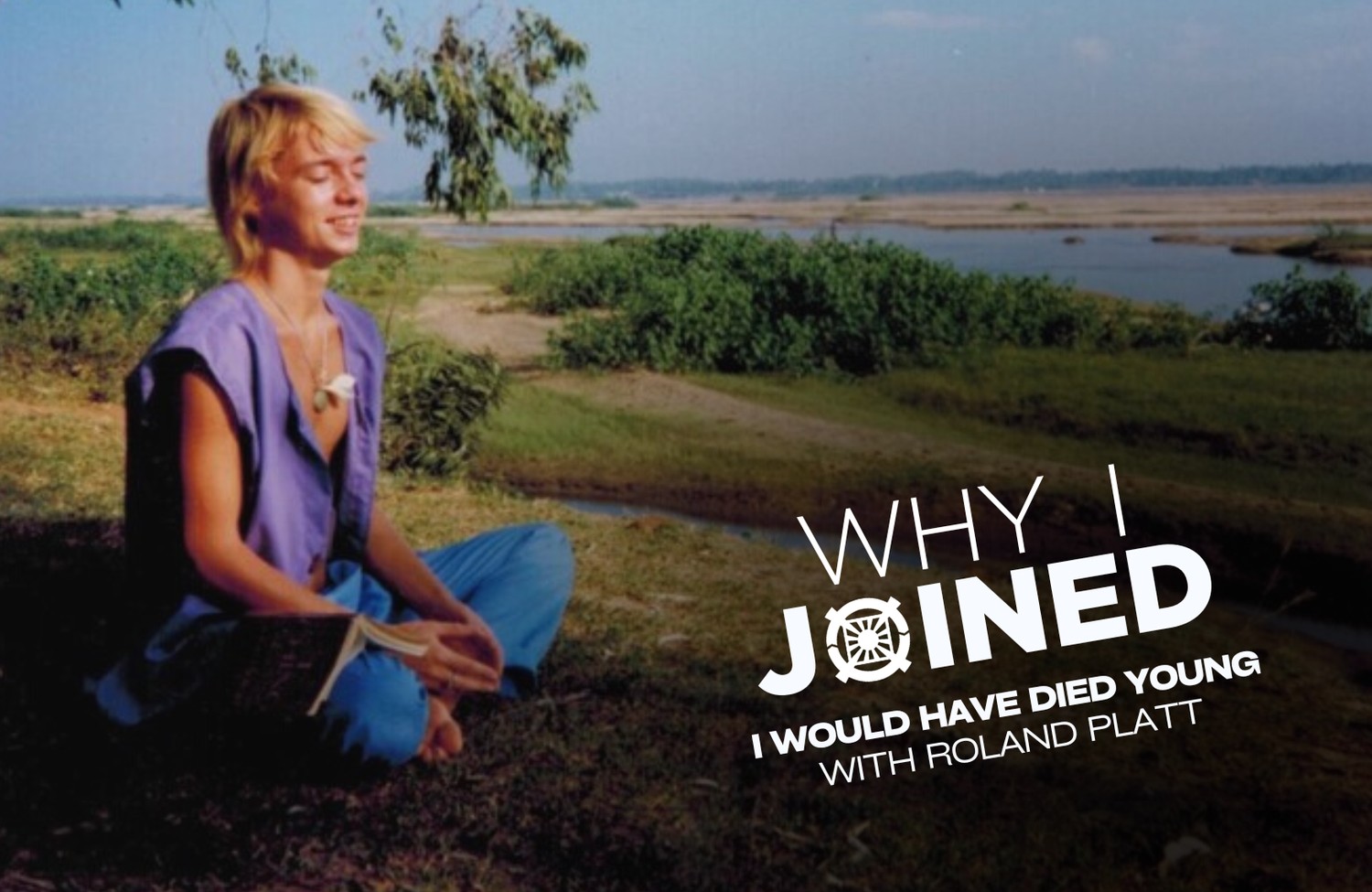
Roland Platt
I Would Have Died Young
Podcast · Why I Joined (FFWPU) · 1:03:51 · USA
Roland was born in Jersey, the British Channel Islands. After embarking on a spiritual journey at age 17 and traveling the world for five years in search of the truth, he met the Unification movement in December 1992 in San Francisco.
Hosts: So you grew up in Jersey. And just for our listeners, as we mentioned, that's not Jersey the state in the U.S. That's Jersey the British Channel. But I know from speaking with you that you're French-speaking. How did that happen? You grew up in the British Channels and have a French accent.
Roland: Well, I'll try to make it simple. I was born in the Channel Islands, but I never really lived there. When I was about six months old, my parents went to live in Scotland. So until the age of five, I was in Scotland. Then they moved to France because my parents really loved the French culture, the museums, the art, the history. So my whole schooling from six years old, I was in France. I spoke English at home. I went to French high school with my friends. Eventually my French was better than my English.
Hosts: Until you moved back to the U.S., I'm sure. Wow, interesting. So how did that have a bearing on your upbringing? What was your spiritual background like? Were your parents religious? You mentioned that they were really interested in culture. But what was your spiritual upbringing like?
Roland: Well, my family, first of all, was very global. I would say we called ourselves Christian, but we were not practicing anything. In some sense, a very secular family. We did go to church twice a year. It was for the Midnight Mass of Easter and the Midnight Mass of Christmas. And it was more for the beauty of the choir and the lights and the atmosphere. I say my family is very global because, just as a snapshot, my father was born in Hong Kong. He grew up on three different continents. My mother was born in the States, but her father came from Russia. He was one of those who escaped the Communist Revolution. And in her ancestry, she has Chippewa Indians. She has French-Canadian trapper. My parents actually met in Mexico and married in Mexico. They lived in Nigeria, which was a British colony at the time. And then when Nigeria became independent, they left. That's why I was born in Jersey, the Channel Islands. They were just stopping over in the Channel Islands where my grandparents lived for a short time.
Hosts: Wow, you were uniquely prepared for our movement, which is ridiculously multinational.
Roland: Yeah, that's why I felt, almost instantly, I felt at home. I have a sense that the whole world is my home. And I don't really identify with any one nationality.
Hosts: I would say that's unique. Maybe it's for a lot of people in the 80s and 90s to grow up in so many different places. And in our movement, it's kind of normal to be like, oh, I was born in Africa, I have a Korean name, but I grew up in the U.S., my parents are German. It's this hodgepodge of location. You get location fatigue when you tell your story. I'm a little curious — are you familiar with the term third culture kid?
Roland: I've heard it. Yes.
Hosts: I wonder if that's something that you identify with. When I started working at the State Department many years back, it was an interesting concept, which I think really applies to a lot of the kids in our movement. Your parents are ethnically one or two different backgrounds, and then you grow up in maybe a completely unrelated place to that. And so you draw from many different understandings, many different things inform your worldview. And it might be very different to people who come from your traditional homeland, so to speak.
Roland: Well, growing up in France, actually, I never felt this is my home, and I never felt I belonged there. And as soon as I was able to, as soon as I was 17, 18 years old, I left France, and I've never felt anything like, oh, I missed that country, or I would like to return there. I just don't have that sense at all.
Hosts: Why would you say you don't have that sense to return there? Why didn't it feel like home completely?
Roland: I think because I didn't have a great experience throughout my school years. My family was a reasonably happy family, and we had everything that we needed. My parents were not extremely wealthy, but my grandparents were. So every year we'd visit my grandparents in Jersey, in the Channel Islands. They lived in a mansion with waiters and maids. But I never really felt happy growing up, and that's one of the reasons that throughout my school years I was quite dissatisfied and turned quite disillusioned with society and with the world. Even though I could do quite well in school, when I turned 16, 17, I really lost interest in school, and I didn't see myself just continuing and, like most people were doing, getting a job, getting married, buying a house. That was never something that I had as my life goals. So I grew up quite frustrated. I was into heavy metal. I had long hair. We went to concerts. After concerts, we would go out into the streets and smash things in Paris. So I've changed quite a bit.
Hosts: Any favorite metal bands you want to mention?
Roland: I went to Iron Maiden in concert. I saw Deep Purple in concert.
Hosts: Can I ask — you mentioned that you were feeling very disillusioned with society at that time. What were some of the things that were going on in the world, things in the news or what you felt about what you observed, that maybe contributed to that feeling of disillusionment?
Roland: Well, this was the 80s, so it was still the Cold War, and there was definitely the sense that the world was divided into two. There was even the possibility of a nuclear holocaust. Actually, I disliked school so much that sometimes I wished that the war would start so I wouldn't have to go to school.
Hosts: Wow. I'm sure there are many kids that can relate to that sentiment even today. So what did you do as a response to that? You teased in your introduction that you traveled the world for five years. What was the catalyst to that, and where did you go? What did you experience?
Roland: Fortunately — because I don't think I would have ended up well if I hadn't had a spiritual encounter — this was age 16 or 17. My sister had a boyfriend who had been a Hare Krishna. He'd been a Hare Krishna for seven years. He'd lived in India. He'd been abstinent for seven years. He was a vegan vegetarian. He'd renounced everything. Then he was back in society, but he still maintained his spirituality. And just by hanging out with him, I got a sense that there's another dimension to life. And I began my own spiritual journey, and I began seeking. I was reading all different texts. I was reading from the Bible, Bhagavad Gita, Hindu Buddhist scriptures. I started doing yoga, meditation, Tai Chi. I became a vegetarian at 16 or 17. Meanwhile, my interest in school and academics was dropping even further. But at least I was engaging on a spiritual path.
Roland: Then at some point, close to the end of high school, I just decided I'm going to do something radical. I'm going to walk out of school, and I'm not going back. I clearly remember this day. It was two months before the final examinations in France for baccalaureate. And I just decided I'm going to pursue the purpose for life, and I don't need all of the schooling, and I don't need this degree. In a way, I felt I'm burning bridges. And this is going to force me to find something. And, much to the disappointment of my parents, who I'm sure had great hopes — I mean, they were both well-educated. My mom had a PhD. My father had been educated at Oxford. But I just walked out of school one day, and I decided I'm not going back.
Hosts: Wow.
Roland: Fortunately, my parents were very open-minded. And something I still remember today — actually, my dad told me, you can do whatever you want so long as you're happy and you're fulfilled. That's what he told me back then. And what I did after a couple of months is I bought a one-way ticket to Kathmandu, Nepal.
Hosts: Wow. Dive straight into the spirituality, right? Go to a Mecca.
Roland: I sure did. When I look back on what I did, I bought a one-way ticket, and I didn't do any research. These days, we have the internet, and we do all kinds of research, and we would take the shots and vaccinations. I just bought a one-way ticket and just went without knowing anything. And I overstayed my visa. This became a five-year journey. I didn't go back for five years. During this time, I traveled. I spent two and a half years just in the subcontinent of India — India, Nepal, Sri Lanka, Bangladesh. I loved the mountains. I loved the Himalayas. I hiked quite often by myself for weeks in the Himalayas. I went into a valley that had barely just opened up to Westerners. It's called Ladakh. It's like a little hermit kingdom in the middle of the Himalayas. I had to hike for two weeks over mountain passes to get there. So I had all of these experiences, and I almost died multiple times. I had hepatitis. I got stabbed one time. I almost drowned twice, and I almost got killed by a snake another time.
Roland: I traveled pretty wild. My way of traveling was not like tourists. I would go on the roof of trains, and I would stay with local people. I didn't stay in hotels or places like that. Where I traveled, I tried to learn a little bit of the local language and make a connection with the people. A lot of my journey was spiritual. I spent a fair amount of time visiting ashrams, which are places where you can study a certain teaching.
Hosts: To face these near-death experiences, you have to be pretty either driven or careless — maybe reckless is a better word. Would you say that it was a desperation to find some kind of fulfillment in your life, or would you say it's more the thrill of the adventure? Were you an adrenaline junkie a little bit, or maybe you just didn't care, and these were just the things that happened along the way?
Roland: Actually, you really hit on it. I would say reckless, and I didn't care much about my life at this point. That's why it's actually a miracle that I'm here today, that I'm alive today, because I know for a fact that if I had not met our movement, I wouldn't have lived more than 25 years old. I was driven, but I also kind of felt that there's not much going for me. One time I was sailing from New Zealand to Fiji Island. This was three months. I was on a sailing yacht, and after three days, we hit an intense storm. The storm was so bad that the skipper of the boat — he was Dutch, a man in his 50s or 60s, who lived his whole life sailing — when he went through this storm, he said, this is the worst thing that I've ever been through. For three days and two nights, we were just tossed back and forth in the waves. Everyone on board that boat — there were about 10 of us, all travelers from different walks of life — we accepted at that point, this is it. This is the end. We're going to disappear in the Pacific Ocean. And quite easily, I came to feel at peace with that. The only thing I was a little bit sad about was feeling like, oh, I'm just going to disappear in the Pacific Ocean, and nobody would really know where I am. Even my family didn't know where I was. That was the only thing I felt sad about.
Hosts: Wow. Missing in action.
Roland: When I look at my life and the things that I did, there's no way I would let my kids do anything like that.
Hosts: You read my mind. I was just going to ask that question. Learn from dad.
Roland: It was a much easier time, I think, because we didn't have the internet, and we didn't know so much. In a sense, the world felt safer. But also, I had a deep sense of trust. From the moment I walked out of school, I knew that somehow God or some higher power — I'd entrusted my life to a higher power. Even when I was alone, when I was in difficult situations, scary situations while traveling, I never really felt scared.
Hosts: That's very interesting. Even though it was easier to travel in those days, I would say there is still a large community of New Age spiritualists that are looking and seeking. My sister is doing that right now. She's traveling through Indonesia, Thailand, Guatemala, Mexico, and doing the whole eat, pray, love thing. It's interesting that you bring up that point about having a certain amount of trust that you're being guided by the universe. When I hear her share her stories, I hear a similar theme come up as well. I guess the next thing that I'm really curious about is — you've spent five years traveling, really experiencing other faith practices, faith understandings, teachings. Then fast forward, you bump into the Unification Church. How did that happen? What was it that hit different for you?
Roland: How that happened was quite a miracle. I was in Fiji, the Fiji Islands. I got the inspiration, I want to meet my family again. I'd left five years prior to that. My family is quite global. I have two sisters. One was living in Ecuador at the time. The other one was living in Bali, Indonesia. I was in Fiji and my mother was in France. We're literally all on different continents. Somehow, I decided I'm going to initiate a family reunion through mail because we didn't have internet back then. We wrote letters back and forth. I can't even remember how we did it. We figured out we're going to meet for Christmas 1992 in the Canary Islands. The Canary Islands are Spanish islands off of the coast of Africa. I'm in Fiji in the Pacific. I need to get to some islands in the Atlantic. I needed to fly over the United States and have a layover. I remember walking into the travel agent. They gave me two options. You can fly through Los Angeles or through San Francisco. Los Angeles didn't appeal to me. It sounded very obvious as Hollywood and quite materialistic. But San Francisco could be cool. I might be able to meet some interesting people there.
Roland: I had a 24-hour layover. I remember landing and walking around being a little bit disappointed by what I saw. But I was on a mission to buy a Frisbee. That's what I had the imagination for. I'm going to meet up with my family. We're going to be on the beach and we're going to play Frisbee. Three people sent me in a certain direction. I asked, where can I buy a Frisbee? I'd walk this way and then turn left. Then I'd go that way. I'd ask someone else. I keep going in this direction. They led me to Fisherman's Wharf. Fisherman's Wharf is a place I would not have been to because it was a tourist trap and I didn't want to go there. But since I was looking for a Frisbee, I ended up there. Just for the note, I've been back there a few times since and I never found Frisbees there.
Hosts: Yeah, not what I would equate Fisherman's Wharf with for sure. So clearly you were being guided in that direction.
Roland: When I got there, I just felt, okay, this is my last evening by myself. I'm going to meet with my family very soon. Just be happy. Just be light. And I had a very light feeling. Then two people come on the sidewalk towards me and they start to talk to me. Her name is Pat. She's from Thailand. And she said hello. But I ended up talking to Marcus, who was with her. His name is Marcus Vonoy. And we had just casual conversation. What am I doing? I'm a traveler, and I'm about to fly out to my family reunion. But while I was talking to him, I had a sense something was going on inside of me. First of all, I could completely trust these two people. And then the second feeling that came up as I'm talking to him — this all happened within the span of three or four minutes — the second feeling was, he has something that I don't have. I really think traveling those five years by myself, I did develop a certain sense of people. Because you have to know who you can trust, who you cannot. And so immediately I felt I could trust him and that he has something that I don't have. And then the third feeling was, I want to be like him.
Roland: And then they're talking about this evening gathering. There'll be people from all different races and all different cultures. And I'm invited. I just said, why not? And I actually hopped into their car.
Hosts: That's very trusting.
Roland: This was my first day in San Francisco. Literally within four minutes I was in their car driving off. And we went to this evening program. I remember hearing an introduction to the Divine Principle. And I resonated with it all. But I got up and said, this is all wonderful. And I know you're having a camp that you're inviting me to. But I have a flight tomorrow morning. And I might be back after a month. Well, they sat me down and they talked to me. And within a few minutes I changed my mind and I decided to stay for seven days.
Hosts: Wow. That's drastic.
Roland: That night we drove off to a place called McCormick Hill in the Napa Valley. The next morning I woke up there feeling really at home. There were people from all around the world. We were singing a song — all the lands that I loved, all the seas that I've sailed are fulfilled in this moment. And that really struck a chord with me. Then we went in. I remember going into this little cabin and hearing the teaching of the Divine Principle. So we have Principle of Creation, which is like the ideal world, and it all sounded good. But then when I heard the Fall of Man, which is what went wrong in human history, in the beginning of human history, it felt like a nuclear explosion. I knew this truth is so powerful. Because I had been seeking and I had researched many different religions, I'd actually stayed in an ashram for six months where they studied all different religions side by side. It was called Shantivanam. It was a Benedictine monk who went to India and he discovered that all these different religions have something in common. He pulled out all the common elements of these religions and he created wonderful services. There would be readings from all these different texts and there would be Indian sitars and there would be breaking of the bread and Tibetan gongs. He mixed everything up.
Roland: When I heard the Divine Principle, for one, I knew I'm not going to join a religion. This was something when I was traveling I felt pretty clear about. All religions are flawed. I'm not going to join a church or a religion. But when I heard Divine Principle, it struck me that this is the truth and this is what I've been looking for all this time. I knew from that moment of hearing the explanation of the Fall of Man that I cannot walk away from this place. My life has changed from this moment on. I consider that the day that I joined, it was the next morning after meeting my spiritual parents.
Hosts: Wow, that's incredible. In one day, you found, as you put it, the truth you were looking for. It was the Fall of Man that struck you. But then what encouraged you to continue in this movement from there? A lot of people get inspirations and then don't follow through with them. But for you, it's been since 1992. That's 30 years now in this movement.
Roland: As I stayed on, the rest of the Principle also hit me and everything made a lot of sense. Then we were coming to the end of the seven days, and in my mind, I'm going to my family reunion. Pat came — my spiritual mother — she came on day six. She told me very strongly, with a lot of conviction, you have to stay for 21 days. I was like, no one has ever told me what to do. I'm pretty independent. I travel by myself. I made all my own decisions. But she had so much conviction. She didn't speak English that well. What she said didn't make sense. But she had so much conviction and she was so serious for me, that I have to stay for 21 days. That if I leave this place, I'm not going to come back. And I struggled with that. I prayed and I talked to different people at the camp. This whole sixth day, seventh day, I was wrestling.
Roland: But I remember talking to the director of the camp and telling him this Bible verse. He told me, when you look at a tree, you can tell by the fruit if the roots are good or not. And simply through that, it kind of hit me spiritually that the fruits are the people in this camp, the staff. I had been to many spiritual places, spiritual groups. But I had never met a concentration in one place of such good people, selfless people. And I realized, oh, these are the fruit of his teaching. And therefore, this teaching is really good. At that moment, I decided, okay, I'm going to stay for 21 days. And I stayed on for 21 days. My family obviously wasn't happy. So I knew when I made that call that, in a way, I'm going to lose my family. At least it's not going to be easy to regain their trust. I hadn't seen them in five years. I initiated a family reunion. They all went there and I didn't show up. But I had this sense that if I'm giving up my family, God is going to give me a much bigger family. At the time, I still hadn't heard about Reverend Moon. I hadn't heard about True Parents or that they were a family. But spiritually I had this sense God is going to give me a bigger family.
Hosts: That's interesting. You could look at it as a spiritual experience — meeting your spiritual parents on the street who introduced you, and this sense of trust that you just right away felt that these are trustworthy people. And then even now this description of feeling so at home with people and a real sense of them. It reminded me of a chapter in James Clear's Atomic Habits where he talks about how our brain picks up on patterns. He talks about the story of an EMT who was able to recognize the signs of heart failure just from looking at her father-in-law's face because she saw the symptoms in the people she was treating every day. So before her logical mind could connect the dots, she just sensed something. This is just my interpretation of your story, but it feels like all of those travels and all of that exposure to people of different spiritual communities really honed your own ability to pick up on who is trustworthy and who is not trustworthy, just off of the patterns of interaction that you had meeting so many different people. I think it's easy to write that off as, oh, that's a spiritual experience, I might never experience that. But to me, it sounds as though those experiences really almost honed your ability to sense that.
Roland: Yeah, definitely. I would say it's both. It's spirit and truth. For sure, the truth hit me in a very powerful way. And I knew this is it. But also the spirit, the atmosphere, the environment. I decided to stay on for 21 days. And after 21 days, I went through all kinds of spiritual training. But I have never — I can say this with real confidence — I've never actually doubted. I've met a lot of Unificationists who went through times of serious doubt. But I think because of that powerful experience that I had in the very beginning, I've never really doubted the path that I'm on.
Hosts: Wow. And your wife is Russian. I think you were explaining to us before we started recording. She's from a specific ethnic group in Russia.
Roland: Buryatian.
Hosts: Buryatian. How has that — now entering into the world of receiving the marriage Blessing, which is our main sacrament, and at the time, you didn't know necessarily who your spouse was going to be many times until pretty soon before the marriage, sometimes a couple of years before, sometimes within a few days or weeks — how has that maybe enhanced your spiritual journey, having a family with someone from another culture, very different culture, probably? And also coming from such a reckless youth. I imagine it must be such a contrast, right?
Roland: To backtrack a little bit, I never had in my mind that I would have a family, that I would be married and have a family. That never once even crossed my mind. So when I look at my life now, I really feel like, wow, I've been given life. I've been given physical life. I've been given spiritual life. And I have this incredible Blessing of having a family, which I probably would not have experienced if I hadn't met the movement. When I first heard about the Blessing, and that actually True Parents would pick my spouse for me, I was actually happy. Because I'm pretty sure I can't pick the right person myself. But if I trust — I could trust True Parents because I trusted the truth. So, whoever discovered the truth must be the messiah. While I was traveling, I did have a sense that in my lifetime I'll meet the messiah. But the messiah that I imagined was this single bearded man walking barefoot in Tibet, in the Himalayas, in the snow, and I'd be following him. So when I actually saw who they are — a couple, and they have a family and they have businesses — all of my concepts were totally shattered. But I was fine with it because I was so impacted by the truth that I knew whoever discovered this is the right one, and this is who I've been looking for. And I can completely trust these people. Therefore, I can trust the marriage Blessing.
Roland: And it is amazing. I said a little bit about my family being very global and well-traveled. My wife is from — I'm from a Christian background, she's from a Buddhist background. And multiple, multiple generations of her family have just lived in one place. And it's a place that I didn't know existed on the map. Kind of Russian townies. It's actually six hours from the Mongolian border. It's a people or race that I'd never heard of. It's just been an incredible journey because the more we're stretched to be challenged in a cultural sense, the more the spectrum is wide of both parents. This is what I think, actually. When people get together, often they get together with people that they can relate to. And that's all very nice. But then it's quite narrow, and the children are born within that narrow spectrum. But if the parents are from opposite backgrounds, really diverse backgrounds, and they're able to get along and to make it work — which isn't always easy, it hasn't always been easy — but because of that, the children are so incredible. When I see my four children, I'm just amazed because they are so much greater, so much more wonderful than I am, or than my wife is, or even than the two of us combined. There's something extra that has been added to these children. So I really feel the term marriage Blessing — it really is a Blessing. From God. I have so much purpose and meaning in my life because I have a family and because I have these wonderful children. And that's really why I do everything that I do. The job that I have, the mission that I have, ultimately is to serve my children and all the other children of Unificationists.
Hosts: So hearing you describe being in a relationship, it brings up for me the kind of universal religious principle of, don't run away from the struggle. That there is something really beautiful that we can learn and expand — our capacity to love, our capacity to understand — through that struggle, or even just from widening our perspectives. I'm curious, especially because you grew up not really imagining that you would be in a relationship or have a family, what advice would you give to couples now, knowing what you know now, to work through those struggles? Because I think that's the existential question for everybody. How do I get through this suffering? How do I get through the struggle to the other side? What advice would you give to people, maybe in context of relationships or just your whole journey?
Roland: I think self-care is really important. I do really value self-care and taking time away, and also not taking things personally. I realize, through the training — I was fortunate to go through eight years of fundraising training, which actually really helped me learn to not take things personally. Don't take rejections personally, don't take someone else's anger personally, maybe they're just having a bad day. And I think that has helped me a lot in relationships and in marriage. I'm quite serious about taking time for myself and sometimes just walking away from everything. My God language maybe is nature. So I kind of know that if I go out into nature — if it's a hike, just a little walk, a canoe trip — I can always come back to feeling at peace and feeling that everything is going to be okay. And something else that I've cultivated throughout my journey is a deep sense of gratitude for life. I feel like gratitude is my anchor. I'm always able to, even in difficult times, challenging circumstances, if I just stop, take a few deep breaths, go outside, breathe in blue sky, trees, I can feel grateful again. And when I can feel grateful, I can see things in the right perspective. And then after that, things will start to go uphill again.
Hosts: I have to say, I'm pretty surprised to hear you mention self-care because I participated two years in the American Missionary Program that you help lead now. We talk a lot about the spiritual principles and practicing that. But it's very interesting to hear you say that because it's also becoming a trending topic in mental health, in spiritual practices. I think people are really coming to this understanding that self-care is so important. For myself, at least as I was growing up in the movement — I mean, I'm 40 now — it wasn't something that we really talked about before. Is that something that you've realized recently?
Roland: I think it's something that I've developed in my married life, perhaps, and my home life. And you mentioned the book Atomic Habits. I've gotten really good at habits. He talks about habit stacking. And when I read that book — oh, that's what I do. I'm learning. I'm trying to do that. I don't think I would be able to keep doing what I'm doing. I have been in charge of this program for the last 20-plus years. It's not always easy. It's often stressful. There's a part of me sometimes that just wants to walk away from everything or run away from everything. And the same with marriage. I just want to walk away and run away. And if I didn't have these kinds of healthy habits of taking care of myself — breathing, meditation, exercise, prayer, being out in nature — I would have run away, or I would have fizzled out, or I would have imploded or exploded.
Hosts: Yeah, dealing with essentially children, young people. I know all you 18, 19-year-olds think you're adults now, but we can testify that's not quite true in hindsight. I'm sure it's challenging to see those kids who maybe aren't so resilient yet, who don't have a lot of life experience like you did, didn't have that self-awareness to go and discover things for themselves. And, having participated in the program, I don't think we realize actually how our team captains and the leaders actually really understand where we're coming from and our struggles more so than we think. When you're 19, 20, 21, you think you know everything. And when you get older, you realize you know nothing. But that must be really hard to see so much of your own experiences maybe reflected back. How do you deal with that in working with these kids?
Roland: One of the reasons I'm so passionate about this program is because of my own journey. And because I really grew tremendously through travel, through going through all kinds of challenges and searching spiritually. Those years are very formative years — 18, 19, 20, 21. Some people say those are the years that really set you on a trajectory for life. So I feel like this kind of timing to take a year or two or three to explore one's faith is really important. And quite often I do go back to my own experience, and times have changed a lot. You talked about resilience. We are seeing that the kids these days are less and less resilient. They have grown up with phones, smartphones, almost since elementary age they've had phones. And because of that, they lack a lot of coping mechanisms and they're not really able to persevere when they face challenges. So we constantly have to — even though we have our own life and our own experience to draw back to — we have to kind of look at this constantly changing landscape, which is our youth and where they're coming from. And especially those who experienced lockdowns for two years and are now coming onto GPA. It's quite a challenge.
Hosts: Wow. Making me maybe rethink our phone policy in our household for our kids. Even though kids maybe don't have the same coping mechanisms — even at that age, even if you had an upbringing where the environment, what you learned in school or from your parents, your family environment, you still haven't really put them into practice because you're not on your own yet for many kids. For myself, my parents — I was not in a good place in my senior year of high school. My dad especially was like, you need to take a year off before college. Get into college, but defer for one year. Don't do it. It's not going to be a good experience for you and you're not going to gain anything out of it. I think you need to go focus on your spiritual life and your emotional and mental health. They didn't express it that way back then, but looking back, it was the greatest decision of my life. It saved me. And it wasn't about indoctrination or, oh, go and learn the Divine Principle more or anything like that. But just being in relationship with other people my age, and we're from completely different cultures and backgrounds, all of us. We lived for a year in Holland, and it's like having brothers and sisters you never knew you had. And then you're all stuck in the same place for a year together and you have to work things out. You can't change out your family. They are your family. And it was the most incredible experience. My goal going in was to become more balanced. I didn't know how. I didn't have a plan, and actually forgot about the goal throughout the year. But at the end of the year, they asked us to look back — what was your goal and how do you think you did? My eyes had been opened. That's how I put it. To other people, to the world. I was less argumentative, more easy to listen, listen rather than speak. And without even trying, you gain something from just being pushed, from being challenged in ways that you didn't even expect or see, and gain some lifelong friends who I can fall back on. They've been there to support me throughout life. So it's incredible what you're doing, Roland, for those kids. And maybe it's not always easy to see.
Hosts: It also brings up the question for me — you mentioned that you're noticing trends in the kids that are coming up in more recent years. You've been doing this for 20 years, so observing the differences, how do you make adaptations to the program to address what you're seeing? I think sometimes people are like, oh, I had a good experience, or, oh, I had really bad experiences, and that's just how it always is. Your concept of the program is stuck to your memories and experiences. But it's actually an evolving thing. So how do you make those adaptations to what you guys are observing?
Roland: The program's always evolving, I think because of young staff. We have staff of my age who've been doing this for 20-something years. But then we have younger staff, and some of them literally just came out of the program, or they went through the program and then they went to college and then they joined the staff. Because they are a lot more in touch with this generation, I think they are able to customize the program and bring in a lot of creativity to be able to impact this particular generation of kids. We're always evolving. There's never one year where, okay, we're just going to do the same as last year. As a whole staff, we get together in the summertime after the year's over. We look back. What should we do differently? What should we change going forward? So we're constantly trying to adapt for our young people.
Hosts: That's very self-aware as well, to know that you need to have all different age groups as part of the staff creating the program, adapting it. We know some organizations and programs who've had a hard time moving with the times. I wonder what keeps your faith fresh. You talked about meditation and taking time in nature. But is there anything that you're reading or watching, or people you're talking to that help you to keep your faith alive?
Roland: I'm always reading. I just finished Atomic Habits actually a week ago.
Hosts: Oh, really? I just finished it yesterday. Yay!
Roland: I went through this UTS course. I graduated recently from UTS.
Hosts: Can you explain what UTS is?
Roland: It's a seminary course, the Unification Theological Seminary. And I recently graduated with a master's degree.
Hosts: Congratulations. For someone who dropped out of high school, not bad. Your parents must be thrilled.
Roland: Yeah. But I do enjoy learning and reading new things. I think one cannot remain stagnant. Same with life of faith habits. Sometimes for a number of years, my prayer life became stagnant and I knew it was stagnant and I didn't know what to do about it. But just about a year ago, things changed and now I can pray every morning. I need actually a good hour of prayer.
Hosts: Wow. What changed?
Roland: When I joined, I used to pray a lot. While I was praying, I could feel a sense of peace and trust and I would get answers. Maybe for a couple of decades, I only prayed when I needed to pray. I need to give a talk or a sermon, or I have a problem that I need to resolve. But recently, I started to pray again, and I was reading these books. I discovered this whole series of books by Lorna Byrne. She is an Irish mystic and she sees angels. She sees the spiritual world from a young age. That's her gift. She can see spirits, people who passed away, and she can see angels. And she describes the world of angels and how each and every one of us has our personal guardian angel who is the guardian of our soul and who never leaves us for one second. As I was reading her books, I really felt how this is God's love for us. Each one of us has a guardian angel to guide us throughout our life. Just from reading her books, I started to pray more intentionally and visualizing all these different angels, and everything that I'm trying to solve or pray for — actually there's angels there that can help you do it. I started to pray a lot more intentionally, and from that point — it was just about a year ago, at the beginning of this year in January, now almost in December — I just started praying in the early morning and having very meaningful prayers. I used to only be able to pray outside, but now I can also pray inside in a prayer room. Things have changed. Life of faith should always be evolving, and one should never get stuck in a rut.
Hosts: That's great advice. I find that very inspiring because for me also recently — and anybody who's listened to any of my sermons online knows that I reference this book a lot — but I read Praying Like Monks, Living Like Fools by Tyler Staton, who is a pastor out in Seattle. I picked up his book after listening to a podcast interview with him, and you can just tell from listening to him speak that prayer is not something you just do because you have to do it. He really loves doing it. He has this very intimate, very authentic relationship with Heavenly Father in his prayers, and it came across in how he talked about it. I picked up his book and it resonated for me so deeply that it challenged me to make my prayers more authentic. We get into this habit — and he talks about this in the book — we get into this habit of using terminology that we think we're supposed to use but we would never use those words in conversations with our friends. It's very prescribed. Even just changing my wording and how I'm talking to God, it really changed my prayer life too. That's what made me so curious to hear your experience as well, because I think there's such a diverse array of experiences and yet there's this common theme that emerges from what they learn. Thank you for sharing that.
Roland: It's the highlight of my day. I look forward to every morning. Early morning, it's still dark. I wake up without an alarm. Surprisingly, it doesn't matter what time zone I'm in. This year, I was in Italy. I was in Korea. I was in all different time zones in the States, but somehow I would always wake up. In Korea, I'd always wake up in the early morning, around 5 o'clock, 6 o'clock, and I'd have this time to myself to pray for about an hour. I really look forward to it.
Hosts: Wow. That's amazing. Thank you, Roland, for a really great tip — to seek ways to refresh your spiritual life and where you feel stagnant. It does take effort. It takes active practice even after 30 years. You never stop learning and growing, and that's a core tenet of our faith that you're putting into practice. Thank you for sharing your time with us and your wisdom, your story. It's been incredible.
Roland: Thank you so much. Thank you for having me.
Reflections about this person
Reflections are anonymous unless you put your name in. Every submission is reviewed before it appears.
Loading reflections…