Rachael McDaniel
Mrs. Rachael McDaniel testimony
YouTube · LVFC Office · 46:14 · USA
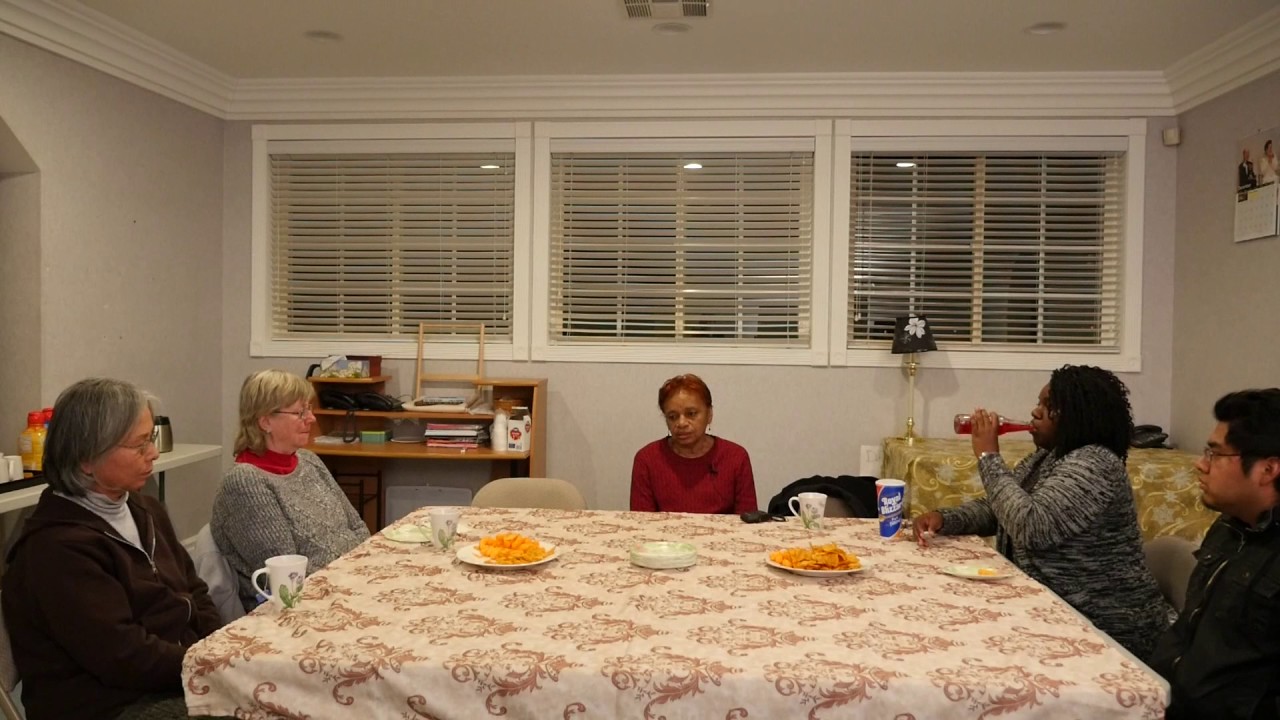
Rachael McDaniel of Guyana recounts how she was raised Catholic, was invited to a Bible class by a fellow Anglican choir member in 1972, was taught the Divine Principle by missionary Barbara Burrows, and later went on a New Hope Show witnessing tour through Europe.
I'm from Guyana, South America. I joined the church in 1972. At that time, the leader in Guyana was Miss Barbara Burroughs — she's now Barbara Van Praag. When I joined, those who were there at the time were mainly older sisters, and there was one or two brothers who were in their 20s. I started listening to Divine Principle after I was invited by one sister who was in the same Catholic church choir that I was in, because I was raised as Catholic. My father was Catholic and my mother was Evangelical, and then she converted to Catholicism.
The rule at that time was that if a Catholic marries a non-Catholic, then the child has to be raised as Catholic, so I was raised as a Catholic and was singing in the Catholic church choir. At that time they were singing in Latin — now they sing in English — especially around the holidays; when the first Sunday of the month came, the mass was done in Latin, and it was always high mass. It was very enjoyable. But then I decided to make a change, because I saw that there was a need for doing something more, something different — a need for the priest to take more interest in the members of the church, the parishioners, but that was not happening so much after a certain time.
So I was invited by another choir member to go to a Bible class — that's what it was called, a Bible class. I never liked Bible class, because I knew what the Evangelical Church Bible classes were like. But anyway, I went after a few times of invitation, and I was taught Divine Principle by Miss Barbara Burroughs. She was the missionary whom Father sent to Guyana, the national leader. At that time, people were being sent out in twos or threes, but Barbara came to Guyana by herself in 1971. She started the church May 1st, 1971 — that's when she arrived in Guyana. Father told her, "Sorry, Barbara, but I don't have anyone to send with you, so you have to go by yourself."
When she went to Guyana, her parents had already passed to the spirit world, so it was just her sister. Her parents had an adopted child — he was Indian, South American Indian — so he was the first spiritual child. She started teaching Divine Principle right away. Her sister listened, but then she was preparing to come to America, so she didn't listen too much. People were coming, though — she was inviting people to come — and I listened to the whole teaching of the Divine Principle.
At that time they used to ask, "Well, who do you think is the Messiah?" For me, I didn't find it very hard to figure out who she was telling me — that this person is the Messiah, Reverend Sun Myung Moon. My thought was: for her to tell people this, and to teach so many people, she must be really very sincere in heart, and it must be something very strong. So she must be convinced that this person is the Messiah.
I was in the church from 1972, and I started living in the center in 1973. At that time we had quite a few members. Then Barbara left to go to England, because at that time the headquarters for Guyana and the West Indies was England, with Mr. and Mrs. Orme — that's where she had to go for meetings. Mrs. Orme was starting a booster group called the New Life Show, and she and Barbara worked together on it; Mrs. Orme was her spiritual mother. They had about eleven members, and then Barbara had to leave and return to Guyana. So Mrs. Orme told her to send another person in her place, and she asked me to go.
I said I would, and the first country I went to was Holland — they had already been to Ireland, singing and witnessing. The New Life Show worked like this: you would sell tickets during the day and give out invitations, then go to the hall, which was prepared. We sang several songs — we had costumes — and it was like a variety concert. Then in the middle of the show, Mr. Orme would speak or Mrs. Orme would speak. After the show, we'd go into the audience and witness to people, to take them back to the centers.
I was with that for not very long. I went to Holland in November 1974, and for the first time I would see snow, because I had never been out of Guyana before — it was snowing. We stayed at House Glory, which was a very big house that used to be like a barracks in Holland where the soldiers were during the Second World War, so it had some memories for some people. Right in the front of the yard there were two of those tombs, and they told us that's where they put people. The house was huge, and where it was located you could stand at the top and see straight out to the ocean, so they could see if anybody was coming to attack — that's where the house was. The flag was flying there, and at that time there was a lot of persecution for the church, with many people saying they shouldn't be there.
At one point the government started saying it was something that should be kept for the people of the country and not just somebody owning it, so now it is a historical place where they can go. We stayed there, the group stayed there, and we witnessed from there and went to different cities. One night we went to Belgium — we traveled about six hours to Belgium, did a show there, and then traveled back to Holland, so it was quite a long journey. From Holland we went to different countries, including the Scandinavian countries: Norway, Sweden, and Denmark, and then we also went back to Belgium.
The One World Crusade was going on in America at the time, and it came to an end. Father wanted the members of the One World Crusade — the first global team — to become leaders, so the first global team members became leaders and went back to Europe to their home countries. Father then started the International One World Crusade European team, and I was on the European team. We were traveling to different countries, and in some it was easy to witness whereas in others it took much more effort.
It started in England, and we did shows and witnessing at the same time, then we went to Holland, Germany, France, and Italy, staying in different places. During that time there was still a lot of persecution going on, and especially in France the persecution was at its height. There was a center called Lille, and that city had a lot of problems with persecution. The center where I was was called Vaucresse, and there, almost every night, we had to sleep in our clothes.
When you came in from witnessing or fundraising you would change, but you put on the clothes you were going to wear the next day — not sleeping clothes — because at any point in time you could get a call saying, get out of the house, there's a bomb. We were getting up at two o'clock in the morning, one o'clock in the morning, and sometimes as soon as we got in we had to get back out. The French police would be there, and so many times we had to walk through lines on both sides of the street, get into the buses and go somewhere, stay there for about an hour, and then they would tell us when to come back. That went on for quite a while when we were there.
Bearing in mind that in each country we stayed three months, in France we stayed four — Father asked us to stay four months. We were all packed and ready to leave after three months when he said, no, can you stay one more month? So everybody had to go back to their different cities and stay for one more month. In France there was also a bomb at Villa Oblet, which was a very big center where many of the workshop team members went after they were finished at the workshops at Monet Castle. Monet was a very huge place — bigger than this house — it was actually a palace, a castle, with a lot of smaller buildings for servants, the horsemen, and the groomsmen, and a huge garden.
Many times when we were there we did performances, because there were a lot of workshop members there, as well as many people who had been witnessed to and came there for a workshop. Sometimes when people saw us dressed for a performance — we used to wear dark skirts and white clothes and a red rose — they would think there was a Blessing. One night they started asking, is there going to be a Blessing? And we said, no, there's not a Blessing, we're just doing a concert, a performance, we have some new members. But people kept coming and coming saying, no, I heard there's going to be a Blessing.
They just stood there outside that castle — it was amazing. They just stood there watching, and we would go out and talk to them, though we were advised not to get too close to the fence so nobody gets grabbed. We would do our show or performance, and then the workshop people would go to bed. What was very baffling was why anyone would be persecuting one person that much — nobody could figure it out. Why so much persecution for one person? They had so many churches, so many different religious organizations, and yet this one person was getting persecution all the time.
Then there was the bomb at Villa Oblet, and that created a problem because many of the workshop guests got scared. At the time I had witnessed quite a few people — some of them were from the Middle East — and some of them didn't stay because of that bomb. The sister was very severely injured, but she was able to recover. In France it was so different from other places; in Germany there was some persecution, but in France they just went all out. We were able to make some membership — many members came, some stayed, and of course some left — and then members came from other countries joining the IOWC team there.
The team kept traveling, and then we went to Italy, where we stayed for a three-month period. We stayed in different smaller cities and went to Rome and Milan at different times for shows. In Italy there was a lot of heartfelt warmth from the people. When we went fundraising, people would come out, and sometimes you were just walking down the street and didn't really notice it, and then all of a sudden you would turn around and there was a group of people behind you — just walking behind you, older ladies in black dresses, coming out and walking behind you.
Why were they walking behind you? Because they had never seen this mixture of people — the IOWC team had people from different countries, so they had never seen such a mixture. They were quite curious, and sometimes they would invite you into their home: oh, come and have something, come and have some tea or some coffee. Italians are pretty kind, and we were very impressed by them. They liked the music, they liked the songs we sang, they came and danced around, and some of them went to the workshop, went to the centers.
I remember when I was with the New Life show and we went to Denmark. Denmark is the first country to legalize pornography, so when we said we had a New Life show, they thought it was one of those kinds of shows. We had quite a time convincing them: no, it is not that kind of show — it is New Life, New Beginning, it's not that kind of content. But they came and they listened, they listened to the teaching, they listened to what the pastor was saying, and they went home.
When the team finished in Germany, it was divided — some people were staying in Germany and some were going to England. Those going to England were strictly told not to take any photographs or anything like that, but somebody had a photograph, and then everybody was deported back to Belgium. There is a place called Austen Day on the English side, and then there is Belgium, so we had to leave England from Dover, go to Austen, back to Austen, and then on to Belgium. People came to pick up their members, but I didn't have another place to go because I didn't have a visa to go anywhere else, so I had to stay with the Belgian family for a while.
It was very interesting there, because the leader was from Austria. In Belgium during the Second World War there had been a lot of destruction and persecution, so having an Austrian leader — it was like having to adjust to an Austrian person who reminded them of Hitler — while at the same time doing their church work. They had some problems with that, but they continued in their work and worked very well with whoever was there. They witnessed every evening, and every Saturday they would have an evening of entertainment to invite more people to come to the center. It was a very interesting and very heartfelt time there too.
I returned to Guyana in 1977 — it had been three years that I was out. Wherever I went, I always gave my address and told people where I was, to make sure the Guyanese family knew where I was. But the one thing I didn't know was the political situation in the country. I knew about the church, the center, the leader, people like that, because I had communicated, so I knew the church was still there — but when I went back I was severely shocked, because when I left in November 1974 you could buy anything, anything you wanted, anything in the stores, anything in the shops. When I went back, people had money but couldn't buy anything, because the government was going socialist, and they had a situation like what was taking place in Poland — they had certain amounts of merchandise, and when you got to the top of the line it was all gone, so you had to go to another store.
I was responsible for buying — we had a children's center in Guyana, the same children's center that Prince Harry visited, which you may have seen on the internet. It was established quite a while ago, around 1972 or '73, and it was started by Mrs. Barbara Burroughs-Van Praag. It started with children of the members, and then as things got so crazy and you couldn't have enough food — you had money but couldn't buy it because there was nothing — Barbara said she didn't want to send any kids away. So she decided to see if they could get something from the government, some help; but first they asked the World Mission Department, or IRFF, and they couldn't help because the focus at that time was on Africa, so whatever they had had to go to the African brothers and sisters.
Barbara and whoever was helping her made some arrangements with the government so they could get certain things so the children would not go without, and that continued for quite a while. We did fundraising for the children's center. Whenever we finished fundraising we had to go to the store or the marketplace and purchase food for the center. That whole children's center was started by Barbara and continued by Barbara and other members and the person who was the leader.
At that time there were no foreign missionaries in Guyana. The only time missionaries went there as a group was when True Father sent out some sisters from Japan, including one sister who was blessed to a Japanese brother. They went to Guyana and did Women's Federation work, and they stayed for about two years — a short time. They stayed at the children's center, and from what I understood they added a wing to the ground floor. After they were finished, they left.
Somehow, people do not understand that there are three Guyanas — it's not just one. Most of the time when people ask where I'm from, I say Guyana — and they say, oh, a Japanese missionary. And I say no, not a Japanese missionary: remember, there are three Guyanas. The missionary for the Guyana that I am from was a Black woman who was born and raised there, and she led the country for years as a Unification Church person. There is Suriname, which is Dutch Guyana — they speak Dutch — and the leader was a Mr. Mikuni, who I heard went to Florida after some time. And then there was French Guyana, where they speak French, and there was a different person there.
Sometimes I feel very disappointed that people don't understand there are three Guyanas, not one — and that British Guyana was led by Barbara Burroughs. I make that point clear because I get pretty upset when I hear people trying to tell me it was this person or that person. I say no, absolutely not, and I don't take it lightly — I get pretty mad about that, because I don't like giving credit to someone else for another person's work. If that person did the job, that person must get the credit, not somebody else. I don't care where you come from; Guyana was led by Barbara for a long time.
Barbara got blessed in 1982, in New York. Her husband was from Holland — an older man who had been in the Second World War. Then she went to Jamaica and worked there as a missionary for a year, and another brother from Jamaica was sent to Guyana — it was like an exchange. She went back to Guyana and he went back to Jamaica, and that brother, Desmond, is now in New York.
Barbara brought a lot of what she had learned from True Father, and also what she had learned from her singing — because when she joined the church she was studying opera. So we had a singing group in Guyana too, and we learned singing and movement and things like that, but still our focus was on witnessing and bringing new members. People joined, mostly young people; they became full-time. Some had to go to school because of the age at which they joined, so you had quite a lot of Unification Church members in some of the high schools. We didn't get a whole lot of persecution, and I think the reason for that is because we were also involved in the community — doing a lot of concerts and shows, and we had the children's center — so all of that pitched in and helped save us from some of the persecution.
Then we had a situation where one child who had come from one of the mining towns passed away. People did exactly the same thing they had done in France — the street was full of people who came and just stood there and looked; the whole place was quiet, you could hear a pin drop. This girl's parents came, had a ceremony, and took her body, but the people standing there just looked and didn't say anything. That did start some persecution after a while, though it kind of stopped because people realized that nobody is here forever. And when the girl came, of course, we didn't do medical checks or anything like that, as you do in different places.
The parents sent her to stay in the center, and we tried to help her to get an education, because this was the purpose really of that children's center—to bring the young people from areas where they could not get the education that they needed. One sister who was from a mining town brought quite a lot of young people to the center, and the children could stay there and get an education. Moving on from the children's center to taking care of members, taking care of brothers and sisters who were joining—many young people joined and they went to different works, some people went into different areas, some members went out. I stayed in the city because I was responsible for making sure that there was food in the children's center, buying the stuff and all of that.
We tried to send members for the Blessing, but every time the applications went in, we went to the American Embassy and they said no. The reason was because they knew we were Unification Church members—in small countries, things are not as spread out as they are here, so you can hardly tell them, no, I'm not, because they see you every day, on the street, you fundraise, you witness, you invite them to some of the concerts, so they know you. There's no saying, no, I'm not. The main question they had was, what do you have to bring you back—knowing very well we didn't have anything to bring us back.
As members, you don't own a whole lot of stuff. Your parents may have their house and things like that, and you live in the center, and you just depend on whatever comes into the center—you have nothing to bring us back. So Barbara had to say, well, it looks as if we're not going to have any blessed members here—let's find something. She talked with some of the older members and said there's only one thing to do: we have to leave the country. To leave the country, you have to have money—we don't have the money. How are we going to leave the country?
One sister had a brother who was a businessman in New York, and she was able to persuade him to lend the money to us so that at least the seven members who were going for the Blessing could go, and that worked out pretty well because everybody was able to leave. Those who were going for the Blessing went to Korea, and the other people stayed in Holland, because that's the country we had to go to first. From there we were able to move around—you had to have something called show money. It had to go around: some persons would come to America and then send it back, and then the next set would come and send it back, and the next set would come, until everybody came. And that's how we came here.
We learned a lot about what Heavenly Father wants to change. Father always said, no borders, no barriers, there shouldn't be any, and it's true that there shouldn't be—but in some countries, if you don't have all this visa and all this kind of stuff, then it's hard to stay there. You stay for a certain amount of time and then you have to leave, and we had different situations to deal with. We had people we tried to help who joined from England—two or three brothers who joined because they were musicians. But one thing they were saying was, I can't live this kind of life, I can't sacrifice all this, I must have money, I must have this, I must have that. Some of them came and stayed around for a while and then left, but one or two stayed and came with us to America.
Sometimes we used to think, why bother with these people—they don't want to be a part of this, they don't want to study Divine Principle, they don't want to know about True Parents. She said, every person who comes through that door is a person who God sent, and this is what we have to look at. Every person who came in there is a person who God sent. It's our responsibility to help them to stay, it's our responsibility to save them. And saving them is not easy, because our teaching is very different from what other churches teach. We tried, we had some disappointments, and some stayed, some left, and eventually everybody came to America.
We had a younger group—a junior group—some of the children had belonged to that group, and they were singing and going to school at the same time, but they couldn't do a whole lot of the fundraising we were doing because they were younger. Some of them are now here—one of them is leading the Women's Federation in New Jersey, and there's another one in another part of New York—some people are scattered in different places. The heart of Heavenly Father expressed through Barbara really did help a lot of members. It helped us to realize you just cannot look at the people and decide this one can't do that and the other one can't do the other—you have to give them the chance to really show what talents they have and what they can do with it. In coming here, I traveled from quite a few countries. I went for the Blessing in 1982—the 6,000 Blessing—and here is where I am to today. We have one daughter, and we're trying to help her remain focused, and she is working with us.
Seven members went to the Blessing—how did we go there? Our group was made up of 30 people, 30 brothers and sisters: we had singers, we had dancers, we had an elocutionist—a person who does her speaking—and we got the funds to travel from Guyana to Holland. We had to travel from Holland to France and then take the plane to Korea. Luckily, in Holland there was a sister who knew how to get around, and we had the experience of going across the border from Holland into France at two o'clock in the morning.
We didn't have visas—to go to France we would have had to stay in Holland for about six months to get one, but we were there for just a short time. We left Guyana on September 18th, 1982, and the Blessing was October 14th, so we had to get to the Blessing somehow. The sister was able to help us with that. We did use decoy cars and all of that to get across the border—it was crazy.
First we had to go to a place called Liechtenstein—it's a Benelux country, which is like Holland, Liechtenstein, and Belgium, they're all together in one, so when you get a visa for Holland, you get a visa for Benelux countries. We went to Liechtenstein in the middle of the night, and then from there we had to cross the border to France. We had four cars—the suitcases were in one car, the one supposed to take us to the airport, then there was another car coming up behind with some of us in it, and another car with the members in another one. We got across the border.
When we got to the airport, some people had their passports stamped and went across towards the plane. All of a sudden, we heard: all Guyanese reported to immigration. I thought, oh no, something got seen. Now all of us—even the ones who were on their way to the plane—had to come back and go to immigration, and we don't speak French, and they don't understand what we are saying. Luckily, Cathy Ridley was there—at that time she was with the African members, and she spoke French—and there was another French brother as well. She asked what was the matter and was told that somebody had a passport that wasn't stamped at the border, so they called everybody. They did a lot of talking with immigration and were able to help, so the seven of us were able to go to the Blessing.
Rachael: That was a rare situation, because we could have been torn back. We had come all this way, and right at the point of getting to go, something happened. Luckily she was there — right there — and this other brother, but the brother didn't speak any English. She was the only one who could speak English, so the two of them worked together and helped us get our passports stamped correctly and get on the plane to go to the Blessing.
Rachael: So we went, and we got matched. I was matched to an African brother, but he didn't want to be matched to me, for one reason or another. He came with a lot of different things, and his one reason was that I didn't look African. I said, 'But what? I wasn't born African — what do you mean I don't look African?' He said okay, and that meant he didn't want to be matched to me. Fine — I'll go back in the Blessing room, and I thought I would have gone home without being matched.
Rachael: Then True Father called everybody to the Jamsil Gymnasium, because the Blessing was supposed to be 6,000 couples, but it was less. On the day of the wine ceremony, Father called everybody there, we lined up, and we had an ansu session. There was a very older sister doing the ansu, and we all wanted to know where she got all the energy to ansu everybody — brothers and sisters — because there were a lot of us. When she was finished and we lined up, Father matched us. Joe and I were matched on the day of the wine ceremony, so there wasn't much time to talk or discuss or wonder about anything. We got matched, we went to the Blessing, and here we are today.
Rachael: You can see how God is working in different ways, and how True Parents came in. Because of how strong they are for God, for the world, for the cosmos, you can see their hand working in everything. It was quite a memorable situation. I don't have a whole lot of big spiritual experiences, but I can still feel the presence of God in many of the situations in which we were involved, because different things could have happened.
Rachael: Take getting the money to go, for example — we didn't have it. We did not have that money to travel anywhere, and every year it was the same: no, you can't go. Our passports got stamped rejected — rejected, rejected — and you'd say, what's going to happen, nobody will get blessed? God worked in different ways. Even though that sister's brother was not a member, he was able to help so that we could go to the Blessing, and not only that, but to give the opportunity for the other members also to travel.
Host: Are you still connected with anybody in Guyana?
Rachael: I only hear through members who are in New York, because it became such a problem — you can't send anything, because then it disappears. I'm just connected with somebody in New York, and if somebody comes from Guyana to New York, then you hurry up and get something to send. That's the only way — if they don't tell me, then I have no idea. But I was glad to see that visit — I think it did raise some concern and awareness of the Children's Center in Guyana, because Prince Harry went there. I'm sure he was invited by the British High Commissioner, because that center became very well known in Guyana.
Rachael: We had to get help from the government, and they subsidize it. One of the things Barbara said was: now that we are subsidized by the government, we have to expect that other kids are going to come to the center — not only kids from Christian families, but all kinds of kids. So it is subsidized, and nobody can just come there and uproot it. A lot of members are in New York now, so I can hear from them how things are going there.
Rachael: I noticed on the internet that Kodan had mentioned something about the Children's Center, and I was a little bit surprised. When Father went to visit Guyana, two of Father's sons went first — I don't know if it was Yojanim and another one — and they had the experience of being told the wrong thing. They were told that when they arrived in Guyana, in the city, they had to get a boat to get to the center. When they arrived and started asking how they were going to get to the city, brother Royal told them: you are already in the city, we just take a car and go to the center. They said no, we were told we had to take a boat to go to the city, and they were not happy about it.
Rachael: They saw it as something that was not right — if you didn't know, you should ask. When you arrive at the airport, the airport is in the city; you take a car and go to the center. There is no boat to go anywhere. Then Father went to Guyana and visited, and he had asked for some help for the Children's Center from Kodan, but I don't know what happened to that — that was a question mark.
Host: What year was that?
Rachael: I don't remember the year, but he stayed there for a few days or something. He was scheduled to give a speech at a big cultural center that had been built. The brother Ronald Magar, who was the leader, told them to hire the place — the hall — for the whole evening. But some people who traveled with Father said no, Father wouldn't need all that time, he's not going to speak that long. And to their surprise, Father was going to speak that long.
Rachael: Because they didn't hire the place for the whole evening, another group was scheduled to come on and speak the same evening, and they started interrupting — which was pretty bad, not good at all. That was just because somebody was too stubborn to listen. Ronald Magar had told them to hire the place for the whole evening, and they didn't, so they got interrupted and Father had to stop. Father had been going to speak for quite a while, because they had invited a lot of people.
Rachael: Some people knew us from our group — the hallelujah group. We used to sing, we used to do concerts, so people knew us from that, from fundraising, from the Children's Center, and that was helpful. It's a small country — they see you every day, you can't hide. We were happy that Father was able to go there. That had to be the eighties, because we left in 1982, so it was sometime between the eighties and the nineties.
Reflections about this person
Reflections are anonymous unless you put your name in. Every submission is reviewed before it appears.
Loading reflections…