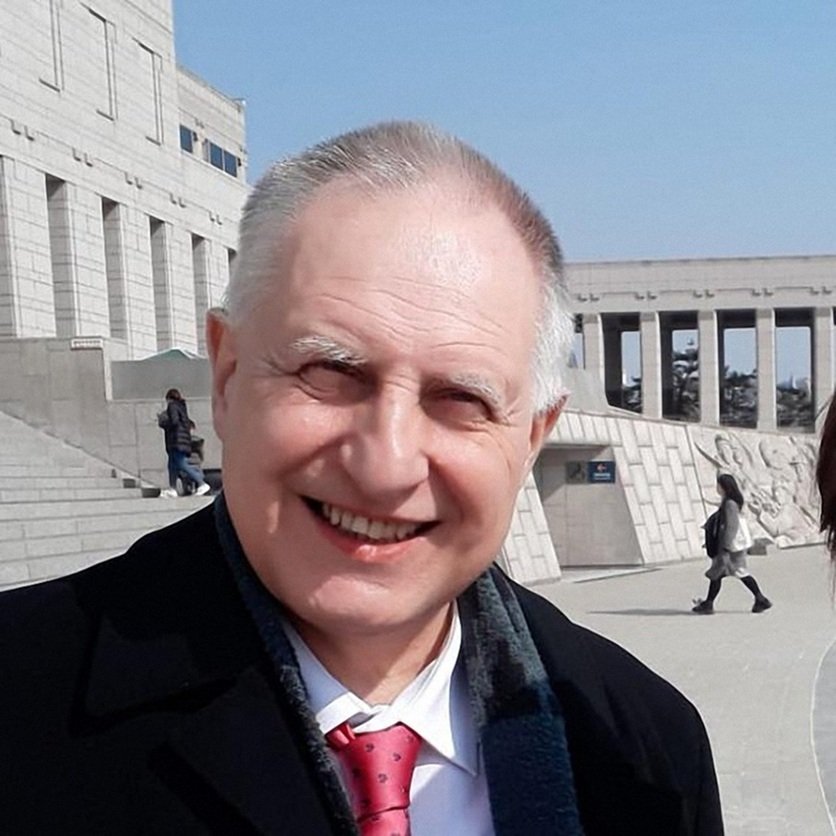
PhDr. Juraj Lajda
More Humanity Even in a Communist Prison?
Book · unificationnews.eu · Czechia
Former Czech political prisoner under communism asks whether Mother Han is being shown less humanity in long-term detention than he was under similar circumstances
See also Alleged Attempt to Influence Witness Statements. Artistic impression of Mother Han in detention cell. Illustration: Grok xAI. Prague, 21st February 2026 — a few hours ago, we learned that Dr. Hak Ja Han, the 83-year-old leader of the Family Federation for World Peace and Unification, has been returned to her detention cell, after a brief ten-day release for urgent medical treatment in hospital. She remains detained on what, in my view, appears to be fabricated and circumstantial evidence.
Dr. Han suffers from multiple serious health conditions: deteriorating eyesight, mobility limitations following knee surgery, and a severe cardiac condition — arrhythmia — for which she underwent surgery only five months ago. Given these circumstances, I am deeply disturbed by her return to detention. It is difficult to believe, that her medical condition could have improved so dramatically in ten days, that her life is no longer at risk.
I am profoundly shocked by the treatment of this elderly religious leader, under the current South Korean administration. From my perspective — and I believe many share this concern — the decision to return her to detention, raises urgent humanitarian and ethical questions.
My reaction is shaped in part by personal experience. I was myself detained long-term under a Communist regime in Eastern Europe. Even in that political system, I was treated more humanely, than what now appears to be a life-threatening detention imposed on Dr. Han, in a country that has been considered democratic since 1987. The place where Dr. Lajda was imprisoned from 1973 to 1976 — the Palace of Justice in Bratislava, Slovakia. Photo: Laurenc Klas.
Her situation brings back memories of my imprisonment in Czechoslovakia, in the early 1970s. Ironically, I was arrested for following the teachings of the South Korean religious leader Sun Myung Moon. Along with 17 other young people — mostly students — I was sentenced to three years and two months, for "subversion of the republic," after nearly ten months of investigation before trial.
During the investigation phase, I was held in remand prison in Bratislava, where I was interrogated daily, until the case file was closed and the indictment prepared. About six months into my detention, after prolonged confinement in a 2-by-3-meter cell — often shared with two or three other inmates — my longstanding atopic eczema worsened dramatically. The prison environment caused my condition to deteriorate severely. Mugshot of Juraj Lajda from 1973. Photo: Archive of the Prison and Judicial Guard Corps of the Slovak Republic.
When I reported this to the prison doctor, he acknowledged that he could not properly treat me, under the limited conditions available. He therefore requested that I be transferred to another prison facility in Brno, where better medical care was available.
I was transported there, and remained for forty days, until my condition stabilized and the acute phase of the illness was brought under control.
Although I was still deprived of liberty in Brno, the conditions were adapted to medical necessity. The cell was larger, I had a bed, and my daily routine was adjusted to facilitate treatment. Each day I was taken to the infirmary, where doctors worked diligently to restore my health.
The decision regarding my hospitalization and its duration, was made by a physician. Whether formal authorization from an investigator or judge was required, I do not know; if it was, it was granted. The purpose of detention was not suspended — but it was carried out with recognition, that I was first and foremost a patient, in need of medical care. Papyrus text: fragment of Hippocratic oath. Photo: Wellcome Collection. License: CC Attr 4.0 Int.
The doctor treated me as a human being, not as a political offender. His duty was to preserve health and life. He acted according to the ethical obligations embodied in the Hippocratic Oath — that is, he would strive to preserve human life at all costs. Political considerations did not override medical judgment. Even in a Communist prison, the principle prevailed that an accused person remains a human being, deserving of care.
I come from a family of physicians; my father was a well-known surgeon. I therefore understand the professional and ethical responsibilities, that accompany medical practice. In my case, medical judgment determined the course of treatment — not prosecutorial or judicial discretion.
This occurred in 1974, under the Communist regime of former Czechoslovakia.
Today, I must ask: who determines Dr. Hak Ja Han's medical fate? Is it the attending physician — or the prosecutor, investigator, or judge? If a doctor recommends continued hospitalization, what prevents the authorities from granting it? Legal procedure, should not supersede the preservation of human life.
Reflections about this person
Reflections are anonymous unless you put your name in. Every submission is reviewed before it appears.
Loading reflections…