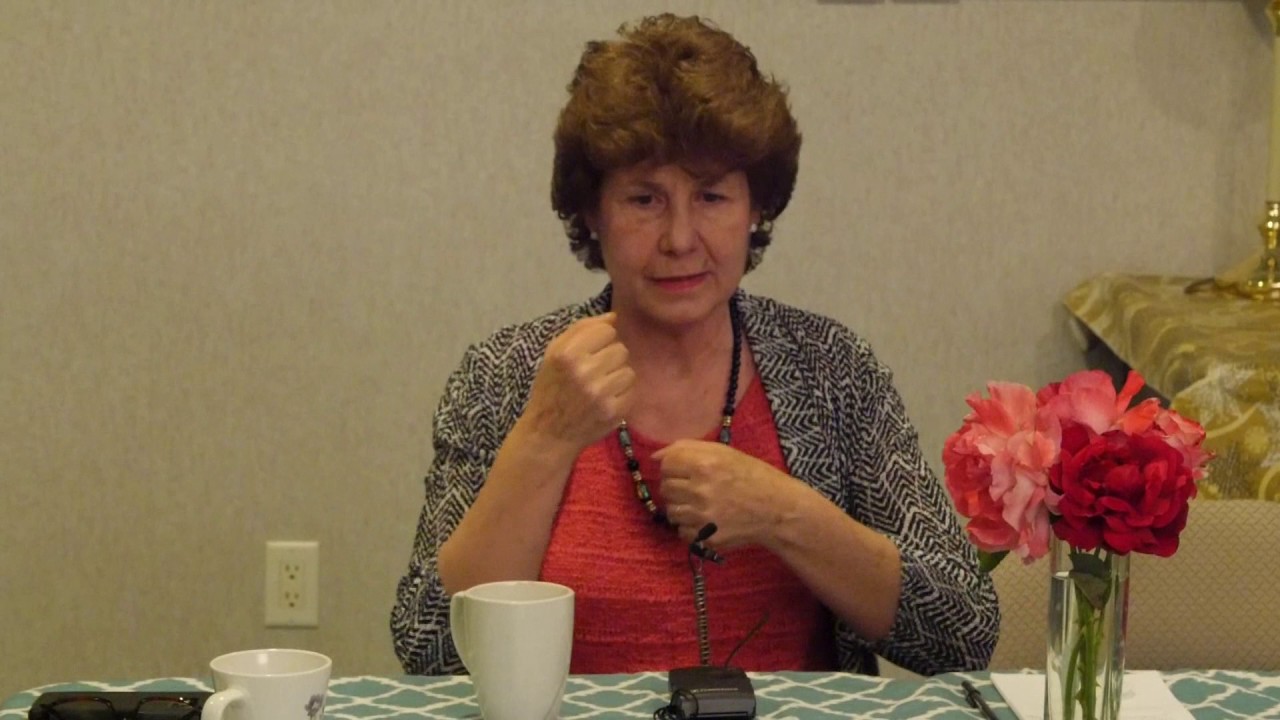
Mary Hida
The story of Mrs. Mary Hida's life of faith
YouTube · LVFC Office · 58:48 · Japan
Testimony video on LVFC Office channel.
My parents are Willis Carrico, born in St. Louis, Missouri in 1920, and Doris Eileen Reiner, born in Omaha, Nebraska. They met in San Diego, California — they were both in the Navy. My father would come into port in San Diego now and then, and my mother was in a Christian Bible study. This handsome man was always coming every few months, and all the ladies were really excited when he arrived. My mother was so shy that she never hardly approached him, but my father sought her out, and two months after they met, my parents married — a month before the end of World War II, in July 1945.
The next year, 1946, my sister was born. My father had decided he wanted to go to Bible school, so he went to Biola — the Bible Institute of Los Angeles — in La Mirada, California, and studied there for a couple of years. My sister was born first, then my brother, then I was born: 1946, '48, and 1950. My father finished Bible school and set off with our family to Japan to become missionaries. People didn't fly at that time, so everyone had to go by boat — my parents went on a freighter, and it took a month to reach Japan. They arrived in Yokohama.
My father began studying Japanese in Karuizawa, in Nagano Prefecture. Other missionaries were gathered there — there was a compound, something like the way we sometimes live in community — and all the missionaries and their wives and children got to know each other that first year. Just after one year, my father went into the countryside, to a place called Shimagawara — which even the Japanese don't know, it's a very small place. His language teacher happened to come from that village, so that was the village he chose. We moved into a Japanese farmhouse, which is very different from homes here.
It was a cold place with no central heating. The only heating was something under the ground where you put your feet and pull a blanket over you, and perhaps a charcoal heater somewhere else in the house — I'm not sure. There was no kitchen, so my father had to build one for my mother; it had a dirt floor. Outside was a well — a pump shared by three families. This was just after World War II, so the countryside, even though people had houses, was very, very poor.
I think the person who had the most difficulty must have been my mother, because she didn't speak Japanese at all. As time went on, we children were always the ones who translated for her — someone would come to the door and we'd go and tell her what they were saying. My father loved being a missionary. Totally loved it. He would adapt everything — he had a bicycle with a cart on the side and would put us children in the cart and take us with him somewhere. We children loved it too. We got to know the neighborhood children, they were just our friends, and we learned Japanese just like they did.
When I was five years old, we went back to America for one year, because missionaries do that — every five years they return to their country. I was in kindergarten. I remember speaking to someone and then them laughing at me, and it was because I had spoken Japanese. I didn't know that was Japanese, but my mother told me afterward that I didn't speak any Japanese the whole year, because I had been so shocked by them laughing at me. After that year, we went back to Japan.
We settled in Tokyo because we needed to go to an American school. There was a missionary school called Christian Academy in Japan. We children went there from first grade through 12th grade. It took about an hour one way — we walked a mile to the train station, got on the train, changed trains, and then walked another mile or so from that station to school. We did this year after year and grew up together, all these children whose parents were mostly missionaries.
To this day we still have reunions — 10-year, 20-year, 30-year, 40-year. Last year I went to San Diego and joined my friends, and next year we're going to have a 50th high school reunion. I don't even feel 50 — fifty years since we graduated from high school, and we're just laughing at each other when we say that. Most of my friends have grandchildren, and some have great-grandchildren. We look at each other going, how come we still feel like we're 18? These people are very precious to me.
Because I grew up that way, I often feel like a second-gen myself — I grew up in this very strict community and then I was put out in the world. When I was 17, we came back to America, and by 18 my parents had moved away, so I was on my own. I worked a little, didn't go to college yet, but I got a job offer in Portland, Oregon at the Japanese consulate. For the three years I was there, I made friends with a lot of people.
To make a long story short, I decided I was going to travel to many countries. I bought a ticket from Portland, Oregon to Calcutta, India, and set off. The first eight months I spent in Japan, traveling north to south, east to west through the villages — it was the most amazing time. Because I speak Japanese, I had no problem. The memories are so many. I also went to Korea, and one thing I remember: I went into the villages there and thought, oh my gosh, that's just like the village we grew up in. At that time Korea was not quite as advanced as Japan in the 70s, and I was so excited to experience that wholesome way of living again.
Then I went to many more countries — Taiwan, Hong Kong, the Philippines, where I stayed six weeks and had beautiful experiences, really learning to love the Filipino people — and then on to Thailand and Burma. I want to tell one story about when I went to India, to Calcutta, because it was a turning point for me. I had already been traveling for about a year, spending a lot of time in people's homes, getting to know people in different cultures — it was all so deep. I knew what poor people were. But when I came into Calcutta on the plane and then on the bus through the city, I could not believe that this was really real.
Even at the airport, there were young people whose arms and legs had been cut off and they were begging. As we went through the streets of Calcutta, I looked left and right — oh my gosh, this is really real. I was extremely disturbed. Two friends I had made on the airplane said, "Why don't you stay where we're going to stay?" It turned out to be an amazing bed and breakfast — actually one of the family homes of Rabindranath Tagore. The lady who owned it, Mrs. Singh, was a woman of the Bahá'í faith, and she said sure, I could stay.
That first night I couldn't sleep at all. I lay watching the geckos racing on the ceiling and the fan going around, crying all night long — crying out to God. I said, I can't believe it, that this is what hell on earth is. I was just praying and praying. In the morning, Mrs. Singh saw that I hadn't slept and said, "Why don't you come with me today? I'm going to go through a nearby village and do my charity work — do you want to come?" I said sure. We got in a rickshaw and went down to what was actually a slum — families of 7, 8, 9, 10 people, all living in one room. She would speak to them in such a passionate, compassionate way, and I was so impressed by her.
They loved her. And she was trying to teach them about birth control or something like that. But anyway, she was a very wonderful woman. Then we got in the rickshaw again and started going back home, I think. We came close to this one area where there was a long line of people with tin bowls, and she was pointing them out. She said, 'See that long line of people there?' And as we got closer she said, 'Do you see that big, huge vat — like a big pot?' We came closer and I did. And she said, 'See that little woman there? That's Mother Teresa. Do you want to meet her?' And I said yes.
So we got off the rickshaw and went over there. She knew her very well and introduced me to Mother Teresa. And Mother Teresa basically said, 'Oh, go up to the children.' So I went to where the children were. And I can never forget that first experience — I embraced, was embraced by, is more like it, a little snotty boy. I held him and I still remember the warmth I felt when he said 'mama' or something like that.
I was also guided to the home for the dying, which was on the same compound. That was where people were picked up off the streets and they could die in dignity — or sometimes they didn't even die, they just got better and went on to live. But some of the people that were there — it was just amazing to think that that's somebody's mother or father. That is the compassion that Mother Teresa had, and she shared that with other people, so there were a lot of people helping people. That was 1973, and I was so deeply moved. I did stay there for a few days with Mrs. Singh and helped out and served. I was never able to meet Mother Teresa personally again, but I did see her in the compound, and it was so beautiful to experience.
After that I took the train with these same friends — they were going up to Nepal, so I said, 'Oh great, I'll go with you.' We went to Kathmandu on third-class train. If you know what third-class train is, it's people bringing their own food and their dogs and their chickens, everything together with them. We went all the way up to Nepal and then had to transfer to a bus to go to Kathmandu, which is the main city in Nepal.
I was there for about a week or so, then we had to get a permit to trek. Trekking is walking, but there are no bicycles, no cars — everybody walks because the mountains are so extreme there. I was able to go for a week, trekking from house to house. We would go to a mountain family and they would allow us to sleep in something like an attic. Then we would have the dal — the soup. That was the same thing we had at every place.
It was an amazing experience to be in those homes and to feel the heart of people who live that way. I just can't express the depth of heart that I felt during that time. Of course, there was no electricity, no toilets. The rivers and streams were where we washed ourselves, and the toilets were wherever. And it was a wonderful experience.
After that I continued to travel — back to Thailand, then through Malaysia and Singapore and Indonesia. The place I stayed for two months was in Bali, Indonesia. I stayed with the dancers — the Balinese dancers. You've seen them with their body twisting, and it was beautiful to stay in the village together with those people. I can still remember the sky in Bali. There was no electricity there either, but it was lit up and the stars were so close — right there, you could almost touch them. I still feel that place in Bali where I stayed: I can close my eyes and I'm there.
That was something I did in 1973, '74, and '75. And finally I came back to America and was trying to decide what I was going to do with my life. I said, I'm definitely not going to stay in America, because Americans had no idea about that kind of life, that kind of heart. I was so disappointed. I went into McDonald's to eat and all these things they were throwing out — my heart was just aching. Oh my gosh, people in Calcutta could use this for a month. My heart was just aching when I came back to America. I knew I had to go back to the world.
The best way to do that was to become a teacher again — an English teacher. So I got a visa to go to Japan. Did I even talk about the way we grew up in Japan? I don't think I did. Anyway, there's so much in my life that it's so hard to know what to talk about — I'll skip it for now because I don't know where to start. So let's say — oh my goodness — I'm about to almost join the church now, and I've skipped a lot of my life.
Anyway, I went back to Japan and started teaching English, and ended up on an island called Shikoku, which is one of the four main islands in Japan. I was teaching English and suddenly one day all these Western people were in front of the train station. The Catholic people who were making announcements told me, 'Don't talk to those people — they're not good.' That was my first taste of Unification Church members. They were the global team — wonderful people from many different countries — and it was right after the Yoido Rally in 1975. They came and were witnessing, Western people from Europe and America.
The New Hope Singers were there too, and the dancers — the Hansan Byodan. They all came to my city where I was the teacher. I was trying to avoid them, taking my bicycle and going around the back side of the train station. But every time I went trying not to talk to them, I would find one person and they would stop me and talk to me. A couple of times I said I'd go, and then I didn't.
The third person who actually got me was one day when I was going up to the place where I taught English — my ABC school. As I was walking down, this one lady, Linda, got me and said, 'Let's have coffee.' So I did. I think she was watching me the whole time I was teaching — I'm not sure, but I think she calculated exactly when I was going to come down. That was the person I listened to, and so she invited me to go where they were staying.
They were staying in a bowling alley. The reason was that at that time in Japan, there were bowling alleys that hadn't done well and were no longer being used — so they were empty. It was perfect for our members because they could stay with their sleeping bags, give lectures, eat, and do everything in these big bowling alleys. So I took my bicycle and went all the way up to the top of the hill. I went there multiple times and they prepared English lectures for me.
After a week or two, they said they were going to leave and go to Nagoya, which is on the main island of Japan. I said okay and said goodbye to them, but they kept calling me: 'Are you studying? Can you come to Nagoya?' I said, 'No, I can't come — I'm their only teacher, there's no way I can leave.' They kept saying, 'No, you can go, you can do it.' Finally I did. I went to Nagoya and told my school I couldn't teach for a little while — it was really hard getting a substitute, but I managed.
They had prepared a seven-day workshop for me in English — just for me. I went through the seven days and was going to go back, but they said, 'Why don't you call and tell them you need to go to this other place — a three-day workshop at the Moriyama workshop place?' That was really hard, but I did it. I called up and said I couldn't come, and they were really mad at me. Then it was a Japanese workshop, and the lecturer kept saying to me, 'Do you understand? Do you understand?' And I was writing down the words I didn't know in Romaji — in Roman letters.
But then suddenly I put my pen down and was listening so carefully, because that was when they were talking about Jesus and about the life of Jesus. The lecturer could see very clearly that I understood, because my tears were streaming down my face. So I think that was about the time that I decided I needed to join this church, because I had struggled so much. I was praying all night long, just like in Calcutta, saying, God, I don't want to do it, but it seems like I need to do this. And then I would get inspired again. I did it like so many other people have done—they've joined in unusual ways.
That global team went to Tokyo, and I witnessed with them as a new member for a couple of months. Then they said they were going to America, so I joined them. By the end of 1975, I was in Barrytown, New York, listening to Reverend Sudo's lectures—it was a 120-day workshop at that time. Leslie was there, and she was the nurse; I do remember that. Then I was asked to go to Rhode Island and some other places, pioneering with different people.
I went to the Yankee Stadium campaign—we took buses there. Next was the Washington Monument campaign, and by that time I was at 43rd Street in New York. I took one bus and I was the bus captain, and when we got there it was a wonderful time. That was the first time I actually heard True Father speak—or maybe it wasn't the first time I heard him speak, but in that kind of situation—and it was very amazing.
At the end of the Washington Monument campaign, everybody gathered at 43rd Street, and Mr. Kamiyama was there. He was aware that I spoke Japanese, so he grabbed me and said, "Oh, come with me and come to my house and stay with my wife—you can translate for my wife. She needs to go to the MFT teams." So I went to their house and basically stayed with them a lot over the years, going with Mrs. Kamiyama to the different MFTs where she spoke.
I still remember—and other people still remember me to this day—that I went to their MFT team together with Mrs. Kamiyama. But one sister said, "Oh, I thought Mrs. Kamiyama was speaking in English." That was the best compliment to me, because it means she remembered Mrs. Kamiyama there. I was there, but she didn't remember me—which means that somehow God was able to use me, even though it wasn't easy to translate. She thought she was listening to Mrs. Kamiyama. That stayed in my heart for many years. When I heard that, I thought, wow, that's how God uses us.
So many things happened. I went to MFT for a few months, and then I went to Dan Pfefferman's IOWC team—Kentucky, or somewhere like that—and then I joined another MFT team. It was Mother's Day, 1979, and suddenly I was called with my friend Cynthia, who was on the same team, to stop fundraising and get in the van. We said, "Wait a minute, this is the best time—I can't quit now, I haven't made my goal yet." But he said, "No, you're going to New York." He told us we were going to the matching in New York.
So we went to New York, both Cynthia and I, to the New Yorker Hotel, where True Parents were matching people. I was number 25 and Cynthia was number 24, in 705 couples. Father matched this wonderful sister who had about 100 spiritual children—he was talking to Vera from the Netherlands. She stood up, and Father matched her with this wonderful Japanese brother, Ichinori. Then right next to him was my husband-to-be, Mamoru.
Father had already looked at me—when Father looks at you, you know he looked at you. But then he didn't look at me; he pointed to my husband and gestured. People were helping me stand up: "Yes, you're supposed to stand up." So I just started walking toward him—but he was way over there. The people were laughing; I must have been cute. And then I thought, oh, I'm supposed to wait for him to come to me.
Right in front of us was True Mother and Mrs. Phyllis Kim—Mother was smiling. As we walked by, Mrs. Kim said to my husband, "Mamoru, beautiful." We went upstairs and talked for a short time—we agreed, this is good, we'll do it—then came down and signed a paper. It was number 24; that's why I remember we were number 24. So my husband and I were husband and wife then, but did we want to go out to the diner and have coffee? Okay. So we went, while Father was still matching people back there, and we talked for an hour or two.
He discovered that I spoke Japanese—he thought that was cool, but it wasn't that important to him. We found out we already knew each other. In 1974, my husband-to-be had become one of the security at East Garden—he was about 20. I was also at the Kamiyamas' house at that time, and many times Father would come to feed the geese at the pond there. He remembered that I had given him bread one time for the geese.
Yoshiko, the daughter of Mr. Kamiyama, was laughing at him for speaking to me in English—she said, "Ajoshi, uncle, you don't have to speak to her in English. She speaks Japanese." She was just four or five years old at that time. He remembered that—that's who I was. We have another memory, but I'm not going to go too much into depth. That was the person I was matched to in 1979, and then we had a three-year engagement. Two weeks after that, I went to Japan and he stayed in America.
The reason I went to Japan was Mr. Furuta, who was in charge of practically everything in Japan that had to do with fundraising, selling, and business—but he didn't speak English. True Father said he needed an English teacher, and Mr. Kamiyama said, "I know someone who could be an English teacher," and recommended me. But when I got to Japan, Mr. Furuta didn't want to study English—he was a very, very smart person, but linguistics was at the bottom of his abilities. He just didn't want to take time for it, and he was always trying to find a way for me to do something else. And when I came—"oh no, the devil has come."
Mrs. Furuta, his wife, said, "Well, I think you can teach at the preschool—you can teach the children at the preschool." So they set up an English program for me there. Those children who were in that preschool are leaders in our church right now, in Japan and in America—they still remember me, and they're probably around 40. Mr. Kuboki, who was the president of the Japanese church, said, "Well, if you don't want her, I'll take her." So I became a kind of secretary to Mr. Kuboki, and I traveled around with him to Taiwan and Korea and different places and had amazing experiences.
In 1982, I came back to the Blessing—we were blessed with 2,075 couples, and that was why I came back to America. It was funny that at that 2,075 couples Blessing, my husband and the other security from East Garden were the last people. Everybody went through, everybody went through—and then there were all these ladies standing together with no husband-to-be. "What are you guys doing there? Why are you just standing there?" "We're waiting for our husbands to come." But they were security—they had to come at the last minute. Just everybody going in, going in, going in, and the curtains closing. The last people in were security.
They had to run and catch up with their wives-to-be. We were the last ones to go in — that's quite an interesting memory, always alone. Even that evening, when they had entertainment and True Parents were there sitting, everybody was sitting with their new husband. I was not sitting with my new husband because — it's very beautiful — he was sitting with True Mother. He was right behind her, protecting True Mother. So there was nothing to be sad about, but I do remember being sad. That was the taste of what my life was going to be.
In 1985 — just three years after our Blessing — I went to start my family with my husband. He had a room in Mr. Kamiyama's house — the same family I had been working with before — and we did our three-day ceremony there. They loved him and they loved me and they took care of us. But I was not actually living there yet. I was in Maryland, and my mission there was city leader. So every month I would go visit my husband at the right time of the month — drive to see him and come back again — for almost a year.
It was nice — it was like having a three-day fling, whatever. And then one time I arrived and he wasn't there. Mrs. Kamiyama said he had gone to the science conference over in New Jersey, two or three hours away, and suggested I take him a change of clothes and just show up there. So I did. Fortunately he had a little bit of time, so we went around and walked and talked for many hours. Then I was just about to go back and he said, wait, wait just a minute.
He went and made a phone call, then came back and said that Irwin — the person who was supposed to stay with him — wasn't coming back that night because the True Children weren't ready to come yet; he was going to drive them from East Garden. So my husband said, why don't you stay? You could imagine — that was how our daughter was conceived, in the hotel at the science conference. Our one and only daughter. I can't believe I'm telling this story, but it was a very beautiful moment.
When I said goodbye to him, I stopped at a coffee shop on the way back. I was overwhelmed with this knowledge — I have a baby. It was not even 24 hours, but I knew, and I started to cry while I was drinking coffee because I just knew. It was real, because I started getting sick whenever I smelled coffee a week or two later. That time was right around Thanksgiving, and to tell a long story short, I fundraised with my daughter in my womb for Thanksgiving, Christmas, Valentine's Day, Easter, and Mother's Day — each time getting bigger and making good money — because I was excited: I was going to be with my husband when this was over.
After Mother's Day, I went and joined my husband in Tarrytown, New York. We had a room there, and I arrived with a big stomach. It was very strange to other people who couldn't imagine something like that, but it was actually very beautiful for us. Our daughter was born and we stayed in that room in the Kamiyama's house — and that was the beginning of my life being on East Garden Belvedere staff, a total, I think, of 28 years.
During that time we did so many things. I was a preschool teacher, and at East Garden you help out for a lot of different things. The wonderful experiences I had at the preschool were that I taught the grandchildren — the True Grandchildren — quite a few of them. Very deep experiences, because they are treasures that you have yourself; nobody can take those away from you. One particular memory is of three cousins — Hyun Jin-nim's daughter, Hyun Jin-nim's son, and Kook Jin-nim's daughter. They were all the same age, within one or two months apart.
They were always in my English class, doing all the finger plays and laughing and joking and fighting and just being who they are. I cannot take that memory away from me — the harmony they had. They were cousins, but they were just like brother and sister. Now they're about sixteen, all three of them. We don't see them anymore, but they know that they had each other and had those experiences when they were young. They have those memories. Many times during my teaching years the children did performances for the grandparents — Father and Mother Moon.
We would be there taking care of them, and sometimes Father would speak and speak and speak, so we had to wait a long, long time in the waterfall room with the children. Of course, that's who we played with, and they knew us. I was known as Mary Sun Sing Nim at East Garden for many, many years. The Borneman children still call me that — they don't call me Aunt Mary, they call me Mary Sun Sing Nim, because that's how they knew me. Those are the treasures I had in those days. The young grandchildren have gone through a lot, but I think they have beautiful memories that they still hold in their heart.
One of the main things that comes to me is how grateful I am for my husband. Mamoru was at East Garden for 38 years — he went when he was twenty and never moved to any other mission. True Parents were here in Las Vegas for a few years, and many times during that period the security team from East Garden would come for weeks at a time to carry out their security mission. My husband would come back and tell me Las Vegas is this way and that way, and I'd say okay, okay. It sounded like something far away and nothing to do with me, but I listened.
Then Father passed away in August of 2012, and True Mother asked my husband and me to come here to take care of the property. My husband kept telling me it was going to happen, but I kept not really believing it because I didn't want to go. I was in denial. But the time did come. We went, and True Mother formally asked my husband, can you go and take care of the Chonghagun property and take care of Kwon Jin-nim's family? Then she spoke to me for a minute or two and said, wife of Mamoru, you can do Women's Federation. That's actually what she said at that time.
In the beginning, when I came here, I wasn't sure if that's really what I needed to be doing. But we came and stayed for three years on this property. Last year, when True Mother moved — pretty much moved everything — to IPEC, where her residence in Las Vegas is now, we were asked to vacate the property and open up every place for the church. God worked very quickly. I thought, okay, I'm going to do it, I'm going to get a house. I think sometimes God works in mysterious ways, because you feel those feelings and your blood is ready to go. That's what happened.
Whatever happened to us at that time, it was a positive thing in the end, because I was ready to get a house. Within four or five days, we were signing for a house and it happened so quickly. Within a couple of months we were in our house in Henderson and got a good deal—a four-bedroom house. It was just perfect, something that we could not even have imagined being in our situation. So that's where we are living right now. We're living in Henderson, which is about 20 minutes from this property. I'm not always used to being so far away, because if I forget something, I can't go back. But when we lived here, I could forget something—no problem, I'll go back and get it. So it was definitely a blessing living here, and we're still here.
My husband works at IPEC, among other things. The one thing about my husband I really have to say is he never lost his spirit. Whatever spirit he had in the beginning, while he was in East Garden all those years, he actually never changed missions. It's always the same—it's always doing what's best for True Parents. And the brothers and sisters are actually an extension of True Parents. He's amazing. He takes care of people the way they should be. From what I can see, basically the way he takes care of people is the way he is supposed to love them and take care of them and not hurt them.
Sometimes I'm going, you should tell that person—no, no, no, no, no. And he'll give them three chances, three chances. So I've learned over the years—actually he's taught me a lot just by who he is—to be patient and loving. We're probably basically both that way because I had a Christian background. But I'm just really grateful that he's in my life. We have a 30-year-old daughter who's been Blessed for 10 years and they're doing well. They live in Manhattan.
The other day when we went to the FamiCom conference, we were asked what is the thing that you're most grateful for. Without a hesitation, it was my husband, because he's really taught me in so many ways. I probably wouldn't be here if it wasn't for him. He loves the True Children with a deep heart and he's always been in the background. He's never really desired to be a leader, if you want to call it that. We're all leaders, actually. There are different types of leaders—there are external leaders, and then there are leaders of the heart.
This is what I'm really learning now in Women's Federation—I'm now the chairwoman of Women's Federation for World Peace here in Las Vegas, and this is my vice chairwoman, Sara Hirado. Somehow I can't believe that it takes so long for us to learn some of these things, but leadership of the heart is everything. It's easy to say it, but when you experience it, you realize, oh, why didn't I do that way before.
When my daughter went to college in 2005, I decided I'd go to college too and check it out. Our preschool was trying to get certified, and so they needed us to take some classes. I started off with one or two classes, and then it wasn't long before I was taking full-time classes. Even my daughter—one time she was taking French class and I was taking an early childhood class, and we had classes right next to each other. At break time, we both went out to drink water, and she said, "Hi, Mom." My classmates were, "Oh, that's your daughter!" So we went to college together. From 2005 to 2010, I had never had any college before, but I graduated with a bachelor's degree. Then in 2011, I graduated with a master's degree in teaching English as a second language.
That was actually part of the reason I didn't want to come here to Las Vegas—I wanted to do something with my degree, which I didn't so much do. As we get older, we need to do so many things to take care of ourselves. I'm not the same as when I was 50, or 55, or 60, or even 65. Every time, different things in your body are changing, and you have to take care of yourself as you get older.
And so I often think of my sister. She passed away four years ago—she was the same age as I am right now—and she was in Southern California. One day I was sitting probably right here, and I got a phone call. It was my own brother, saying Judy is on life support. She was the oldest of us 10 children—I realize I left out a whole lot about my family, but there are 10 of us—and she was always the one who hosted everything, all of our get-togethers, our reunions, and things like that. She had a heart attack. My husband drove me to Southern California where she lived, and not even 24 hours later she was gone. I was holding her hand and she was gone. It was very devastating to me. She was so young.
And so every time I exercise, I do two different things. Four years ago when I came here, one of the first things I wanted to do was find a yoga studio. About one mile from here, there's a place called Pilates and Yoga, and that's where I've been going for the last four years, as often as I can—not so often these days. The other thing I've been doing was actually interesting. When I turned 65, I said to my hairdresser who was cutting my hair, "What can I do to celebrate?" And she said, "You can join our bowling league." I said, "Bowling? I don't even know how to bowl." She said, "No problem. My 92-year-old mother is the best bowler of all and we're on a league. We have six teams—you can join one of the teams."
So that's what I did. Within a week I was on the bowling team. That's been two years and this is my third season. My teammates are 84 and one year older than me. The different teams—the 94-year-old lady is good, they go up to 200 sometimes, even 185. It's amazing. And by the way, we are the top team—the top team of six teams. I hadn't bowled for a couple of months because I was sick with this lingering cough, and also I was busy. They kept calling me: "Mary, when are you coming back to bowling? We miss you." Two days ago I went back and I could still do it—I have a good average. It's like typing or riding a bicycle: once you do it, you don't forget. I want to be healthy. I also have another brother who passed away at age 39. We've got to be strong.
Reflections about this person
Reflections are anonymous unless you put your name in. Every submission is reviewed before it appears.
Loading reflections…