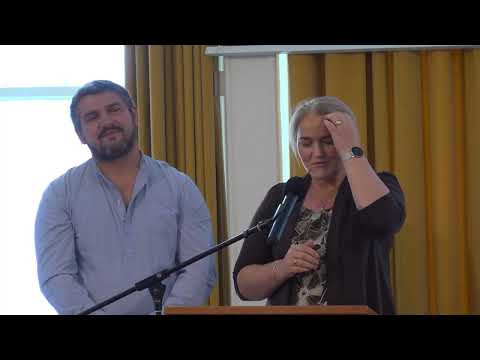
Marius & Laureta Scorcea
Testimony of Trip to Korea
YouTube · FFWPU UK · 33:25 · UK
Laureta Scorcea shares her excitement and gratitude when she and her husband Marius were unexpectedly invited to return to Korea for the first time since their 2003 fundraising mission.
Laureta: My name is Laureta. I couldn't say no to Karen because I wanted to express my gratitude for having this opportunity to go to Korea. I wanted to start from just before Uncle William sent a message on the WhatsApp group—who wants to go to Korea? My first reaction was: well, yes, I want to go to Korea. We had always wanted to go. Every year we'd been planning it—next year we're going to go to Korea.
The last time we were in Korea was in 2003. We were in a fundraising team, doing fundraising at that time, and ever since then I had so much nostalgia. I so much wanted to go back to Cheongpyeong—we both wanted to go back, with our children actually. Every year we were thinking, okay, next year we're going to go back, next year we're going to go, but it was never possible. To go to Korea you have to go for 40 days or 21 days for seminars, and it is not so easy to get such long holidays from work—expensive, and so many things.
So when I saw Uncle William's message, I said, yes, I want to go—but I didn't expect, at all, at all, at all, any positive answer. Then after a few days I saw the message from Uncle William: yes, I could go to Korea. I couldn't believe my eyes. I went to get my glasses. Did I read it well? I was so happy.
And I felt so much—there had been a period for me when I wasn't feeling the presence of God so much. I think it happens to everyone sometimes that we just feel down, that we just don't feel that. So when I saw the message, I said, how could I not feel the presence of God? God is there always for us; we just need to feel that. And I felt so grateful to God at that point.
My focus was to go to Korea to meet True Parents. I was preparing my heart, my mind, myself, just for that purpose. On the 12th this visit began—going to True Father's burial place. All our group from our room thought we were going straight away. We went to do the PCR test and then straight to the bus. As we were waiting, queuing to get into the bus, I was last in the queue. The bus got full just before me—everybody went in and I was left out.
I felt that was a kind of spiritual sign for me. Maybe I hadn't prepared myself so well; maybe I hadn't prayed enough. I was almost crying. I went back, and I decided in my head: when my husband comes, we are going to go together. My husband hadn't arrived yet—I had come on the 10th and Marius came on the 14th. So I told myself, okay, we're going to go when he comes; maybe it was just a sign that we should go together.
The next day, on the 13th, I was sitting with Auntie Miti and we were talking about whether to go and visit True Father's Panyang Won. I said I had decided—after that experience—that I was not going to go without Marius. Anyway, we went to have lunch with Auntie Miti, and a Japanese sister and a Korean sister came over to say hi to her. They said they were going to True Father's prayer place and asked if we wanted to come. Auntie Miti asked me, and I said I had decided to go with Marius when he came—and yet, I don't know how, but we ended up going.
It was raining that day. Auntie Miti said maybe we would go later because of the rain, but the sister went to get an umbrella, came back in five minutes, and said: okay, let's go. We ended up going to True Father's prayer place. It was raining, but it was such an amazing experience—these sisters were helping us, explaining everything. There was such amazing energy there; you could feel God's love. Afterwards we had the opportunity to go in and visit the palace, and these sisters guided us. I had never been there; it was my first time.
I was telling Auntie Miti: did God send these sisters to us? I felt so special—such special help from them. When Marius came on the 14th, there were no more visits to True Father's resting place, so he couldn't go. If I hadn't gone, if those sisters hadn't kind of pushed us, I would probably not have gone at all—and that would not have been for the best.
Seeing True Mother—the first time we saw her up close was at the Peace Center, at the celebration for True Father's 10th anniversary. Seeing True Mother was amazing; you get such a different energy when she is closer to you. It is different from when you see her on the videos—she looks so well on the videos—but when you see her in person she gives you so much love. And you can also see that her health is not the best; you could see. I love that—seeing True Mother, and singing and dancing in front of her.
At the Victory Celebration we had the chance to sing and dance. We sang the song 'Serengeti' for True Mother, and I was on the stage singing. I was somewhere at the back and couldn't see very much, but True Mother was very close to me and it was so amazing. She looked so happy—she was clapping and her face was glowing. I just love True Mother—not because she is True Mother, but actually as a mother, I really love her. Sharing that time with all the brothers and sisters was a different experience for me too. In 2003 I was in Korea with a small fundraising team, but this time there were brothers and sisters from all over the world, and sharing this experience with all of them was amazing.
Marius: I know that most of the brothers and sisters here in the UK nation have had the chance to be in Cheongpyeong. For us, as my wife explained, we were in Korea 18 years ago and we were just a small fundraising team. We were young members at that time, just matched together, and we had this chance to go to Korea to get to know each other. We were young in spirit, and afterwards it was really, really nice to experience the Korean nation—the Messiah's nation, the original homeland.
After 18 years, going back was like going back in time, and it was really amazing because I could remember all those experiences I had had. One of them was that we had to wake up at one o'clock in the morning to attend Hoon Dok Hae with True Father in Jeju Island—we had to leave very early because we had said we wanted to be near to True Father and True Mother. There was a van that came to collect us and we were driving for about two and a half hours. When we got there, all the elder brothers and sisters who were attending True Father were looking very curiously at us: who are these people? We said, 'We are from Albania, we're fundraising in Korea.' 'Oh, Albania, oh, very good!'
When True Father saw us, he said that today we had a day off from fundraising. He gave us a special donation of 3 million won, and he invited us to spend the day in Jeju—he also gave us a boat trip. It was a very, very nice experience. I feel so blessed that I had the chance to shake True Father's hand, and really, this experience will stay with me for the rest of my life.
Marius: Going back to 2022 and attending Reginald's meeting — as my wife was saying, I didn't have the chance to attend True Father's Seonghwa ceremony, and to be honest, that was one of the reasons I didn't want to go to Korea. But at my wife's insistence — she said, "Don't leave me alone because I'm going to lose myself" — we went. For me it was the experience of my life again. Cheongpyeong is like — when you go there it's a totally different atmosphere, you are like in heaven. I want to thank Dr. Michael Balcom very much for giving us the chance to take part in that experience.
I also want to share two experiences from that trip. The first: when I arrived in Korea, you have to go for your PCR test at the hospital, and right on that day there was this ceremony — an international conference think tank. I had to go to the hospital and was getting late, and Peter offered to give us a lift to the stadium so we could attend the ceremony. When they saw us arriving by car, I don't know — I thought they took us for VIPs — and they took us straight to the VIP stand. We went and sat at this table, and it was like, "Lola, what are we doing here?" — but it was such a funny experience, and really such an honour to have those kinds of seats.
The conference think tank was very inspiring — to see all these former leaders, especially the ex-CIA director, Michael Bay, yes. It is inspiring to see all these people trying to improve well-being and world peace, and of course they need support — we are the ones who really provide that. If we each do our part as individuals, I am very sure that something good can come of it, not only for ourselves as Unification Church members but for the world. Another very nice experience was the tour that Dr. Michael arranged for us — visiting the DMZ zone and having a wonderful time together. There was a lot of walking up and down, but it really was a very, very nice time, and we had the chance to have dinner with President Song, which was a wonderful experience as well.
William: I was really happy that they went, because it has always been nice for people who don't normally get the chance to go to be able to go — which is why I put it on the WhatsApp. I thought, God can choose, not me; whoever's heart is willing and wants to go, let them be the one to participate. I expect you have all been watching the programmes on television about the life of the Queen who just passed away, and there are so many. Please, if you haven't watched them, do watch some of those documentaries — they give you a real sense of who she was, the kind of person she was, and the life she lived.
I just want to mention a few things from a providential point of view — starting with where she came from: Britain. What is Britain? We all know that Britain is the Eve nation, and it has actually been the Eve nation since the time of Jesus. Britain has had, for 2,000 years, an incredibly important and significant role in God's providence and dispensation. The whole of the Christian world should have created the worldwide foundation to receive the Messiah, but the whole continent of Europe was unable to do that — instead it followed dictatorship, fascism, communism, and all these different things in the twentieth century.
Britain, though, was fortunately able to create the worldwide foundation to receive the Messiah — through freedom of religion, rule of law, and free trade, all spread through the British Empire. This meant that True Father was able to be born into a relatively free and democratic society and to travel around the world to deliver his message. Britain also gave birth to the first Israel — the State of Israel in 1948 — and to the second Israel, the United States of America.
In many ways Britain also tried to give birth to Korea — sending the first Protestant missionaries there, translating the Bible into Korean — and the great Korean Pentecost at the beginning of the twentieth century was sparked off by events that took place in Wales. And as the Eve nation, Britain should also have provided the bride for the Messiah. That didn't happen. But this is what Father said: the True Mother would have come out of the Christian realm — perhaps she would have been a British woman.
Father said: "It could be — why not? Once the worldwide foundation had been accomplished, I would have picked the True Mother on a world level. Imagine if the Royal Princess of England had become the True Mother. I'm only interested in one thing — how to restore the world. It's because our movement was rejected by Korean Christianity that our boundaries became so limited. If we'd been supported, the Korean movement would have immediately become insignificant, because the movement would have become worldwide and universal with no boundaries."
Father continued: "Let's say that the True Mother had come from Great Britain, the source of English-speaking culture. The US is in the position of the son to Great Britain. It would have been very rapid and easy for America to humble itself to Britain." He said that at the Day of the Love of God in 1984. It didn't happen — various things went wrong in the nineteenth century that made it impossible — and Father obviously regretted that.
So let's look at the Queen herself. That was her lineage — God's prepared lineage in that sense. She prayed every day and went to church every Sunday without exception. You might think she always wanted to become Queen, but actually, when her father was crowned, she prayed every night — and do you know what she prayed for? She prayed that she could have a brother. The last thing she wanted was to become Queen. That was the kind of person she was — a person of incredible humility.
And this is what she would have read every day in the Bible — what Moses said, from Deuteronomy, about what must be done when you have a king: "When he sits down on the throne of his kingdom, the first thing he must do is to make himself a copy of this teaching on a scroll — the Mosaic law, copied under the supervision of the priests — and that scroll is to remain at his side at all times."
He is to study it every day, so he may learn what it means to fear his God, living in reverent obedience before these rules and regulations, and by following them. He must not think himself better than his fellow Israelites, or change the command at whim to suit himself or make up his own versions. If he reads and learns, he'll have a long reign as king in Israel, he and his sons. When I read this, I thought that's very much like the way in which the Queen led her life as Queen — inspired by the biblical tradition, inspired by God — revealed what it is to be a queen or what it is to be a king.
And the only place in the entire Bible where it says somebody should be humble is here: "He must not think himself better than his fellow Israelites." So it's the only place in the Bible that says a leader — it says that Moses' main quality was he was humble. And it was said that the king should be humble. He shouldn't think he's better than anybody else.
And then I listened to the Archbishop of Canterbury when he was talking during the Platinum celebration, talking about the Queen. He said when he met her, he was asked what kind of person she was, and he said her main quality is she is humble. That was her main quality — her incredible humility. She was interested in every single person that she met individually.
Do you know how many people she met personally? About 3 million people. She had over 400 engagements a year, probably over 100 people there. She would meet them all individually — 70 years times 400, it's a lot of people she met personally. And she remembered them. There's one journalist — a nobody — who said, "Oh, I met the Queen," and then some time later said, "I met her again, and she remembered me." It's just extraordinary, that kind of person who wants to meet every person individually and treats them like that.
And then Rabbi Jonathan Sacks said that one day — after the 75th anniversary, I think, one of the anniversaries of the liberation of Auschwitz — she invited a lot of Holocaust survivors to go and meet her at one of her palaces. And normally, without exception, the Queen is an incredible stickler for time, being on time and finishing something on time. But at this particular event, she listened to every single Holocaust survivor, even though it went way beyond the time schedule she had allotted. And one of her assistants said it's the first time she'd ever done that. She wanted to listen to every single person's story individually.
And I was so struck by that, because it reminded me of True Father as well. True Father always wanted to listen to reports. I personally would not have the patience to just sit there hour after hour after hour, listening to a report from one person after another from all over the world, day after day, year after year. But he did. And so I realised that's the kind of person she was as well, and these things struck me very, very much.
This is a book which was published, I think, for one of her jubilees — not the Platinum one, the one before that — and it's called The Servant Queen and the King She Serves. So that's how she saw herself — as a servant. She served God, she served Jesus, and she served her people. That's what she said when she was 21 years old. I'm sure you saw that little talk she gave when she was 21 years old — incredible self-possession at 21 years old, to understand who she was and to make that kind of commitment, and to complete it 75 years later. It's just astonishing, that kind of a person. And this is the very first time she ever wrote a foreword to anything, because that embodied and captured how she saw herself — as God's servant and the servant to her people.
And of course, very luckily, she actually met the Little Angels — I think in 1971. They came here. I couldn't find the photograph anywhere. You can Google it; it just doesn't exist on the internet, I don't know why. But it's hanging around downstairs somewhere, or maybe up here. And that was an incredible opportunity. She went backstage, which she didn't often do, to meet the Little Angels. You can see Bowie Park there in the background. I don't know the circumstances of how that event took place. And it's a great shame it wasn't followed up, I don't think, in any way.
But she was the kind of person who wanted to connect to God. In the 1950s, there was a great evangelist — the greatest evangelist of the 20th century was Billy Graham. And when he came to England at that time, in the 50s, he was regarded as really enthusiastic, just over-the-top American evangelist, preaching and speaking and calling people to come and dedicate their lives — just very un-English. But she wanted to meet him, even though he was really controversial. And her advisor said, "Oh no, you can't meet him — he's not Church of England, he's too controversial." She said, "I want to meet him." And so he came to the palace, and they became very close friends. And really, that relationship with God was the core of her understanding of who she was.
And that's why I'm sure — I hope — you'll watch her speaking on Christmas. We always do, just testifying and sharing about what it was that was the centre of her life. As we can say from that, this is really the centre of what it is to be English, in that sense. She was the embodiment of Britishness. There's a whole history of 2,000 years, and she embodied that in her own life.
And then if you look at it — we sing the national anthem, and I love the national anthem. Do you know why? Is the word "Britain" there? Is the word "England" there? It's entirely non-nationalistic. It's called the national anthem, but actually there's nothing national about it. It's not like "Deutschland über alles," and the French one, which is even really bloodthirsty. Lots of other countries talk about their nation. The British national anthem has no mention of Britain in there, or England.
It's entirely "God save the Queen." Nobody knows who wrote it or where the music came from — it just emerged out of the West End theatres. But the expressions in there, the language of it, all comes from the Bible. And of course we should pray for God to save the Queen, because as a leader, the most important thing leaders have to do is make decisions. You want the person to make a good decision, which means you want them to be in a profound and deep relationship with God, totally sincere. So that's why we sing "God save the Queen" — not "Let Britain be great" or "Let England be great," but "God save the Queen." It's entirely a personal thing. Really wonderful words, actually.
And of course, now we're going to sing "God save the King." King Charles also comes from an interesting lineage — not only in terms of his mother, but also from his own personal background. It's very interesting. If you watch some of the documentaries made when Prince Philip died, it's extraordinary — his mother was basically a saint. Extraordinary. And so you can see, somehow, history turned out the way it turned out. But one needs to recognise that the Queen is who she is, or who she was.
And one of the things I noticed: when she died, what was the weather like? All over the country there were rainbows. Who made the rainbows? That was the Queen shining upon people — the Queen shining upon her country and smiling. She's incredibly happy, because she's now with her beloved husband Philip. And when you look at the Family Pledge, I think in many ways she embodied it in her own life — quite extraordinary. So yes, she's very happy there in the spiritual world, and shining. On one hand, it's grief and mourning, but on the other hand we can be incredibly happy for her, because she's where she wants to be.
She waited until she tied up all the loose ends. The Platinum Jubilee — she made sure the succession was there. On Buckingham Palace, the final thing, there was the Queen, Prince Charles, the Duchess of Cornwall, William, Catherine, George, and Charlotte. The four generations were all there. That's the succession. We talk about the three great kingships, and she made sure all that was in place.
And then there was a little bit of political turmoil going on in this country. She thought, I can't just die now, I've got to wait. And so she accepted Boris Johnson's resignation. Astonishingly — you saw on television — she was completely mentally 100% there. She was walking around with a walking stick, but completely there; she looked completely well, even if frail and old. And she spent 30 minutes talking to Boris Johnson. Then Truss appears.
She spent 30 minutes talking to her, made her the next prime minister. And then two days later, she died. I felt — she felt — "Now I've finished everything. All the loose ends are tied up. Now it's time for me to go." That was her decision. Everyone was shocked. It came completely out of the blue. She wasn't bedbound. She wasn't sick. She wasn't ill. She just felt: it's now a new era, it's time for me to pass on, it's time for me to go.
After 70 years on the throne — most people want to retire when they're 65 years old. Who wants to work for 70 years? Not many people. But she did. And so we're incredibly grateful, incredibly thankful for her, and she deserves all the honours that she will receive in the spiritual world. She's welcomed by her father, Jesus, and of course her own parents, and also by Philip. But now we have a new king. The queen is dead. Long live the king.
Reflections about this person
Reflections are anonymous unless you put your name in. Every submission is reviewed before it appears.
Loading reflections…