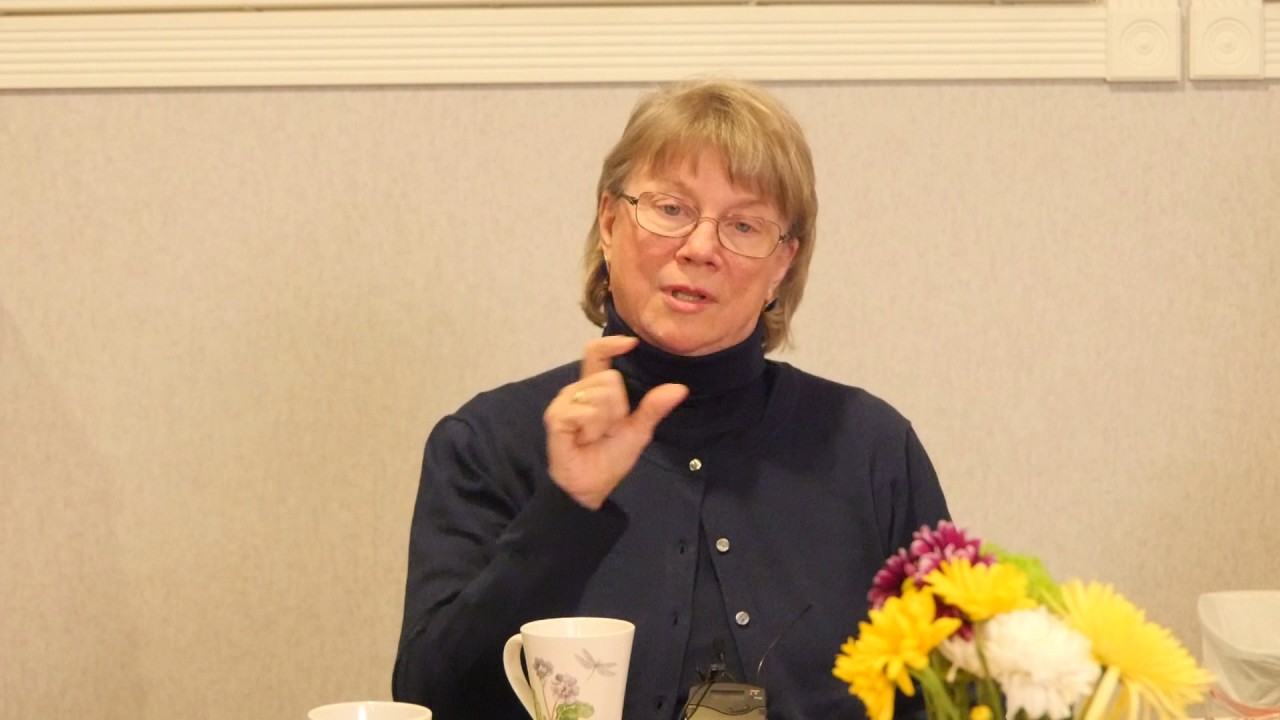
Lydia Compton
Mrs. Lydia Compton's testimony of her life of faith
YouTube · LVFC Office · 31:42 · USA
Testimony video on LVFC Office channel.
My life began in Ohio, in a small town called Franklin — about 6,000 people — and I was there until fourth grade. That's where I first learned about God and creation. My mom was a person who really loved God and really loved creation, and so every Sunday, at least, she would take my brother and me on long walks in nature and point out the names of all the flowers, the birds, the bushes, the trees, everything like that. She shared her heart of love for creation with me and with my little brother, and that was a routine we would do every Sunday after church.
When I was in the fourth grade we moved to Richmond, Indiana, which is a bigger community — maybe 40,000 at that time — and the main thing about my relationship with God at that point developed beyond just creation. I began to hear and learn about God through music. From my early time, there's this one song which we still sing these days that was really deep for me, because I remember it from my childhood. I'm not going to sing the whole song, but just a couple of passages so you know what I'm talking about: "This is my Father's world, and to my listening ears, all nature sings, and round me rings the music of the spheres." That's enough.
That song was sung in West Richmond Friends Meeting House every Sunday when I was a child, growing up in a Quaker meeting. My brother, my mom, and I would sit in the pews, and that song would be sung often. Quaker meetings — I don't know if you know — don't have a single minister, a single pastor; they have a team of people called the elders of the community, and they sit in what's called the facing bench — like this — and everybody else is out here. Out of the silence — there's a lot of silent meditation — people can speak from their own inspirations about God. For me all of that was over my head. I was pretty young, and the main thing that went into me, I think, was the music.
The next stage in my relationship with God came when I went to camp — Girl Scout camp, maybe elementary school age. This time music was part of it too, but this time it was about singing together with people, more like: "Peace of the river, peace I ask of thee, O river, peace, peace, peace." Those kinds of songs touched my heart in those days, and I really felt God when I was young in those ways.
The next stage in my life of development with God came through my relationship with my uncle. My parents were divorced when I was two years old, so I didn't ever really have a father growing up — I just had my uncle, Uncle Bob. Uncle Bob was an administrator for a college; I never really knew his exact position, but he was very smart, very down-to-earth, a very humble man. He and his wife took care of my mother, my brother, and me as family, every weekend, every holiday, every summertime.
He's the one who taught me how to fish — how to put the hooks on, how to put the bait on, how to cast the rod, catch the fish, how to make the fish come in, how to pull them out of the water, how to catch them, how to take them off the hook, how to clean them, scrape them off and cut off the head, how to fillet them, and how to cook them. I learned the whole schmeal when I was maybe nine or ten years old. He was also a geology buff and liked to collect rocks — he bought my brother and me a little tumbler that we could roll the rocks around in until they got smooth and shiny and beautiful, and he taught us about fossils and a lot of things in creation that way.
He also began to teach us about responsibility — about taking responsibility — more than my mom did, because she was so busy taking responsibility herself that she didn't have time to teach us. But he taught us a little bit about it, and in fact he gave me my first job when I was twelve years old. He organized a night school — a predecessor to the community college, before community colleges existed — and every night they would have classes that people had to come to. Obviously coffee is very helpful for keeping people awake in the evenings, so my job was to come in, get the big tub of coffee with the thing in the top, add the water, put the coffee in, and start it up before the classes started every day. I lived across the street from the college, so it was just a quick run across and back — it wasn't that hard, but it was a bit of a challenge for a twelve-year-old.
Responsibility came into my life at that point, and school was going well. I was a pretty good student — not great, not A's, but B's usually. In my whole life in high school I only had one D, and that was in geography, which I feel really funny about now because since then I've been very interested in it. I guess the teacher was just so awful that I couldn't take it in at the time.
From the time I graduated from high school and went to college, basically the next seven years God went underground — and it wasn't his fault. I was giving him too much of a hard time, and so he had to go underground because I couldn't relate to him, and I cut everything off. I asked one of my college professors why I should believe in God, and my professor said, "Well, if there's a God and you believe in him, then great; if there's a God and you don't believe in him, you might have a bad, bad time." But somehow that wasn't a strong enough argument — by that point I didn't think it made much difference. I mean, there's no God, so what's the difference with this whole thing, anyhow? So I decided that God didn't exist, and I just decided that I could do what I wanted to do and proceed with my life that way.
For seven years, roughly, I did what I wanted to do, and God was very much underground. I'm sure he tried in many ways to connect and get me to open my heart and mind to him, but he didn't have much success — I was pretty resistant and pretty determined to do what I wanted to do. Somehow, in spite of myself, after about seven years of wandering around and doing a lot of stupid things and being really irresponsible — doing all the things I knew I wasn't supposed to do, abusing nature, abusing myself, abusing my friends — really in many, many ways not being what God's daughter should be like. I feel a lot of pain about that time, and I'm sure God did as well. It was really pretty clear that Satan invaded and had a lot to say and a lot to do with me for a time — really jerked me around and gave me a lot of pain and difficulties, a lot of depression and confusion and misdirected activities.
But somehow, after all of that, there was a point where I was open to some extent, and I don't know exactly how I got to that place. A friend whom I had met after college wrote me a letter saying that she had found a community — they were growing their own vegetables and giving food, vegetables and fruits, to community centers, the places where homeless people could come and get food. They were doing a lot of good service things, they ran the farm themselves, and they had other businesses. It sounded interesting, so I decided to visit her.
It turned out she was bringing me to the Unification Church in Oakland, California. At that point it was called — I believe — New Education Development, though I'm not sure that was a very long-lived name for the place. Anyway, I joined at that time, went there, and heard Ricky Josvick play with the band and some other guys, heard Dr.
Durst gave his first lecture, and he sold the elephant story—which probably everyone has heard about—all the different ways you can approach the elephant and figure out what it is, and everybody has a different idea. That was intriguing to me. In college I had majored in philosophy, and one of the good things that happened is I got an education. Having that education—especially in philosophy—focused the questions for me about God, about truth, about reality, about what's the meaning of life. But it didn't give any clear answers, at least not any permanent ones, because every new philosopher you heard would contradict the guy who came before, say what was wrong with his argument, and then present his own—and then the next guy coming after would contradict him. It was a continuous back-and-forth for years.
When I left college I had, behind everything else, a kind of intellectual curiosity about what happens next, because I had the whole course of philosophical history up to the present but didn't know what was going to come next. I had gotten depressed about the direction it was going in. Philosophy, up to the 20th century, became more and more atheistic and more and more secular, opening the doors to communism and a lot of negative things. I was getting disappointed in philosophy right around the time I graduated from college, and that didn't help with any of the things I was trying to deal with.
So when I heard the Divine Principle in a very rudimentary form at Oakland—just principles of education, a very simplistic version—it still touched some of the basic things, the basic questions that I had been dealing with. I felt like the answers were there: all the questions that had come up through all the studying I had done and couldn't find answers to—I felt, "Oh, this is it. These are the answers. This follows things through, this carries things into the future, this makes sense." And so I had to stay. My intellect was intrigued, and I was inspired by the people—they were a really nice community, everybody was very nice. My brother says they smiled too much, but I enjoyed it anyway. It was a very good opening for me into the movement.
I guess you could say that God peeked out from his underground position a little bit and began to try to open my heart and open my mind and open me into understanding his love and all the things that he had to offer. But it was a really long process. I joined in August of 1974, and I did a lot of different things, which I'll talk about a little. It wasn't until August or July of 2012—August 2014—when I really fell in love with God.
It was a long course—40 years of basically doing humble, servant-of-servant type work. Most of us in the movement did a lot of that for a long time, so it's nothing unique to me. But when I look back I realized that I was paying indemnity for those seven years, because my attitude had been so bad that I had to pay greater indemnity. As we know in Divine Principle, when you do things with the right sincere heart, God can forgive more easily and you don't have to pay the full price. I might have even been able to connect within a year, within seven months or something, but because my heart was not sincere, God had to ask me to go the longer course.
I think I have an amazing mom—I actually have amazing ancestors and an amazing mom—because I know there's no way, on my own, considering where I was when I met this movement, that I could have stuck with it. I think my mom was praying consistently, and I think there was an incredible foundation among my ancestors to keep me on the path. It was hard. A lot of it is very vague because I think I was coming out from under such a big cloud of darkness that a lot of it I just don't have in my mind. Some things are opening up and I begin to see glimpses back, but a lot of things I don't remember clearly because there was a kind of fog from my fallen life in front of me.
When I finally did find God—in the sense that I finally felt I was kind of back with God the way I had been as a child, a little bit like that feeling—it was when I first saw our True Father. Actually, not just saw him, but was close enough to have an internal connection with him. Most of the time when I was in the movement, whenever we'd go to see True Parents, I would go to the back of the room because I didn't feel I was worthy to sit in front.
I could never understand how people felt so empowered to go sit in front—every week, every time Father spoke, some people just plop themselves right in front. How audacious! How could they sit like that in front of Father every time and not feel any embarrassment or shame about it? I felt, "Oh, I don't have any claim to be that close to Father," so I always was in the back. Consequently, since I was always in the back, I didn't really connect internally with what Father was saying. I could hear it, and I could understand it, and I could believe it, and I could trust it, and I could act on it, and I could accept it completely—but I did not experience anything in my heart from Father at all for many, many years.
When I finally did have the experience, it was in Cheongpyeong in 2012—July 26th—at the end of a workshop. Women's Federation had a workshop and Father had spoken, and then there was an OSDP workshop that I attended right after. I won't forget the date because it's one of the few days that I remember: July 26, 2012. I went to Hoon Dok Hae with Father—the first time I was in a room that was about four times as big as this room. The amazing thing was that there were only about 40 people; each morning Father gave Hoon Dok Hae for about an hour to the people in the OSDP workshop, and there were usually about 40 people in the room each time.
As usual I went to the back—not this far back, but to the back. But Dongwoo Kim's wife, at one point, was talking to another Korean sister; they were sitting together in the front before Father came in. Then she turned around and gestured to me, and I got up and went up front. She gave me a little lap robe and sat me down beside her. Father was about as far away as Reverend Kim—Reverend Duba is now—just that close to me. It was an intimate and very close type of experience.
I can't tell you much of anything that he said. Of course, this was late in Father's life—in fact, the next month is when Father passed, very shortly after I met him for the first time and the first time I felt like I was part of his family. I really felt like maybe I was one of the last people to become a new member of his family, one of the latest babies—but a pretty old baby. He was talking about mathematics and directions—north, south, east, west—and all kinds of things. I'm a fairly smart person, but I couldn't follow what he was doing at all.
I think a lot of people had that kind of problem toward the end when Father was speaking, because a lot of what he was dealing with was probably cosmic, spiritual stuff that is a little bit beyond us earthly beings. But he was interesting, and I was just enthralled to be there, and I felt so much love coming from him. When he spoke I listened very closely, and I didn't take notes—which I usually did, which would make me look down like this and I wouldn't have seen anything or been able to have eye contact with him. So I actually looked at him, and I could see his eyes, and I could communicate internally with him. I could feel his love as a parent towards me, and it was a really precious, precious moment.
But I don't think I really understood about God so much even in that moment. I think it was about Father, but it wasn't so much about God—we hadn't made the connection yet. When Father left the room—well, first he was sitting there, and Mother was right next to him. I wasn't really paying so much attention to Mother, but I was aware of her. At one point one of the grandchildren, a little boy, was on Father's lap for a while, and then he got off and was running around, trying to go underneath the table where Father was sitting, and Mother got up from her seat and went around and picked him up and took him back to—
She took the little boy to the back of the room and gave him to one of the nannies. I had the feeling she was a little bit annoyed that they had let him be in there loose with Father with nobody there to watch him—that she had to get up and go take care of it herself. But she didn't say she was annoyed; I just felt she should have been, because she shouldn't have had to do that. It was very motherly, and I appreciated it. I felt like Father was so old that it might not have been good for him to have a little boy crawling around under his legs anyway.
Father finished speaking and was sitting there, ready to leave. Two big men came to help him get up and walk out of the room, but he said no to both of them and got himself up from the table—though they did help him out of the room and held him as he went. What was really funny was that when he got almost to the door, he turned around and spat, and the spittle landed on me and a couple of other people. What a treat—the Messiah's spittle. An amazing experience. That was the beginning of my relationship with God through our True Father.
For the next couple of years I was floating a little bit in that experience. I would bring it back to my mind and keep myself lifted up just by remembering it. One thing I hadn't told you about my family was that they were very patriotic—extremely patriotic. In 1964 I worked for Barry Goldwater running for president, which was a very conservative, very Republican, very pro-American type of campaign. I went door to door putting out flyers and leaflets as a high school junior. Then, as I said, when I went to college my perspective changed, and I worked for Eugene McCarthy—the other side of the spectrum entirely.
That was a crazy year. James told us in his testimony about his experiences in Vietnam while I was on the other side, trying to get us out of there. That year was maybe even crazier than this year politically, with all the changes in candidates and everything that was going on. Robert Kennedy was assassinated, and none of the original players ended up being the ones elected in the end. It was Hubert Humphrey—who wasn't even one of the original candidates—who ended up being the one elected. A crazy year. But the patriotism I had ran through both ends of that political spectrum. I felt I was working for America whether I was doing one or the other—I want America to be great.
So when the God's Hope for America tour was announced in 2014, my patriotic ancestors and my patriotic spirit became so intense that I begged and pushed and cajoled until my husband finally said yes—you can go, and we'll figure out how to help pay for it. They made the arrangements, and I was able to join the tour not from the beginning but in Florida, and travel with it all the way through to Minnesota—basically three weeks. Those three weeks were a time when my relationship with God was deepening, and I was beginning to fall more and more in love with God and to realize how he had been working in my life and what role I might have to play.
Bishop Kim brought a quote into the mix that has stayed with me: "America is God's hope for the world." We were talking about God's hope for America—how can we make America great—but he brought that larger vision in, and it made me realize that America has an amazing, huge role and responsibility in fulfilling what God needs at this time. The Kingdom can't happen unless all people are part of it. We have so much wealth, so much blessing in this country—so much ability, so much talent. Everything this country has, including the education system, is so much more than anywhere else in the world. Even Europe, I think, is too broken up into compartments to do what this country can do. I became really acutely and intensely passionate about that part of our providential role through those three weeks on the tour.
Every day we would get on the bus at eight in the morning and not get off until eight at night, stopping periodically at different places for rallies—singing "God Bless America" and a few other songs, offering prayers, and hearing short talks, one or two stops a day, all around the country. Sangmood was there teaching us all Korean, which was very helpful. Mike Balcombe was an amazing leader, teacher, and guide throughout that time—truly like a father for the bus. He took care of everyone, guided things very well, and was always ready to come out of the bus and greet each new community we came into.
After a while they started doing this thing where they rolled out a red carpet from the bus, and we would all come out onto it and into the midst of the people gathered there, joining them for the prayer and the music. All of these stops were at holy grounds that Father had created in 1965. I believe he also came here to Las Vegas, but that was before I joined the tour so I didn't experience that part. Over 21 days we visited many, many holy grounds: one at the Capitol, Danbury, Plymouth Rock, Niagara Falls—so many places around the country, stopping to pray at each one.
My American ancestors are very passionate and patriotic, and I'm sure they were inspired the whole time—right there on my shoulders saying, "Yes, this is great!" and pushing us forward. I really felt a lot of inspiration and hopefulness and wisdom, thinking about what we were trying to do. I felt like we were waking up the spirit that Father had planted when he put the rocks in the ground at all those holy grounds around the country—touching that spirit and bringing the flames up again, so that America as a nation could rise up and take its role and responsibility as a providential nation the way it's supposed to.
That was in 2014. It was also around this time that I finally had a chance to work a little while alongside my husband, after being married and Blessed together for many years. We had received the Blessing in 1982 at the Madison Square Garden Blessing. He is a fundamentalist Moonie and has always been extremely passionate about doing his mission. We had four kids, and so much of the time our paths in the daytime didn't intersect very much—late at night and early morning, yes, but in between it was separate course.
What has happened here in Las Vegas is that we've actually had a chance to become husband and wife—kind of in reverse order. Normally people come together as a couple before they start having their family, but in our case it was the reverse: we were together, but we weren't really together very much of the time. So now we're beginning to get to know all of our annoying points, which is great fun. We're in Las Vegas, and everything that happens in Las Vegas stays in Las Vegas, right?
God is really amazing and very precise. His love is very precise—not general. People often talk about the embrace of God's love, and that's there, but God's love is also very particular: each person loved in their own particular way, given the particular experience they need in order to grow. In my experience there were so many times when things could have gone one way or the other, and yet somehow God knew exactly how to make sure I did the right thing—how to get me past whatever barrier or obstacle was keeping me from growing.
I don't want to say my job is finished, or that I've completed my role, or that my growth is over—nothing like that. But I do feel like I've come to a new plateau in my life. This is a time for me to grow and expand on what I've already reached. I don't have to climb the ladder as intensely as I did before, but I do have—
Of course, to keep trying — one step in front of the other, to keep going, to do what God needs. And that's what I'm about now.
Reflections about this person
Reflections are anonymous unless you put your name in. Every submission is reviewed before it appears.
Loading reflections…