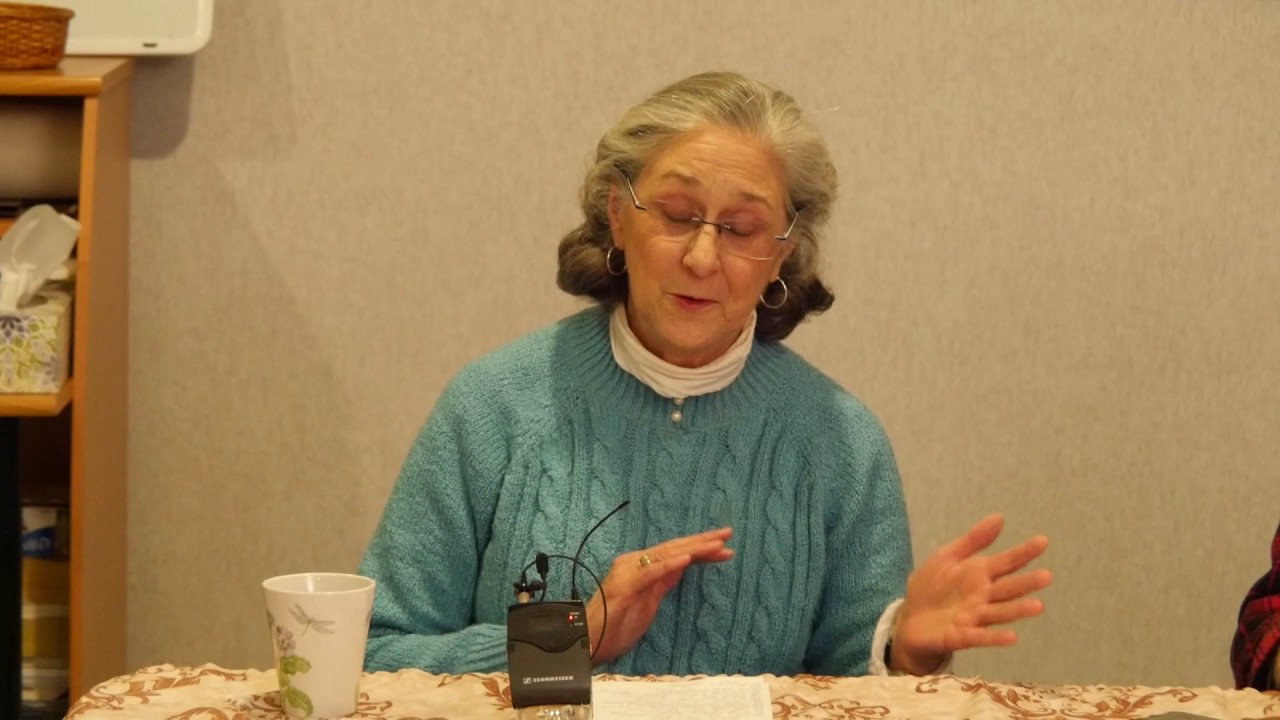
Leslie Rigney
The story of Mrs. Leslie Rigney's life of faith
YouTube · LVFC Office · 1:01:17 · USA
Testimony video on LVFC Office channel.
My life started in Boston, primarily. My father was a Boston Blueblood, and my mother was from Pioneer stock. She was educated—she had her college degree, her mother had a college degree, and her aunt did. They were very educated people. My father was well-educated too, but he had a great love for the ocean. He was a marine biologist, and he taught at Harvard, even though he only had an undergraduate degree. On my father's side, the ancestors came from the Mayflower. The direct ancestor came on the second Mayflower, and the ancestor's brother came on the first Mayflower.
On his father's side, the first ancestor came in 1628 to Salem to fish. He also helped in the American Revolution—helped to get Washington across the Delaware, and many things. So it was rooted in America. My mother's family, part of them came in the early 1700s, and others came in the mid-1800s. They were all Pioneers, and they had very close family ties. I was born with a silver spoon in my mouth—I still have the silver spoon. Our family had a lot of challenges, though. They say that bluebloods have a problem with alcohol, mental illness, and politeness, but I would add hubris too. Although my father was very humble in many ways, there was a lot of pride.
We first lived in Cambridge, Massachusetts, and we went to the Episcopal Church. I still remember it—the incense and the nuns—and it was always a very positive experience for me. Then when I was five and a half, we moved to the countryside, 20 miles west into a 17-room house that was surrounded by country. It was a really beautiful garden. I spent so much time outdoors. I had an older brother, a younger sister, and a younger brother—four of us. We were pretty much free in one sense, although there were a lot of expectations of us.
My parents had parties. We had to dress up, serve the hors d'oeuvres, say "How do you do?", curtsy—there was a lot expected of us. We had to go to private schools and work very hard. I remember doing about five hours of homework every night. But significant for me in my religious life was that when we moved to the country, we belonged to a Unitarian Church. Our minister really loved Jesus, and he really loved God, so I really learned that God is love. I remember looking out the windows in the Unitarian Church—which are always clear. I see the beautiful sky and the clouds. I could just really feel God is love. You can see Him in the creation, and I just really loved nature.
When I was 10 years old, I had a very deep experience. My uncle was in California with his family, doing construction work, and he just decided he had had enough. He said, "Okay, I'm selling the house. I'm buying a boat. You can come with me or not." So he bought a 60-foot schooner, and his wife and three children got on the boat—the two-year-old had to be on a rope at all times. They sailed down through the Panama Canal, and then they came up to where we lived in Massachusetts and took us out on the boat.
In the front of the boat was a very long wood where the jib is attached—the small sail in the front. In order to man the sail in rough weather, there was a net underneath for security. My parents let us do pretty much a lot of things, so I was lying there on my stomach in the net, looking down at the ocean, and I just felt God's heart. It was so profound. I really felt, oh, God is really alive, and I can feel His heart—I felt His heart in the ocean. It was a very deep experience for me. As Unitarians, in our home, we really didn't speak about God at all. We didn't do any studies or anything.
One time when I was 12—we would go skiing a lot with other families—there was one lady who lost the back of her earring, a very tiny piece, in a shag carpet. She said, "Oh, it's no problem. I'll pray to St. Anthony. He'll help me." She prayed to St. Anthony, and right away she found it. I was so amazed. I thought, oh my gosh, the saints are really quite active. That was also significant to me—beginning to understand about the spiritual world.
Then life went on. My parents had a divorce, and I was very heartbroken by that. I left my father, I left my mother, and we had to move out of the house we were in. The life I was heading toward looked like it was not going to happen. It was like a dark curtain came over my future, and I couldn't see it. Then I had a dream—a dream of the house I was going to live in when I grew up. It was this beautiful house. After I saw that, I felt, okay, it's going to be okay.
Then the high school years went by, and it was all about fitting in, all about being popular—which I really wasn't, but I tried, like everybody else. I went to an all-girls school, and there was just a lot of demand academically. Finally, there were the debutante parties. I remember being presented to Boston Society at the debutante cotillion, and I went to many friends' debutante parties. But around the same time, one of my best friends was killed in an auto accident on Cape Cod. It was really, really difficult to take in all this blitz and think that she had died. I didn't really feel comfortable in that environment.
I took a year off from school. I had been going to go to Washington University—I had a roommate and everything, and they even asked me to join the fraternity because they didn't understand my name was actually a girl's name. I took the year off instead and tried nursing. I was curious about nursing, whether I'd like it, and I really loved it. I realized that was what I wanted to do. I was really blessed that way. I had a lot of criticism—people thought I should be a doctor, not a nurse—but I wanted to be a nurse.
Then I did other things. I went moose hunting in Newfoundland and got a moose. Then I went to Kentucky to work for the Frontier Nursing Service—in eastern Kentucky, in the hills. The nurses are on horseback, going to homes and doing deliveries, taking care of people. They have nursing centers too, and people come to them. It was a total life-changing experience—the culture was so different. During this time I had also been doing a lot of studying about religions. I was reading the Bhagavad Gita, reading about Buddha, reading the Book of Mormon, and really trying to understand things—reading the Bible too.
When I got to Kentucky, people would have prayer meetings in their homes. You'd go up there and they'd sing songs without any guitar or piano, and they'd pray. Then I went to the Baptist Church, and people just had such a faith in Jesus. I thought, well, that's interesting. Our teaching in Unitarianism was just, well, he's Jesus, he's the Son of God—it wasn't like he IS the Son of God. To me it was just amazing. I thought, wow, maybe I could believe the same way these people do. I was so impressed. I had an incredible experience.
One night—typical story—there was a lightning storm outside. I couldn't sleep, and I saw some kind of vision on the hillside. From that moment, I was totally changed. It was like before I had been seeing in black and white, and now I was seeing in color. I felt Jesus was with me, and he was my older brother, and he was there with me all the time. One of my jobs was taking care of six horses and a mule. The mule had been very stubborn and very uncooperative, but after this experience he was so cooperative. I thought, wow, I can talk to the animals too—it was such an experience.
The people who were Christians recognized that I had had this experience—I didn't say anything, and they recognized it. There was such a communication among the people there. It was very profound. I was due to come back home when I got into a really bad accident. I was driving too fast—I love to drive fast. I was going about 70 miles an hour on the straight, and I must have been daydreaming, because I was thinking about God. I was thinking about how beautiful it is to be with God, and yet the world is so miserable. I thought, well, if God really wants me, I'll stay here and continue. It was right around then that I hit the curb, and I was thrown out of the Jeep.
The Jeep went over and down the ravine about four times. It took about an hour and a half before anyone figured out that I wasn't coming home. Somebody called up: "Your Jeep is down in the valley here." I broke my back. It took me about a day and a half to wake up. Still, I didn't feel any pain. I was with Jesus, and the sisters were there. It was such a profound experience. Then my mother came and picked me up. I went home and had quite an experience at home, because my family is very atheist. One thing, another.
I did get to nursing school that fall, and I was baptized in the Church of Christ, which was a very deep experience for me. My father came for the ceremony. I really felt that I was God's daughter. They say when you change perception of yourself, then other people's perception of you changes. Although I never had any leadership position in high school—there were only 45 people in our class, so there was opportunity there—I never had any leadership. I had all kinds of leadership at nursing school. They wanted me vice president. They wanted me head of the glee club. They wanted me to go and represent them at a nursing school convention—a student nurse convention. It was like my life was totally different. Every morning I'd get up at five and go around the pond and meditate and pray, study the Bible. It was a very wonderful time for me.
Then a year after I started nursing school, my father suddenly died. I was very close to my father. I was actually going to go live with him—he had a new wife, a very nice lady, and I liked her a lot. It was just an incredible shock to me. It was like the rug was totally pulled out, so I couldn't stay in school. I had to drop out of school. I had a very difficult time for many months. Finally, I had to go and live with my mother for a while.
I actually made a conscious decision to stop believing in God because it would have been too much stress to go into my mother's home and still believe. I made that conscious decision. After that, I went to nursing school. It was just a different life altogether—all about doing well in school, getting to know some friends, dating, whatever. In one sense, I learned more about communicating. When I was really into this early Christianity, everything was black and white—it was either good or evil, either God or Satan. I must have been, in one way, hard to live with. This way, I became more rounded. I started to be able to relate to people, really where they were.
After nursing school, I took a job in a hospital for mentally disturbed children. After three months, they made me head nurse on that floor. That was interesting. After a year and a half, I had enough of that—all the nurses burned out after a year and a half, it was so intense. Then I went back to school. I went to Boston University and got my degree in nursing. When I had been in Kentucky, I realized I wanted to be a midwife—a nurse midwife. But I didn't want to go to school in Kentucky.
One day I was up on a ski trip. I was in line talking with this guy—he was a doctor, actually an obstetrician. He was talking about my interest in midwifery. "Oh, I know," he said. "There's a school down in Brooklyn. You can go there." I came back. My best friend and I, we both looked into it. We both applied. We thought, well, here it's May—we're not going to be getting into school. We'll do something together for a year, then we'll go. One day I got a phone call: they didn't have any more room in the dormitory, but could I come? I said, "Oh, sure. No problem." Then I said, "But when?" They said this year—which was one month from then. So I packed everything up and went off. My friend didn't get in, but she went to Scotland to another school. I went to Brooklyn.
Then I was living by myself, which was the first time I'd really lived by myself since nursing school. I realized I had everything I wanted in my life. I was comfortable relating to people. I was in midwifery school. I had a little sports car. Everything was all wrapped up. But it wasn't quite right. There was something missing. I realized I had lost my God. I had lost my God. I said, "Oh, my gosh. I've got to find him again."
I started to go to churches in Manhattan. The churches were either very spiritual but then they didn't make sense, or they made a lot of sense but they weren't very spiritual. No one was witnessing in Brooklyn or anywhere in New York except up north in the Bronx where the center was, so there had to be some other way for me to hear about the church. What happened was my classmate had a good friend—there were only twelve of us in the class, and she and I used to go swimming every day. She told me one day, "Oh, Leslie, a friend of mine is visiting from France—she just came back. She met this religious group there that sounded really interesting. They're out to change the world." I said, "Oh, I'm from Boston. Everyone's out to change the world." I wasn't looking for that.
Anyway, this friend stayed with her. My friend's roommate, who was also a classmate, was a Catholic nun—an older lady, forty at the time. She was very interested in what this girl had to say. Then she started going after me: "Oh, Leslie, let's go up to Unification sometime." I said, "Later, later." Finally, I'd given up on all the churches in Manhattan. There was one that I really liked—Calvary Baptist—I was going there, trying to study. But my mind couldn't bend the way they were expecting people to bend their minds in their teaching. It just didn't make sense. I said, "Okay, Sister Olivia, let's go."
We got in my car, a little MG. She had her habit on—quite a colorful outfit. We drove up; it took about an hour and a half. It wasn't around the corner. It was just a very beautiful house, a lovely house. People were so nice. They were all young, young students. They taught us the principles of creation. I was so enthralled. I said, "Oh my gosh, this is fabulous. It makes so much sense." I was so excited. She liked it too. We decided we'd come back.
They weren't having any workshops because Philip Burley had just come there as the center director. He had been the president of our church. He was sent to New York because Father wanted him to find a training center—he's very spiritual, and I think Father realized he was going to find it. Farley Jones was sent down to be the church president, and Philip was too busy to do any workshops. We had to go twice a week to hear a chapter—back on Wednesday night and then on Sunday. The twelve chapters took six weeks.
At one point, Philip said, "Why don't you go down to Washington, D.C. and meet the church down there?" They were a slightly older group—all students, pretty much student dropouts. I said okay and went down. While I was there, Philip came down because he had something to show Farley Jones: this property that he had found. He had been looking in Manhattan and had found something on West 43rd Street, but it was much too big and too expensive for what we could possibly afford then. Father said to look along the Hudson. He found Belvedere. He showed me the brochure. I said, "Oh my gosh, that's the house I dreamed about when I was fourteen." I was so amazed—and he was amazed too. Anyway, there's a whole story of how we got Belvedere that would take a whole other time.
Then we got Belvedere, and True Parents were coming. Meanwhile, I was working as a midwife in Brooklyn, getting an internship, getting practice delivering babies. I stayed a couple of days at my instructor's house—Wesley Samuel's house. On the weekends, I'd go up to the center in the South Bronx. That was my life for the whole summer.
Then we were fundraising for Belvedere, but I was a terrible fundraiser in the beginning. I worked seven days a week, twelve hours a day. It was an easy job—I was taking care of this one lady who had been one of the original Rockettes, and her boyfriend was a psychiatrist who wanted to make sure she had everything she needed. I just was with her all day and we had a great time.
Anyway, True Parents came at the time of the science conference—the first science conference. They flew in and went directly to it. This was phenomenal. To me, it was so exciting, the idea of science and religion coming together. My father had died, and I wished he could see this day because I knew he would have liked it. I didn't know much of anything about how you treat True Parents, how you greet them or anything. Ms.
Ms. Kim is coming down the hallway with Mrs. J., and True Father and Mother are also in the group. I run up to Ms. Kim and say, "Ms. Kim, can I meet Father? Can I meet him?" She brought me over to Father. I said, "How are you doing?" and shook his hand. That was really, really exciting. Ms. Kim said something to Father — I didn't think to ask her what she said. Then True Father and Mother are sitting there; they had just gotten in from Korea and must have had some heavy jet lag. I remember bringing them water — it was very special. That was the first time I met True Parents.
Later, we all went out to Belvedere — True Parents lived in Belvedere at first, before we got East Garden. Father had us all come into the living room. I still have a picture of what Father and Mother looked like then. Mother didn't look very good; apparently she was so sad leaving her children — she had just had a miscarriage, and she had actually had many miscarriages. She came and was there with us. But Father was very bright, just smiling so brightly.
Thinking back now — here he comes all the way from Korea to America, into this room with about 25 young people. For the most part, people had not graduated from college; we're talking about 18, 19, 20-year-olds. I thought, what is Father thinking? There's so much he has to do, and this is such a small group of people. I remember Father asking, "Who has a college degree?" Three of us raised our hands — "Okay, you're in charge of witnessing." I said, "Father, I have a job." He asked, "Who makes more than $1,000 a month?" — I think I was the only one who raised my hand. "Okay," he said, "you keep your job."
The next many months were quite interesting. I had to get up at 5 o'clock in the morning to take three subways to work, come home, then go out witnessing to different clubs and people available in the evening. Joe Tully came to take over from Philip Burley, who had been transferred to Colorado, and the first twelve Japanese brothers arrived — they were trying to learn English and each had their little cubbyhole to study in. There was some friction there. Joe Tully became center director and would say things like, "The sisters should iron the brothers' shirts" — he'd been in Korea, and I don't know what happened there to give him that idea. So there I am, up at 2 o'clock in the morning ironing some brother's shirt while he's sleeping. It was okay; I felt that was the right thing to do.
I was getting up at 5 o'clock in the morning to go to work and sometimes falling asleep while sitting with a woman in labor — it was an experience, I'll say. One time the head nurse called out, "Hey, Foster, you better wake up and check that lady!" She had barely delivered; we just barely got her into the delivery room on time. It was terrible. There are many stories like that.
Finally, it was a burnout situation. I had a meeting with Reverend Kamiyama and Joe Tully — apparently Reverend Kamiyama's sister was a midwife — and he said, "My sister needs a lot of sleep. Maybe you should just take a nap during the day, go someplace where no one's looking, some closet or something." There were triple bunk beds and I was on top, so nobody would have seen me. But I didn't feel I could do that; I was really gung-ho. After many months, though, I was burning out — it was just a little too much.
Reverend Kamiyama said, "Okay, I want you to quit your job." I said, "Quit my job?" He said, "This is really serious — tomorrow." "Tomorrow?" My boss was head of the American College of Nurse Midwives, for one thing, and in charge of ten different hospital midwifery services in New York City, for another — and she had tried for years to get the position I had, because there were only two midwives at that hospital. I thought, this isn't going to be good. But I followed what he said, and I did it — in three days. I was never forgotten in the whole annals of midwifery in America. The midwife became a Moonie.
Reverend Kamiyama wanted me to go to Washington, D.C. to witness to politicians, but it just felt like that wasn't the right thing for me to do right then. I had gotten rather spiritually open, which was not a very comfortable thing to be in New York City. I talked to David Kim, who was at Belvedere, and he said, "Why don't you go to Colorado?" So I went to Colorado. But I want to say something about True Parents during that time in New York.
A lot of members were coming in, there was a lot of witnessing happening, and True Parents would come down to New York quite a bit. I remember Father would come and call everyone in the house to come up and meet him — but there would be just a handful of people, because everybody was out witnessing. Maybe a cook, or someone spiritually open who was doing things around the house. Father would be there and say, "Well, do you have any questions?" He was just like a father, answering questions to the children.
I think of it now — what must he have been going through internally, with his hope for America. This is the same time he was talking about America as God's hope; he gave many speeches on it, and if you look at the early speeches he gave when he first came to America — I think back and ask, how could he have had such hope? But then it became wonderful. The Europeans came, the Japanese came, we had J-House and Belvedere. The Japanese did fundraising and showed us how to fundraise. It was a really wonderful, wonderful time.
Going to Colorado, the experience I had with True Parents there was quite something. It was a Day of Hope tour, and Father and Mother came — I just wanted to see them; I didn't care about anything else. Everybody went down to Denver, and I just stayed where I was. There was a pond, and I was across from it, and I saw Father, Mother, and Mrs. Che walking. It was as if the whole creation was in this incredible feeling of harmony — I can't describe it, such a beautiful feeling of harmony around True Parents. It came through this kind of spiritual openness I was experiencing, and it was just such a wonderful thing. I sometimes remember that and think, this is how God wanted us to be with the creation.
I pulled myself together eventually and went back on the Day of Hope tour and had some really wonderful experiences through that. Then we were fundraising for Yankee Stadium, and I was on a trailer team — two vans and two RVs, one set for brothers and one for sisters. Every day we went to a new city; they'd drive all night while we slept in the van, then we'd stay a couple of days in some RV park and fundraise. We went back and forth across North Carolina. It was a really amazing experience.
As Yankee Stadium drew near, I realized while fundraising that I really wanted to go to the seminary. The first class had already started. I had been at Barrytown for the 120-day training after the Day of Hope tour and had helped set up the infirmary for the students. I stayed up all night one night, made my application, sent it in, and was accepted into the second class. But what happened was that Father wanted to bless three of us sisters who were in our 30s, so he pulled us out — we didn't go to the seminary after all.
I thought, okay, he wants us to go to the Blessing — and that's good, because I had been feeling that I had to go to the Blessing or I wouldn't be able to work. My work was so connected to obstetrics and the family. I was doing a seven-day fast to prepare, studying, working in the infirmary, and all these things were happening at once. Then one day I was in the car with a few of the older blessed sisters, and they said, "Oh yeah, Father's going to have a Blessing."
I'm driving, right? So I said, oh, my gosh. So, all right. So then I did another seven-day fast, and then Father started to call people down to Belvedere. He's calling this group of people, and he's calling that group. Every day I'm going to see Mrs. Stewart — Mrs. Stewart, did Father call me yet? No, no, no, I'll remind David Kim. Mrs. Stewart, did Father call you yet? What's going on? And so anyway, I'm going through this — one day, two day, three day, four day.
Finally, I'm in the infirmary. I'm talking with David Fistigi about health food or something. And the phone rings. So I pick up the phone, and it's Colonel Park. And I say, hello. And he says, hello, this is Colonel Park. I said, yes, I recognize the voice. Are you okay there, Leslie? Yes, I'm fine. Well, Father would like to speak with you. I said, really? I said, oh, okay. And so Father comes on the phone. He says, well, Leslie, you want to be married? And I said, yes, Father, if it's okay with you.
Then he said, well, do you care if your husband is educated? Now, you have to know I grew up with all the preppies you could ever want, and all the educated people you could ever want to be with. And I was not interested in this group of people because they didn't have heart and they didn't have spirit. And so that didn't matter to me. I mean, it was later that I realized there is a difference. But it didn't matter to me at the time. I said, no, Father, that's okay. He said, okay, well, can you come down here? I said, yes, Father.
So I hung up the phone. I said, David, what shall I wear? He said, you better wear the best thing you've got. So I just tore down there and I went to get a car. And they said, oh, I'm sorry, there's no cars available. So someone took me to the train. I got off at the wrong station. Anyway, finally I got there. And apparently, I don't know, Father just waited until I got there. He didn't do any of the blessings until I got there.
So anyway, I walked in the room. Father's sitting in the chair. Mother's there. David Kim is there next to Father. Mr. Kamiyama. And Father says, sit right down here. So he had me sit right down next to Mr. Kamiyama. Maybe I was three feet away from Father. And so Father's saying, oh, and how are you? He's really trying to butter me up. I'm fine, Father. Anyway, on my way down, I'm thinking, okay, what do I want for the Blessing? It wasn't that I hadn't thought about it. It wasn't that I hadn't had conversations. Everybody said, Father's first choice is always the best. So that was in my mind. And so I'm thinking, someone that knows Father, that really has a relationship with him, someone who has faith, someone who can really articulate the message. These are the kinds of things going through my mind.
So then Father says, okay, now do you care if your husband's educated or not? So I said, oh, same question. No, no, that's okay, Father. He says, okay. And then he asked a few other things, remember? And he said, do you want Korean, American, or Middle Eastern? And I thought, Middle Eastern? I couldn't even think of any Middle Eastern brothers. I mean, the church wasn't very big then.
There's a whole story I didn't even tell you, which is really the best story, and I will tell it if there's still time. But the previous summer I had been in Father's house, and Phyllis Kim said to me, oh, Father is looking for a wife for Spiro. Spiro Olivas was on Father's boat. He was one of the first mates on Father's boat. And he and I joined the church at the same time, and he was a tough customer. I thought, oh, she's going to have a terrible time, or she's going to have the time of her life — yikes, Father's looking for an American wife. That made it the furthest thing from my mind that that would be me.
So then Father says, okay, I've chosen someone for you. He's the first mate on the New Hope. And I said, oh, Spiro! And Mr. Kamiyama says, no! I just was totally flabbergasted. I mean, you have to know that you couldn't find two more opposite people if you beat the bushes from here to Kingdom Come. You just couldn't find two more opposite people. So anyway, I remember I said, your Father's first choice is the best one. So we went back into the room.
He had a terrible headache, so he's going to say yes to anyone. And he had just met me again because he was asking about his sister who was a dentist and could she come to America. And he was thinking, boy, this sister looks really bad, she looks really wiped out. But then he thought I didn't look so bad that day. And then we didn't really have any idea what to say. But we said, well, what do you think? I said, well, I guess it has to be yes.
So we went back in, and my spiritual mother's there, going like this. I didn't even see her. So I just ignored that. I mean, if I had seen her, I don't know what I would have done. But anyway, we bowed, and that was on a Friday. And then Saturday we had our engagement ceremony. And I was realizing, well, this is interesting. I've always loved the ocean, and he's connected to the ocean.
My absolute favorite story when I was growing up was Kokilo. Kokilo was about a little boy that lived on an island, and he had a donkey. Well, Spiro, when he was a little boy, he lived on an island, and he had a donkey. And this young girl with her uncle came to visit — this rich girl with her uncle came to visit the little boy and the donkey. That was my absolute favorite story. Well, this was our story.
So it was fairytale-ish, and I guess I felt up for the challenge, and I respected him. He seemed to have a lot of depth to him, and I know he loved Father. So anyway, it was really the challenge of my life. And it could have worked out. Father knew best, and it could have worked. But there were some conditions that weren't met by me and weren't met by him, so it didn't work out. But it could have worked out. And if I had to go back to do it again, I know I could have made it work out. But anyway, it was an adventure.
But I want to tell you about the story that happened before that. After Yankee Stadium, we went back out fundraising. I was sent to Pittsburgh, which was supposed to be an indemnity city because there had been so many bad conditions about fundraising. People had been lying all the time — oh, we're raising money for drug rehab or whatever they were saying. And so people were fed up with Moonies because they'd been lying all the time. So we determined that we were just going to tell the truth. We were only going to go where we could get permits.
And we were going to have a button with Father's picture, and we were going to have our Unification Church membership badge. And we would tell people, I'm Unification Church, and I'm fundraising for our work. Anyway, we were doing barn-to-barn fundraising because that's the only place we could get any permits. And we had a lot of adventures. It was quite something. And then I was thinking, Mother's going to have a baby soon. And I thought that she was going to be having caesareans for some reason.
And I thought, there really needs to be someone in that operating room because I know how they talk in operating rooms. It's terrible the way they talk when they think the patient's asleep, which in those days the patients were asleep for the most part. So I called someone. I said, I think you'd better get Dr. Bergman, and you get him to be there when Mother has her baby. So I don't know where that went. Anyway, I get this phone call, and I think it was Lady Dr. Kim, and she said, Leslie, do you still have your nursing license in New York? I said, yes. Oh, because we need to have someone come and be with Mother in the hospital. Can you come? And I thought, oh my God. I said, okay.
So I went, and it was supposed to be all hush-hush. They had me stay at Belvedere, and no one was supposed to know why I was there. Mother typically would go over her due date — really over her due date, almost four weeks over. So I don't know. Somebody was counting wrong. So I was there, and every day I'd go up to Lady Dr. Kim's room, and we would pray and prepare. And one day I got locked out of Agora House.
And if anyone knows Agora House, there are these wells by the windows. So I was realizing, oh, that window is open. I can climb in that window. And then the thought came to me that, well, you have to be careful, Leslie, because you might fall down into the well. So I said, I'm not going to fall down in the well. So then I'm going to the window, and honest to God, something pushed me. I'm not kidding. Something pushed me down, and I went, and landed flat on my back in the well. It was okay.
I got up, and the wind got knocked out of me. I went and told Lady Dr. Kim what happened. She said, "Oh, you've got to be careful — it was really a spiritual battle." I really respect anyone who is with True Parents, because it is a spiritual battle, and the spirit world around is something else. I learned from that. But later, when Jungtunim — remember, they said he fell off — I remembered that. I said, no, he didn't fall. He was pushed. He was pushed by a spirit, and that's what I believe happened to him. I really believe that because of my experience.
Anyway, day after day after day, I'm waiting, and then finally someone said, "Leslie, why don't you just come play tennis with us? You never play tennis. Come and get out of there and just do something." So I went out and played tennis. And then, okay — we're on our way to pick you up. I said, oh my God, I've got to take a shower at least. So they were waiting for me, and I came out, and we got in the car.
The problem was the hospital was not cooperative. They would only let someone in with a patient if there was a nurse. I think even in those days, they wouldn't let the husband in, and they certainly wouldn't let Mrs. Che in to be with Mother when she was in labor. Mother's doctor was wonderful — a wonderful lady. But as it turned out, by the time we got there, no one else was in labor, no one else was there. So the doctor was able to talk the nurses into what she insisted — that Mrs. Che be with Mother during the labor.
I don't know how I'd have been with True Mother in labor — I've been with a lot of people in labor, but that was a little bit over the top. I was really glad Mrs. Che was with Mother. And Sun Jin Nim was born. She was born between Yankee Stadium and Washington Monument. What does that tell you about Sun Jin Nim? Very, very amazing. And she was such a beautiful baby. This is the height of persecution, and they wanted someone in the room with Mother — Michael McDivitt was outside, but they wanted someone in the room because they didn't want anything to happen to Mother.
I was in the room with Mother. Sun Jin Nim was so beautiful, and all the nurses' hearts melted when they saw her. And of course then they saw Mother's chart — "Oh my God, this woman's been through so many deliveries, and yet she's so beautiful." And then they realized she must be really loved, that her husband must love her so much. Between Mother and the baby, it really turned people's hearts. And I was so impressed by Mother.
You have to understand — I gave up my midwifery to join the church. Not right away, but I did, and it really was hard. I wanted to do that for ten years. But because I wanted to understand what a real loving family was, I got my answer. I got this chance to be with True Parents with their baby, to see what a loving family is. It really answered my prayer. It was amazing.
Mother was exhausted, so she was just sleeping all the time. But then every day the entourage would come in — Dr. Bo Hi Pak, Hyoil Kim, this whole entourage. And Mother would just get up, wide awake, talking with people, animated, listening to all they had to say. And as soon as I left, right away she went back to sleep again — except when Father called. Father was fishing in Gloucester. When Father called, Mother just woke up and she was so happy, talking, talking, talking, talking. She was so happy. It was so beautiful to see.
We were there for three days, and then Father came to pick up Mother. He came in the room, and Lady Dr. Kim told me, "Well, you're not supposed to, but take some pictures." So I got some pictures of Father and Mother and Sun Jin Nim — Father had to put on the gown and everything. I still have it. He and Mother are holding the baby, which is so beautiful. I just felt so much love. I could feel that Mother's heart was not just for Sun Jin Nim but for all the children of the world. Her heart is just so big. It was such an incredible experience.
Then we were getting ready to leave. Mother gave me three $20 bills. She told me, "I want you to give this money to this person, this person, this person" — she had them picked out. One was a nursery nurse who was so loving to Sun Jin Nim. Another was the cleaning lady who wanted to learn how to say good morning in Korean. And the third one — I can't remember who it was, but they were all special people to Mother. So I stayed back and gave them the $20.
Then Father came out. He was holding Sun Jin Nim — he was so happy, so proud. Mother was in the wheelchair. The head nurse comes out: "Oh, you can't be holding the baby. She has to hold the baby." I said, "You know who you're talking to?" And I thought, oh my God. But it's like what I heard someone say yesterday — Father had no defensiveness in him, no anger and no defensiveness. He just said, "Oh, of course." And I said, Wow, that's the dominion of love. That's what it really is. Because anyone else being spoken to like that would get their feathers up. But Father was just really on top of it. It was just so incredible.
Afterwards, I had a chance to go to East Garden for a few days to help take care of Sun Jin Nim during the day. Nami Onuke was helping Mother recover, and then she was going to take over. So I was just there for a few days. I really wanted to stay at East Garden, but Father said, "We're in the middle of the Washington Monument campaign and I can't keep you here." So it was back to Barrytown. I ended up taking care of people who couldn't really survive in Washington, D.C.
There was one scene where Mother bottle-fed the babies — not because she wanted to or thought that was the best thing to do, but because she had to have so many children and it was too draining for her to breastfeed. But this one time, she was letting the baby nurse a little bit. And some of the younger children came in and gathered all around — Damanen was there. It was so precious, just really sweet. I can't quite describe it. But it was a wonderful scene. She was so happy with all of the children. She just had such a deep connection with each one of them.
At one point, one of the older boys came in and started jumping in the crib. We didn't have Sun Jin Nim in the crib — she was in the bassinet — but there was a crib, and he was jumping in it. Mother came in and just said a couple of words, and he stopped right away and got out. I said, oh my gosh, she really has this connection with these children. Whatever she says, they can do. So that was very special.
I went back to Barrytown. But then later, Phyllis Kim asked me to come and help with her, to be with her when she was in the hospital. And then I came back to East Garden for a few days. I saw Mother one time — and it really struck me, because in those days, the only time we saw Mother, she was coming out with Father, very elegantly dressed, very quiet. She'd sit down, go out, and that was it. Well, I saw a different side of her. She was really on top of everything at East Garden — a really strong lady. She was managing a staff of forty people, and at that time nine children. It was very impressive to me. So that's what she was really doing.
Reflections about this person
Reflections are anonymous unless you put your name in. Every submission is reviewed before it appears.
Loading reflections…