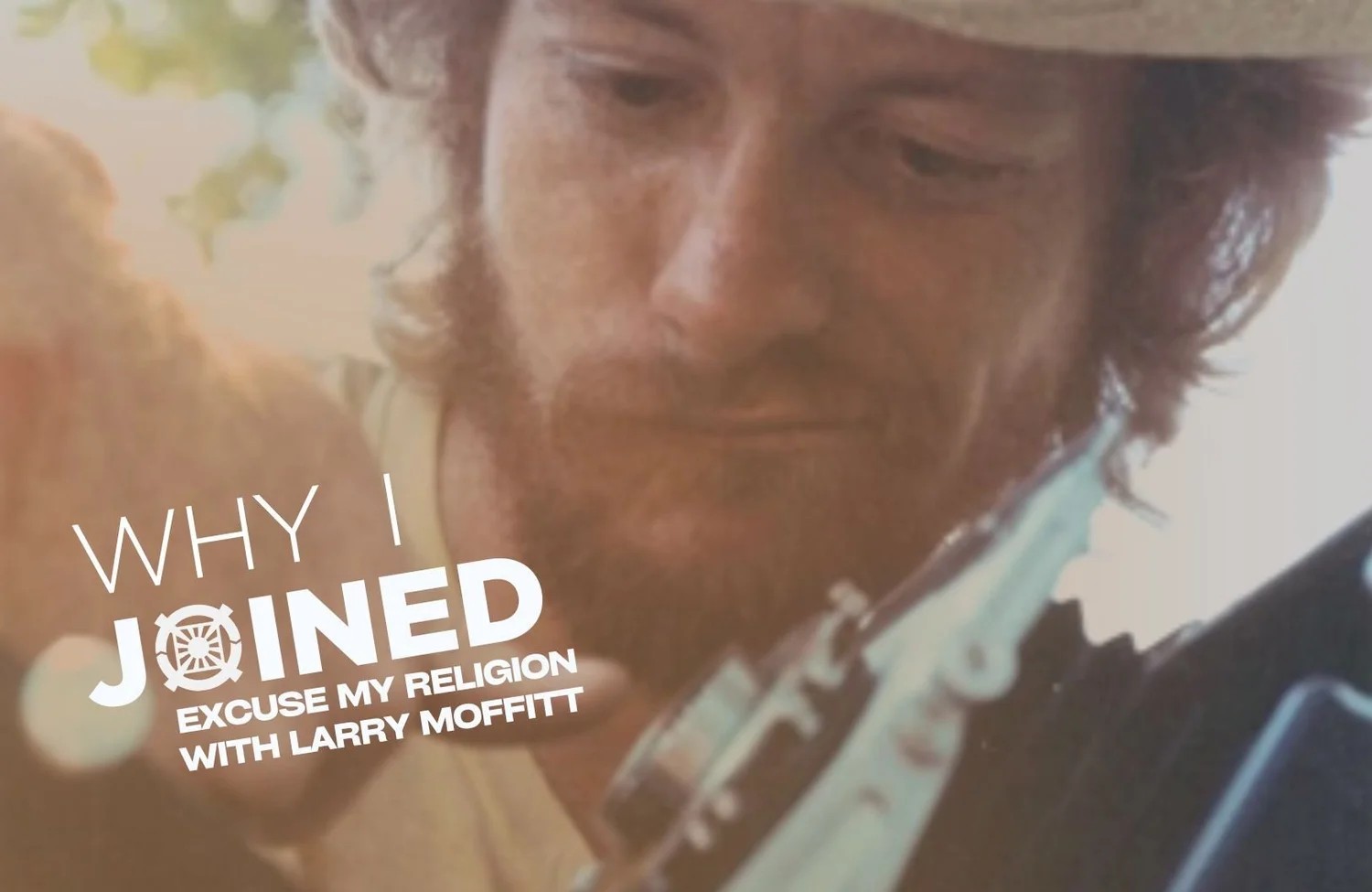
Larry Moffitt
Excuse My Religion
Podcast · Why I Joined (FFWPU) · 53:18 · USA
Projects by Larry Moffitt
- Searching for San Viejo: Notes to My Younger Self
Memoir
All his life, God has been knocking gently on Larry’s door. Somehow, he always knew there was a God who had a personality, ideas, and
Hosts: I have to say, I'm a big fan of your writing work ever since I got to preview pre-published copies of your short stories when I was doing my missionary year together with your son, David. They were so entertaining — just really perfect for lifting the spirit.
Larry: Thank you very much. You know, I have to write. I pretty much have to. Some people have to do things — they take drugs, or they take over countries and enslave the people. I write. That's what I do.
Hosts: It's been on my bookshelf — this is the copy you gave me about three years ago. I picked it up the past couple of days to refresh my memory, and it's inspiring to see someone from our movement have a light heart on very serious issues.
Larry: This place needs a little more laughter. It's all very intense when you feel like you're on a mission for God, right? Before I met God, I think the universe was in a hot, dense state, and I was very young. You said in the intro that God's been gently knocking at my door. I always knew. I didn't have a blinding flash. I never had to discover God. I just sort of — God came in through the air conditioning. I just always knew God existed.
Larry: And there were little things, the way God teaches little children. I was like eight or nine in Casper, Wyoming. I remember this experience. My leather shoe was stuck inside rubber galoshes. You can't get a wet leather shoe out of rubber galoshes, not with a team of horses. And I had to get it out because I had to go to school and it had stopped snowing, so I didn't need my galoshes, and the other kids would laugh at me. So I had to get my shoe out and it wouldn't come out. It would not come out. I tugged and I tugged and I tugged, sitting on the step that went from the kitchen down to the basement. And I said, 'God, please help me get my shoe out.' Just that. And I reached down and tugged one more time and bam, it popped out. I gave full credit to God at that point. I said, 'God, thank you so much.' And it was like kitchen-table conversation. I was always bending God's ear after that, walking around doing stuff.
Larry: In Sunday school, we would hear the Bible stories. Jesus sent some guys into town, said, 'Go get this donkey. I'm going to ride it into town and the guy will let you use it.' So they went over and got the donkey. They said, 'Jesus wants to borrow your donkey to ride into town.' And the guy said, 'Sure.' I told the Sunday school teacher, 'If I had been alive back then, I would have helped Jesus. I would have helped Jesus.'
Larry: I don't know why I started praying that way in high school. I don't know what it was. I just lay there in bed thinking, maybe God needs something sometime. Might need me to go in and get a donkey from the neighbors, something like that. So I would just pray, 'God, if you ever need anything, just ask. Amen.' And I did it the next night, and the next night. I ended up doing that for about my freshman and sophomore year — '63, '64, '65, something like that. As I look back on it, I think that's when I said, okay.
Larry: And then one time, Donna Hilton — now Donna Avey, she kind of runs Alaska, nice lady — called me up on the phone. She tracked me down at work. She had seen some of my audiovisual shows that I used to raise money for. And she called me up and said, 'What do you believe in?' And I said, 'I believe in unity and energy.' She said, 'Is that like — do you believe in God?' I said, 'Yeah, sure. Of course. If you have unity and energy, God will show up.' She said, 'Okay, plan to come over Saturday for lunch. Plan to stay all night.' I thought, wow, I don't get that kind of conversation much.
Larry: So I went over, and I was just this happy barefoot pilgrim, I guess. I was definitely searching. My hair was long because Jesus's hair was long. I was a Christian, but I never went to church, so I didn't have any of that baggage, I think. When I heard the Divine Principle lecture, Robert Morton taught it to me. He knew I had Christian background and a Jesus-y vibe. And he said, 'So you can see, Jesus did not come to die.' And I said, 'Well, everybody knows that.' He said, 'You're a Christian, right?' I said, 'Yeah, big one. Because Jesus kept trying to get people to follow him, and when they didn't, he even cried. Shortest sentence in the Bible is “Jesus wept.” He said, “I wanted to gather you guys like a hen with chickens under my wing. You guys wouldn't have anything to do with it.”' I thought, how could that not be more clear? So of course he was trying to do something. So I tried to find out, what did Jesus want to do? That was kind of my question after that.
Larry: After dinner, I heard a lecture each night. I would ride from work — I was audiovisual production manager for the State of Texas Welfare Department — get on my motorcycle, ride over to the center, and hear another lecture. Go help them chop vegetables in the kitchen and talk. Patsy Casino was there. And Frank Groh came by one night. He sort of became my spiritual son without even knowing it, or me even knowing it.
Hosts: Can you explain what a spiritual son is for those of our listeners who might not be familiar with that terminology?
Larry: Oh, that's if you witness to somebody. Like Donna called me on the phone, so I'm her spiritual son. I'm the guy that she introduced to the movement and to True Father and True Mother. So she's my spiritual mom. It's just a term of affection we use. I was listening to the mission of Jesus, and I saw Frank outside the window — this really skinny dude with a T-shirt and jeans. He kept walking up and down the sidewalk. I thought, he's trying to decide whether to come to the house. Then he disappeared out of view. The doorbell rang, and I said, 'Oh, he came in.' I went outside and met him. We instantly hit it off. We had all kinds of foundation. I showed him the map of where all the different centers were because I had seen enough around. I was just brand new there.
Larry: And I wanted to join. They kept saying, 'No, you can't join.' This was Esteban, who's the leader in the Bronx. He said, 'No, you can't join until you hear…' And Mark Hernandez said, 'You can't join until you hear the conclusion.' I said, 'Okay, okay.' So I tried to get them to let me join. I gave them some money. I gave them my refrigerator — it was out on the farm. They moved my refrigerator into the kitchen. 'Thank you very much. Okay, can I join now? I'll come every Sunday. This will be a great church.' And they said, 'No, you've got to hear the conclusion first.' And everybody said, 'Ooh, you're going to hear the conclusion.' They were all excited. We're chopping vegetables.
Larry: Then one evening I came over for the lecture, and Donna took me up to the prayer room. She said, 'We'll be in here because they're doing stuff downstairs.' She had Miss Kim's little red book — a little textbook. She was reading it. She said, 'So if you don't finish your mission' — this was returning resurrection — 'if you don't finish your mission on Earth, this is a spiritual law, you have to come back and work through somebody else to do things, because things happen on Earth.' And I said, 'Well, does that apply to Jesus too?' She said, 'Yeah.' I said, 'Jesus didn't finish his mission, so he has to come work through somebody else.' She said, 'Yeah.' I said, 'Well, is he working through those guys?' And I pointed to the picture on the stand. She said, 'Yeah.' I said, 'Well then, they're the Messiah.' And she said, 'Yes.' I said, 'Wow, that makes me a disciple.' I said that, which was really a stretch because they hadn't even let me join. So I was really jumping the gun.
Larry: She said, 'I think this is a good time to pray.' So we prayed. And in that prayer, there was a tremendous spiritual experience in the prayer room. Austin, Texas in the summertime is all cicadas, 24 hours a day, cicada noise. There were no cicadas. There was no noise, no traffic on the street outside. There was no sound, not one sound. And the carpet was kind of billowy, and the walls — I could feel them kind of billowy, like I was inside, as I figured it out later, inside a womb. Then she prayed for a little while and then she kind of fell silent, and we were just sitting there. I said, 'Is this a spiritual experience?' She said, 'Yes, it is.' I said, 'Wow.' Then she went down and told Stephen and Mark and Beatrice. We had the evening meeting and I said, 'Now can I join?' And he said, 'Well, yeah.' So that was it. I didn't hear the rest of the stuff like the parallels of history. I didn't hear that until a couple of months later. They skipped right to the end. I was ready.
Larry: And I had prophetic dreams that just scared the crap out of me. I would wake up screaming from one of them. I realized, wow — a little prayer in high school, what does that end up with? But I was ready because I had been searching everywhere. I was a journalist. I worked for the student newspaper, so I went out to the Children of God commune in Thurber, Texas. This was before they kind of went off the rails. They were very, very devout there and they were just stoned out of their minds on Jesus. One of them had dropped acid — taken LSD, lysergic acid diethylamide, for you young people — had dropped acid 500 times. If I did that, I'd see Jesus too. But I wrote a nice article about it, very positive, very straight arrow. This is what they're trying to do and this is what happens. They were suffering a lot of persecution.
Larry: Then we did some fundraising and went to the Sunburst Center in Colorado. There were some crazy people up there, a guy named Frank Makeda — that's my dad. They started this band called Sunburst. About that time we got called to Washington to go pray and fast on the steps of the Capitol. So I'd been in the church about two weeks. We were praying for President Nixon. I had watched the Watergate thing on TV for a year every night. I said, 'Nixon, you idiot, you jerk. Good, we're going to get this guy.' Three weeks later, I'm sitting on the steps of the Capitol. On one hand I have an American flag, and on the other hand I have a sign that says, 'God bless President Nixon.' And my hair was short. I thought, what? I did a zoom-back, 100-mile zoom-back, looked at myself and said, 'What the heck?' And I realized — well, if it weren't for the fact of the picture of those two people on the little table in the prayer room, because that's why I joined. I said, 'Well, there's going to be some weird stuff. I'm going to find some uncharted territory.'
Hosts: You really tapped into the sentiment of the whole country at that time, which was, 'Oh my God, Nixon.' And then suddenly you find yourself a complete 180 within the span of a couple of weeks. Why were you praying for Nixon? What was the viewpoint our church was taking at that time, when so much of the country was completely antithetical to that sentiment?
Larry: It was pretty amazing because nobody was thinking about this at that time. Nixon at that time was like the goat that the village puts all its sins on and then drives into the desert with stones. 'I am not a crook.' But here's the thing — this is what True Father said. He said, 'If we get rid of President Nixon, Vietnam will fall.' He had a way to solve the thing in Vietnam. He said the communists will take over and there will be just an unholy terror of a bloodbath in Vietnam. And it turns out he was 100 percent right. They must have killed six or eight million people there and drove many people into boats who died on the ocean when they took over.
Larry: He even met with President Nixon. He was down in Washington, and there was an opportunity to meet Nixon because he had put these ads in the paper that said, 'Forgive, love, unite — forgive President Nixon.' That's actually when the persecution against our church started — when the church started standing up for President Nixon. I saw the ad in the paper. 'What the hell is this? Forgive, love, unite?' I didn't like the idea of forgiving Nixon, but I liked 'forgive, love, unite,' because — unity and energy, remember, that's when God shows up. There's unity and energy, and all that resonates. I said, 'Oh, that works. That works.' Then I thought, that's it. That's what we have to do with Nixon, of all people. Forgive, love, and unite. And then I found out why — because otherwise Vietnam is going to fall, and all hell will break loose.
Larry: So Nixon invited True Father to meet him at the White House. True Father found out, and the night before, he got this brother in a car. He said, 'I want you to drive around the White House seven times.' He drove around the White House seven times while True Father and True Mother prayed in the back seat. Then they went into that meeting the next day. You see everybody seeing the picture of Nixon and him shaking hands, but the story behind that — he went into the thing, and True Father said, 'Let's pray.' Nixon said, 'Okay.' So they stood around in a circle and prayed. And the prayer went on. Five minutes. Ten minutes. Twenty minutes. Alexander Haig, former general — who ended up being a good friend of True Father's — looked up from the prayer, looked up at Nixon. Nixon just winked, went down, prayed. This guy went out on a limb, put all these full-page ads around the country. He can pray as long as he wants.
Larry: Haig's job was to end meetings. His job was to poke his head in and say, 'Mr. President, you have a meeting at four o'clock.' That would end the meeting and you'd gracefully usher the person out. So he couldn't do that. It just went on as long as it went on. They finished the prayer. And that's basically what True Father needed to do. He told Nixon, 'You need to repent to the people, confess everything, the cover-up. It'll be a big, huge splash, but it'll die down and your career will be saved and you will stay in office and you can save Vietnam.' That's hard to do. It's very hard to do. The reality in Washington is the president is surrounded by many people with very strong opinions. You're constantly weighing the odds — which way is the wind blowing? It's a horrible disease that exists in politics. So he wasn't able to really do that. Eventually he was hounded out of office. Vietnam fell, and a dark period came on. But it didn't have to happen.
Hosts: I can totally see how it would have been really difficult for Nixon to admit to his failures, being such a public figure. But even on the more local level, for everyday citizens, the idea of forgiving him was also just ludicrous, because they felt so betrayed. It speaks to human nature, right?
Larry: Exactly. The persecution of Nixon had been going on, the bad news and stuff like that, for more than a year. Nobody was in a mood to forgive him — not the media, not the people. So I don't know how that would have happened. But God can move people's hearts. He can change hearts. It depends on the quality of the repentance, the quality of the remorse. We are hardwired — we are in our software — for do-overs. Forgiveness exists. I don't think forgiveness was God's plan A, because originally mankind was not supposed to fall. But forgiveness came into being because it had to. It needed to be created, such a thing as forgiveness. And now it's part of our DNA. So eventually human beings can change. They can forgive. I was mainstream America, hippie, liberal guy, long hair, a little Jesus-y around the fringes. But forgive, love, unite — that resonated with me.
Hosts: What a powerful beginning to your political and communications career, working for this movement. I wonder how that shaped you moving forward. You spent a lot of time with True Father and True Mother, our founders, and you had the benefit of a lot of personal experiences with them. Can you speak to some times with them?
Larry: I had a wonderful thing happen. I was working in the performing arts department because I was in Sunburst. But I quit singing because I actually wasn't a very good singer. I would double whoever the strongest singer next to me was, which was always Sandra Lohan. So I would sing whatever she sang — an octave lower, or a half-octave, or a third, or out of tune. Sometimes Frank Makita would move my microphone down if I got too out of control. In a way, he served mankind by doing that. Go, Dad. My job really in the band was to tell jokes while the ladies changed outfits. They would go change and I would do some stand-up. From that, it segued into becoming the master of ceremonies for the church holidays from about '78 through '83 — five straight years. We had four holidays back then: God's Day, Parents' Day, Day of All Things, Children's Day. Those took place January 1, sometime in February, sometime in June, and sometime in November. I was the emcee for each of those.
Larry: I got to tell jokes. True Father and True Mother were sitting in the back. Everybody would watch them out of one eye, and when I'd tell a joke, they would look. If he laughed, they would laugh. Sometimes I was a little on the edge. Dr. Pak said, 'I like Larry's emcee-ing, but I never know what he's going to say.' He was on pins and needles the whole time.
Hosts: Who was Dr. Pak in the movement?
Larry: Dr. Pak was a chief assistant. He was a colonel in the Korean military — military attaché to the Korean embassy. He joined the movement in Korea. He was like True Father's number one person over here in the United States for a long time. I worked directly on his staff. He was terrified every time I would emcee. It helped him grow. It was an amazing experience over five years. So True Father got to know me. He saw me all the time. He already, I think, had figured out who he was going to match me to.
Larry: Because when the Blessing came and he sent out this thing — anybody who wants me to help them choose their husband or wife for them, come down to the ballroom at 6 a.m. — there must have been 2,000 people there. Everybody decided on their own if they wanted to go. He picked me out fairly early. I was low-hanging fruit. He had already thought about it. So get rid of the easy ones first. He pointed to my forehead, like that. And then without taking his eyes off me, he moved his hand over to the side, down behind him, right into the forehead of Taiko Sonoda. She stood up. We went out to the middle. Some people were clapping because I was already very well known for the emcee thing. People would laugh as soon as they saw me sometimes. And True Father just hit me in the shoulder real hard. Bam! And he said, 'Beautiful.' So we went off to the talking room and talked. True Mother was laughing and people were clapping. It was pretty fun.
Hosts: So the question everybody wants to know is — did you make True Father and True Mother laugh?
Larry: I did. I made them laugh, actually, a lot. I discovered something about — if you're ever in charge of emcee-ing a show, first of all, act like nothing's wrong, even though you're dying and fearing. Do not let the fear show, otherwise people will feel uncomfortable for you. So just go out. And if a spotlight falls over on the stage, say, 'Hey, I got this.' Also, if you can make them laugh the first time you're out on the stage, you own them. You make them laugh.
Larry: True Father explained one time the purpose of laughter. I used to listen to True Father's speeches to try to study his humor, because sometimes he would make us laugh. True Father never did anecdote jokes. 'A Jew, a rabbi, and a priest walk into a bar' — he never did those kinds of jokes. He would talk about men and women's relationships. Women do this — makeup. Men do this — we walk like that. He would get everybody in hysterics. He would wake everybody up if anybody was falling asleep. He said one time, the purpose of humor, to make people laugh, is that they lower their barriers. And when they lower their barriers, they can receive love. That's the purpose. So I burned that into my mind. I thought, when I go out on stage, the first time I'll do something that makes them laugh. It got to where as soon as I would come out, they would start laughing. So it got easier. Or I'd just drop my notes and they'd scatter — do a little Charlie Chaplin. There's no level to which I would not stoop. But make them laugh. They lower their barriers and they can receive love.
Larry: We have six and a half grandchildren. When you have grandchildren, suddenly everything makes sense. Because before then, your children are you, version 2.0. But when you have grandchildren, it's like lineage. You see how ancestry unfolds. I can now see my ancestors better. I can see myself better, my lineage better. I see myself in the ribbon of time, the big river of time, and where I am. And I know I'm finite. I'm already in my 70s, so I'm on the back nine no matter what. At some point I'll be somebody's ancestor. They'll come by every ten years with a toothbrush and some Windex and clean my stone.
Hosts: I want to backtrack a little bit. You're talking about your lineage, this family you've created. You had five children, and now you have six grandchildren. Your wife, Taiko, is from Japan. And at the time, America and Japan had quite recently been enemy nations — within living memory. So what was that like for you, being introduced to a Japanese woman as your wife? Did she speak English? How did her parents react?
Larry: She spoke broken English. I would find myself talking to her in broken English. Somebody told her I was doing that, and she said, 'Talk to me in real English. Otherwise, how am I ever going to learn?' Okay, I'm trying. Her parents were very friendly to the church, had joined the church by that time. Even after persecuting her for a while, they finally joined. They said she might end up marrying an American. Her mother saw the atomic bomb that blew up Nagasaki. She saw it from her garden. She was a teenager. It was 70 miles across Nagasaki Bay, so pretty much unimpeded view. And her father was an aircraft mechanic in Tokyo. He was working on the planes for the Kamikaze project. He was always sad. He said the best of our young people were in that program, and they went off to fly and give their lives for their country. It was a one-way trip — to try to dive their plane into a ship.
Larry: He came to America. He was amazed at America. He said the thing that amazed him was the scale of everything. The houses are bigger, the streets are wider, everything. We took him to the Air and Space Museum. He was so fascinated. He saw the B-29. He looked inside. He said, 'So this is what a B-29 looks like inside.' He had been wanting to see that. So the war was kind of immediate for them.
Larry: When we first got matched, we thought, to clear up any ancestral resentment, if there is any, let's do a 40-day prayer condition. So we prayed together for an hour a day for 40 days. It gave us a chance to see each other. We could pray. We could get to know each other. It was a win-win. Near the end of that condition, Taiko had a dream that all my family and ancestors were standing around her. My mother came out of the crowd and kissed her on the cheek. And then on the 40th day, exactly on the 40th day, a package arrived for her from Japan and a package arrived for me from Texas. Imagine trying to time that to arrive on the same day, sent by regular mail. It had some gifts for her and for me. I had a couple of secretaries — she had blouses for my secretaries, everything. My parents sent me a big care package, some cheese crackers and all the food of life, and some gifts for Taiko. And so they came and they loved Taiko and they took her out shopping and they blew her mind with their love for her.
Larry: Then we went to Japan. Our parents wanted to have a Shinto wedding there in her little village. Her little village is like 85 houses. We went there and my parents came over. We had a Shinto wedding where I'm wearing this hakama. It was amazing. Taiko and I sang a song after the wedding. We sang a song called Homeland. Every Japanese person knows that. We sang it together and she does harmony. She has perfect pitch. She was going up and down with the harmony. It ended up being pretty nice. Perfect pitch and imperfect pitch — so perfect and nearly perfect.
Larry: I said some words after that. The war was only 30 years old by that time. It seemed like yesterday for these people. They all had relatives that had disappeared in the war, killed, their bodies never found. They started to cry. The old men would wipe tears from their eyes furtively or step outside. We were just talking away about how our countries never should have fought, because the East tradition and the West tradition need each other. The East has this huge family tradition. The West has this pragmatic tradition. Together they can create the kingdom of heaven. And I said, 'I didn't come here to steal your daughter. I will make sure that she is connected, and our children are connected, to your homeland. They will understand their Japanese roots.'
Larry: After that happened — my dad and mom were there, and everybody was crying. I didn't know that was going to happen, but it just kind of came about. Then these old guys all went up to my dad afterwards and toasted him with sake and apologized for World War II. And my dad apologized back. It was like — I never imagined that kind of thing would happen out of that phone call in Texas. 'What do you believe in?' 'Unity and energy.' It was a wonderful experience. I realized, the earth is one family, and spirit world is real. Spirit world exists. They are real. You can think, 'Oh, when I die, I'll just be oblivion.' That is BS. It really exists. And not only that, there are people there. So many people that care about me and care about you. Care about each one of us. I learn it in some way every day. There's some amazing thing. I'm the luckiest guy that ever crawled out from under a rock.
Hosts: That testimony really speaks to one of the core beliefs we share as Unificationists, around the sanctity and importance of the Holy Marriage Blessing ceremony — because oftentimes True Father would match people from enemy nations together. And it wasn't even just for you as the members, but for your parents to have that opportunity to heal in a very real way. We think of peace as this very philosophical concept, and yet to have two people from enemy nations apologize face to face — maybe more so in light of all the conflict going on right now in the world.
Larry: It was just tears and snot filling the room. These old guys that never show emotion. They played this thing of 'get the groom drunk' — they would toast with sake. Her mom came out with a big thing of sake for me and a little thing for them. They would come up, and she would pour mine, and they would have theirs. I thought, here's where I die. Here's where I take one for the team. I knocked it back, and it was hot water. For thousands of years, Japanese mothers have been saving their sons from this — from alcohol poisoning at their wedding.
Hosts: Oh, man. That's brilliant. She was looking out for you.
Larry: If you have gratitude, you will never go to hell. That's another thing. If you have gratitude, you will never go to hell. If you have a grateful heart, a generally grateful heart, you will never go to hell. There's nobody in hell that's grateful. Also, the advice I give to young married people — you guys have all been married for a while, so you've already figured this out — but I tell them, help your spouse win every argument. Just help her. She totally sucks at arguing. Just help her win the argument. Because 10 years from now, even a year from now, nobody will remember what you guys were discussing. We've argued over a donut or something that happened a block away. It's crazy.
Hosts: I love that. Having gratitude is the key to having a peaceful and spiritual heart, that lives beyond us. In your book — it's a collection of essays, not a straightforward memoir, lots of funny anecdotes and serious points — I love the way you put it when you talk about being part of a minority faith, a minority religion. You say, 'Excuse my religion while it slips into something more comfortable.'
Larry: That's right. Pardon me for breathing. You know, if you can be a member of a persecuted faith, you're actually very blessed. Because you'll find out who you are to the gut level. Your faith will become solid. It will become absolutely rock-hard. Plus, it will inspire God. Be a member of a persecuted faith.
Hosts: I think what you just described is the complete antithesis of what most people imagine when they think of members of the Unification Church. They think of people who are kind of brainwashed and maybe mentally vulnerable, just blindly following without any critical thinking. And yet what you just posed is very opposite to that. Could you elaborate a little bit more on what you mean — or maybe an experience?
Larry: We did a street-preaching condition one time. This was 40 hours in New York City. Now, New York City has no shortage of crazy people standing on the street corner shouting. It's like we're legion. But this was a street-preaching condition where we would preach about God and preach about Divine Principle. We would stand there and people of New York would come by, and we'd talk at the top of our lungs. Some people would listen. I got spit on — spat upon, with saliva. And I was thinking, hey, that's okay. I know who I am, and nothing can hurt me. You can't hurt me with that. You've got to try better. Now, if you hit me with that trash can over there, that would hurt me.
Larry: I had done that for several years. I was coming home from the newsroom one night. It was pretty late, and I thought, what the heck. So I stopped there at the corner of Macy's where I did my 40 hours. I just stood there for a while. People were coming by. I waited until it was just right. And I shouted, 'People of New York!' I gave a little short sermon. When I shouted 'People of New York,' people jumped back about 10 feet, as they customarily do when encountering a New York City crazy. That was fun. I loved it. So the devil made me do it. I enjoyed doing that.
Larry: I have seen the proof of the reality of divine providence. Lincoln talked about divine providence in his second inaugural address. 'Perhaps it's the providence of God that every drop of blood that has been drawn by a slave-master's whip now has to be repaid with a drop of blood drawn by the sword.' He was talking about the war. He said, 'the providence of God.' That's providence. God's providence was kitchen-table conversation at that time. People talked about it. They thought about it. It was in church sermons. It was in people's conversations. You talk about it now — what? But actually, it still is real. The same God that was around then is still around now. The same God that was around the time of Jesus and Moses. The same God that endured the hell-storm of world wars and the persecution. The same God that is currently enduring the horrific carnage that's going on in Israel and Gaza. The same God is still alive.
Larry: That's why when you talk about a sorrowful God, it means something. Imagine your parents — and you've got kids. If your kids are bashing on each other, you're in hell. And if the older kid does something nice for the younger child, takes care of them, protects them, you feel, 'Oh, my work is done. It's heaven.' Imagine you have 8 billion children. And look at what we do to each other. So God has a providence. God works. God does stuff. I have so many things I would have done over in my life. You can't get out of this place in one piece without regrets. But one thing I never regret is following the spiritual path I did.
Larry: I was at the seminary. I had gone to the seminary, left performing arts. And then somebody told True Father that there were a couple of guys at the seminary who had communication degrees or journalism degrees. So Peter Kim called me and asked, 'True Father wants to know if you want to come start the newspaper instead.' At that point, nobody could be taken from the seminary — that was like sacred turf. And I said, 'Yeah, I'll do whatever True Father wants. I'm cool.' So we went. That was October 10th, 1976. I went down a media path and I helped start newspapers and worked in newspapers, and was able to write a column every week for a couple of years in the News World. They gave me space. That really helped me refine my chops. So when I wrote my book, I already had a voice. I know my voice.
Hosts: This is getting into a little bit dicey territory, but you went from very, very liberal views as a young person all the way to the present, where you're serving as the executive director of the Washington Times Foundation, which I think we can all agree is a very right-wing-associated organization. Where do you stand on the political spectrum? Because from personal conversations, it's a little more nuanced than that.
Larry: I'm a registered Democrat. And I'm a moderate Democrat. The Democratic Party has kind of marched off and left me in the dust. But I like classical liberal ideals. I like social liberalism. I like taking care of people. I like helping people. I think those are liberal ideas more than conservative. And liberals have more fun. This shocks people. My boss is Michael Jenkins, and he's still horrified. 'Larry, don't tell anybody.' Oh, yeah, cat's out of the bag now. I was always a liberal.
Larry: Here's the thing — I was a seeker. A seeker for truth. Journalism and religions are the same. Both are looking for truth. Same kind of truth. Exact same truth. So I'm still the same. I'm the same as I always was — a pain in the neck, questioning things. And that's my value. That's what I contribute. I'm always walking around bending God's ear. 'What about this? What about that?'
Hosts: Having that kind of curiosity after all these decades in a faith — that takes a lot of self-knowledge and security, actually, to be able to continue asking questions. Even in your line of work, being on what some people might see as the opposing party, and still being able to hold space for both sides — that's an incredible gift to give in the political sphere, but also to God, that you're still seeking God's perspective after all these years. What keeps you inspired to do that?
Larry: I'm still a seeker because I'm interested in everything. I'm just curious about everything. When I was on my little place out in the countryside thinking about joining this church, just before I figured out the conclusion in the prayer room, I was praying at night. I said, 'God, I found this group of people. They're saying things I have always known is true, but I never heard them all organized so well before. They all have short hair, so they can't be very creative, but they're going to be a good place for me to be. And I think I will go with them in their group.' I'd already decided — if they'll let me join, go with them until something better comes along, that's more true and more exact. I'm still searching, but still some of this work.
Larry: I had a spiritual experience — and I don't tell this to very many people — but God spoke to me out loud, or somehow so that I heard it in every atom of my body. Just three words: 'It's a deal.' That was it. I burst into tears and I cried and I apologized for all the crap I had done, for all the deception and selfishness and everything in my life. I just cried and cried and cried. Never had that kind of experience. So then I gave them my refrigerator. 'Now they'll let me join. Small return. I thought this will do it. Hey, I'm no dummy.' Didn't work. Didn't work.
Larry: I'm still a seeker. If I find something that's more true, I'll join it. I'll go there. If there's something that's more toward God, I'll join. The thing is, the more I get inside God — it's like the closer I get to God, the farther away I am. The closer I get to God, the bigger the whole thing is. It's like going down into a fractal. You keep seeing this landscape opening up, and it keeps getting bigger. It's frustrating because I feel like the more I know, the less I know. At some point I say to God, 'I don't know a damn thing.' That's kind of where I've arrived at right now. But I'm still me.
Hosts: I feel for myself also, I have kind of a similar experience. They say, when you're 21, you know everything, and when you get to like 40, you know nothing. This is what your kids teach you. But it brings to mind what Father Richard Rohr talked about in an interview I listened to recently — when we let go of this need for certainty and we can embrace the unknown. It just creates the space for God to work his miracles in all its majesty. Whereas we kind of define what's supposed to happen, and we create a little box. And then how does God work these incredible, amazing unexpectedness inside of that tiny little box?
Larry: I do not assume that I will go to heaven when I die. I never assume that. 'Thank God I'm saved' — because I don't know. My prayer to God is, I want to be useful. I want to do something useful when I get to spirit world. Please don't put me in a dark place where there's nobody, just my echo. I want to be useful. I want to have something to do. I don't care where it is, what realm it is. I want to have something useful to do. I'll figure it out after that. I don't assume I'll have this giant eternal reward.
Hosts: I think for certainty you'll still be a seeker. And I think that's all we can hope for, especially in eternity.
Larry: I believe in that. I can't wait — in the spirit world, I'm sure there'll be lots of laughter. I love learning, and I love hanging out with people.
Hosts: Well, it's been a pleasure hanging out with you, Larry. This has been an opportunity of a lifetime to get to know you a little more in your story.
Larry: Thank you so much, both of you. I had no idea what this was going to be about, and I kept putting it off because I was busy with a bunch of stuff. But what a wonderfully, beautifully relaxing and invigorating trip down memory lane this has been for me. Thank you so much.
Reflections about this person
Reflections are anonymous unless you put your name in. Every submission is reviewed before it appears.
Loading reflections…