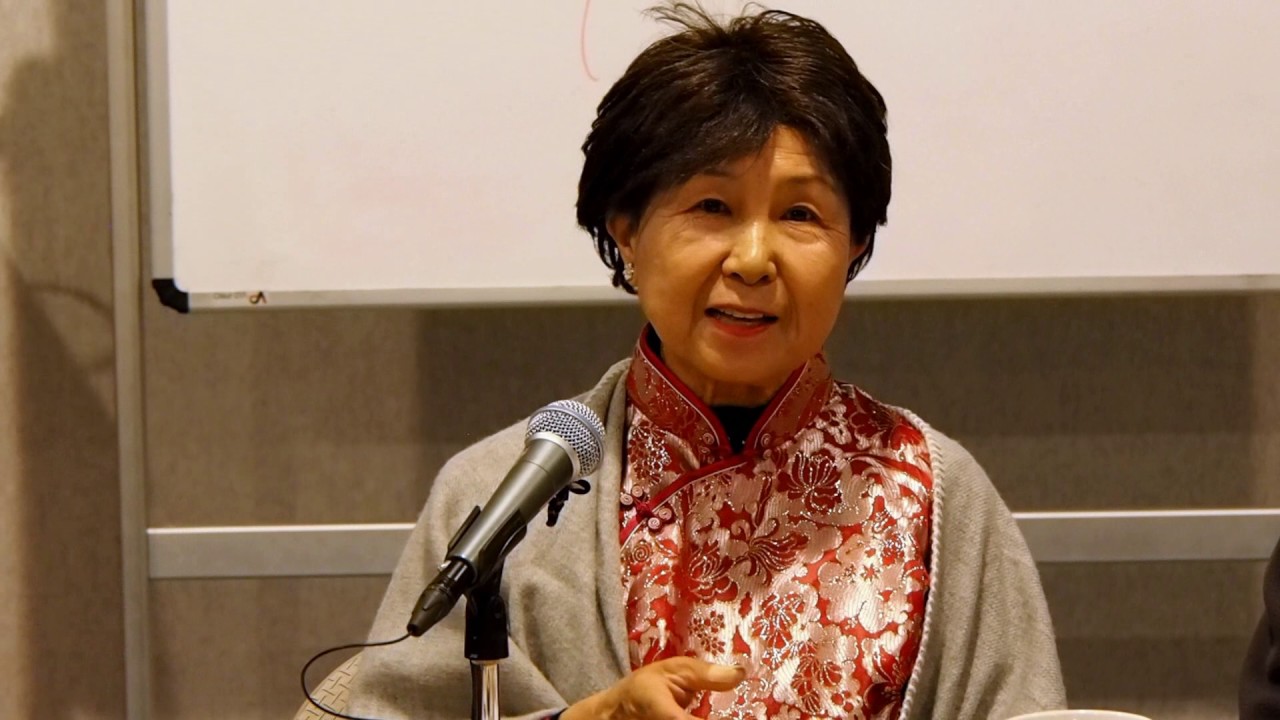
Kazuko Walton
The testimony of Kazuko Walton's life of faith
YouTube · LVFC Office · 59:32 · Japan
Testimony video on LVFC Office channel.
I was born in Japan, January 1, 1948 — a New Year's baby. My father was working in China when my mother married him — his family, as the youngest son's family, was old, so he didn't receive any inheritance. After the marriage ceremony, the decision was: let's go to China, it was a new start. So they both went. They traveled to Kyushu Island, took a ferry boat to Busan, took the old train through North Korea and on to Pekin. Near Pekin, there was a Japanese community town, and the company provided everything. He worked in the cement company, for the construction company, working with the Chinese.
He told me, "I learned many wonderful things from the Chinese people. The Chinese people — number one, endurance. Second, the nationality is the Korean people. North and South Korea both have tremendous patience, tremendous energy, and the future can be great fortune." He kept telling me this. He didn't go to war because he was very sick, so he came back to Japan — and then I was born, after World War II.
I joined a church and started Divine Principle on July 7, 1967 — I was a very young student. They pushed me to join formally, but I needed two more years; at least I needed to finish my career studies. So at the time I didn't go. Then I joined January 1, 1968. It was my birthday. It was God's Day — the first God's Day. I just reflected to myself: wow.
After that, it was my mission to work in Tokyo in a Western restaurant as a waitress, because Mr. Kuboki wanted a reception — international people were coming and they needed a restaurant. We were training three Japanese ladies, one manager, and four or five workers; the name was Lupon. I thought at the time: in the future, the Unification Church needs a coffee shop in Ginza, more welcoming to international people, near the headquarters. So I studied to get a certificate and passed the written test and everything.
Then I went to Mr. Kuboki and said I would like to open a very nice, fancy cafe for the international people who come to Tokyo. He said, "Sorry, your mission changed." What did I have to do? — you need to go to the fundraising team. Oh my gosh. So my dream was broken. But anyway, I followed. The fundraising team made two teams — one was Flower City, the north part, and the other the south part. They wanted to buy land for a building — Kingdom Heaven, the model for Korea, what they call the champions.
They didn't say how much needed to be raised; they just started the fundraising teams. I went with the north part of the team, and other people went to the south. About two years we did this. In 1970, Father called the two fundraising teams, showed appreciation and support, and they bought the land — the champion land. It was very special, though I didn't fully know until later. They were invited to a 21-day workshop and sent to Father — our young team — in 1970.
Then Father said the entertainment was finished and he asked, "Who likes to go to America with me?" I said yes — I go — very high chance I would go. I thought everybody would raise their hand. Nobody. Just me. Father said, "You crazy. Make sure you come with me. More hardship in America." I looked around — nobody had raised their hand — and I thought maybe I had made a mistake or something. Anyway, too late.
I stayed a couple more years. Then on January 1, 1973 — another birthday — the announcement came: my name was on the list to go to America. We arrived February 27, 1973 — the day Noah's Ark came to rest after the 40-day flood and found dry land. I never forget that. I was reading the Bible on February 27. Oh, March was my arriving — the United States. I was so excited.
A few days ago, True Mother came and five missionaries were singing. I just remembered over 40 years ago — oh, just like me when I first came. I was so excited to give singing to True Parents, and that day I decided to sing. I was holding my small carnation in my hand. When everybody's singing was finished, I went to True Parents and gave the flowers. Both True Parents received my flowers — that is my good memory.
Just that campaign, in support — 1973, Carnegie Hall, 21-City Tour; 1974, Madison Square Garden, 26; Yankee Stadium in '76; Washington Monument — the last seven-year course was just coming to a finish. We didn't know what the purpose of Yankee Stadium was, but at that time we really needed financial support. Father said he really wanted somebody to come to America — the qualification: a very healthy body, and somebody who could make money. I was the chosen one. I don't have so much knowledge or anything, but somehow God gave me the talent: whenever we went fundraising, I made a lot, and offered it to God, focused on the providence.
I want to explain my Blessing situation. For the 777 Couple Blessing, my age was three months too young. Then for the 1800 Couples Blessing, I was already in America, and Father said, "Don't go — if you go, don't come back." We really needed these groups of sisters to keep making the foundation for America, so I didn't go. Then for the 1974 Blessing in Barrytown, only sisters who had turned 30 years old could come. But I was born January 1st — one day, just one day short of December 31st.
Should I go or not? I said, I have to follow absolutely what Father said. So I didn't go. The sisters in Barrytown said, "Why don't you come? You could be blessed with us. Why didn't you come?" But my heart said I can't. Many people born in February or March came and received the Blessing — but I just watched. So I had to wait until 1982.
By 1970 or 1971, Terry hadn't joined the church yet, so I had to wait anyway. Then on December 31, 1980, I met him. Father took me — I stood first — and Father picked Terry: "Come." Father stood back and checked from behind: "You are too short." But I had missed all the 777, 1800, and 1974 Blessings — this was my only chance. So I went up on my toes, very high posture. Father said, "Oh, I see," and moved on. Then Mr. Han gave a signal, somebody took a picture, and it was sent to Thailand, all over the world.
Terry's sister Fleece was an 1800 Couple working in Thailand on her 21-year course, and she saw the picture: "Oh my gosh, my brother has been blessed to a Japanese lady — kind of short, but." In 1982, I was blessed — 2,075 couples. At rehearsal, I looked around and all the Americans looked the same as Terry, and I was marching with the wrong person. I was so serious that I marched right alongside him. Then a voice came: "Kazuko, Kazuko." I said, whose voice? "Oh, stay there, don't move." He came down, grabbed me: "Okay, tomorrow is the real Blessing. Stay with me and don't go to the wrong person."
Then many things happened. I thought about how True Parents talked about servant of servants and God's son — they had to finish the eight stages, completing in 1989. From 1982 to 1987 was our dedication time. Then in 1989, Father was looking for IW workers in Europe, and the qualifications were church leader, national leader, or IWC commander. Nobody was there — Father asked, "Who was IWC commander?" Terry raised his hand and stood up, and Father said, "You go to IW work in Europe — entire Europe." After graduating from UTS in 1988, he went in 1989.
At that time, Mr. Ompil Kim was in charge of entering Europe. Then Hyojin Lim prayed for the Berlin Wall — it was very crucial. In 1989, True Parents finished the victory of the eight stages, and I thought Father was very seriously focused on doing something in Germany. First Terry went, and then Ompil Kim called me to come and bring the children. It was my son and Julia — she was just nine months old.
Kazuko: My son was four years old at that point. The whole family had followed Mr. Ompil Kim's direction to Germany, to Europe. Then, on October 15th, True Parents arrived in Germany. After November 9th—as everyone knows—the big happening: the Berlin Wall fell. True Father said that because of the unity among the blessed couples in Europe, this was the most important signal. He had come in October emphasizing that we should keep True Parents' love and True Parents' heart. We didn't know the Berlin Wall would fall so soon, and then the East Germans came flooding through.
Kazuko: The dramatic change came because of True Father's victory at the eight stages in 1989. In 1989 and 1990, the Soviet Union's top professors and 300 students from Moscow were invited to Washington. True Father had already gone to Moscow and negotiated for 3,000 students to be educated in Divine Principle. From Moscow, students were constantly coming, and Terry was going around giving Divine Principle lectures. After those 3,000 people finished, in 1991, Terry was called on a mission to go to the Soviet Union.
Kazuko: The day of his departure was the same day the Gulf War started. At midnight, the president made the announcement—but at six o'clock that same morning, Terry had to depart for Moscow. He said goodbye: "I don't know if I'll see you again." In July 1991, True Father announced the Tribal Messiahship: the direction was either go to Russia or return to your hometown. Terry had already left for Russia before the announcement even came. So there was no choice—I was left raising two children in America. I decided it was better to go to Russia, and I went in July 1991.
Kazuko: Terry had arrived in January of that year. Then in August 1991 came the famous three-day coup d'état. Julia was looking down and crying. A tank was moving near the apartment, heading toward Red Square. Every TV channel was showing only classical music—nothing, no news reports at all. I was frightened. The American Embassy said to pack up and leave for Ukraine; the train was leaving. I didn't know what to do—I had to wait a couple of days.
Host: Can you explain the timeline—the 3,000 students?
Terry: We educated 3,000 students in America and were continuing to teach in Russia. In fact, when I first went to Russia, we held our first 21-day workshop—it was in St. Petersburg. When the hardliners tried to take over the government, many people came out into the streets and stood in front of the tanks, even climbed on top of them. We heard that many of those young people on the front lines had attended Divine Principle lectures—they were really among those in the front line at that time. Then finally the hardliners surrendered, and that was when communism was finished. Gorbachev declared the end of communism at that time. The miracle was that nobody was killed—no shooting, no blood.
Kazuko: Then, continuing—pioneer Russia time. In 1993, True Mother came for the first time, and I had just arrived. Women's Federation. They came to prepare, but most of the time there was no food; even at the hotel there was nothing to eat. Many members had come from New York wanting everything to be perfect for True Mother. I had prepared coffee and milk from Germany, and they told me, "No, True Mother doesn't like that." I said, "No, this is good coffee and milk, there's no problem—go ahead, bring it." She drank it. In the morning for breakfast, I made melon with a lot of lemon juice, and they were a bit humble about the dish—but True Mother and the True Children really, really liked it.
Kazuko: After welcoming True Mother in 1993, January 1994 came—it was always on my birthday that something new would arrive. Terry came back from a meeting. "What's the news?" He said, "I want to tell you—we have to go somewhere far away." We had just pioneered Ukraine, come back to Moscow, welcomed True Mother—and now what was next? I had small children in school. My son was six years old and Russian school was too difficult for him, so I asked Dr. Suk if we could send him to a Japanese school for one year to learn basic Russian. He agreed. The year in Moscow was almost finished by March, but we had to leave soon. And where our family had to go was Siberia.
Kazuko: Even Russian people—even among Russians themselves—don't like to go to Siberia. In history, the people who caused difficulties were sent there, and they died there. But we had a mission to Siberia, so we had to go. Arrangements were made for an apartment, a permanent home to live in. The journey was three nights, four days by train. We were somehow excited. Then we arrived—it was minus forty degrees. It was wintertime; our departure had been January 23rd. At the train station it was so cold that there were no birds, no animals—what kind of place was this?
Kazuko: Then we were supposed to meet somebody—but I'm sorry—the apartment owner had changed their mind, with no way to contact us during those three nights and four days. No cell phone, no computer, nothing. So what to do? We had the whole family live in the workshop space, and that's how we carried on. Then springtime came and we found somewhere to stay. Terry had the idea to put an advertisement in the newspaper looking for English-speaking students—an interesting kind of job—and that's how we built a staff. One of the staff had a contact with a local orchestra. We rented a space and opened the Unification Church—the official title for it was perhaps "character education."
Host: You mean you started the church?
Kazuko: The Unification Church—yes, that was the name. One student had the contact with the local orchestra; they came on stage, and that was the opening of the church—the first Sunday service. Everyone was so excited, because after 1991, in a country that had gone through such collapse, there was nothing to stimulate people. Then the Unification Church came, and Divine Principle came, and all the students were very happy. Each day there was teaching—teachers and students, character education, the two of us.
Terry: Russia is actually seven time zones—it is so big. Siberia takes up this whole eastern region. There is Lake Baikal—the deepest freshwater lake in the world—and right nearby is the city of Irkutsk, which is where we were visiting. There is also one of the autonomous regions of Russia called Buryatia—that is actually where Genghis Khan was born. Mongolia is just below, but Buryatia is where he was actually born, and it is still part of Russia, one of the autonomous regions. There is a city there called Ulan-Ude. The Minister of Education in Ulan-Ude was very positive toward our character education program, and we had a good foundation there.
Kazuko: Then one night, Dr. Suk had a dream. True Father came to him at three o'clock in the morning—an emergency. Father told Dr. Suk to send people right away to Mongolia. At that time, Terry and I were in Ulan-Ude with the Minister of Education and the teachers—it was a very important education program. Dr. Suk contacted Terry and said we had to go to Mongolia within one week, traveling by train from the border.
Terry: Actually, just two days—just two days from there.
Kazuko: Just two days before we were to leave for Mongolia—less than one night—I checked my passport and found it was expired. We had a team of four ready to go: one national missionary from Cambodia, Mr. Tate, and four of us altogether, to teach character education based on True Parents' lives. With an expired passport, there was no way to go. But I prayed about it. I decided to carry the expired passport and go anyway—if the officer on the train told me to turn back, I would turn back. But something happened, and I got into Mongolia.
Kazuko: On the train, the officer came to check documents. He showed me my passport and checked the date. But Julia had placed an extension date in my passport, and the officer saw it—"Okay"—and moved on. Thank you, angel. That extension date was Julia's fortune breaking through for us. The day Julia put that date in my passport—that was Julia's fortune. I was shocked, but I was very happy. I could go.
Terry: To get that far in just two days, you need the Minister of Education to write a letter to the Mongolian Minister of Education. We didn't know anyone in Mongolia, but we had good friends with the Minister of Education in Ulan Ude. We went to him and asked if he would introduce us to the Minister of Education in Mongolia—he agreed. We sent the letter, but the Department of International Affairs in Mongolia received it, and they invited us to come, with the condition that we first meet with their Department of State. We met the Minister of Interior Affairs, and we had just published a book in Russian—Father's Life combined with some of the Divine Principle. We debated whether to give it to him, and we decided to go ahead.
Terry: We gave it to him, and the next day he called us—very excited. He really loved the Divine Principle and was inspired by Father. He said he would set up an appointment with the Minister of Education in Mongolia, and through him we were able to set up workshops for university professors and college students. At first we couldn't hold them in Mongolia, so we actually brought the participants to Lake Baikal, to Irkutsk. Those workshops were for the top professors—university professors and high school principals.
Terry: In Mongolia, the plan at the time was to make Buddhism the national religion—because after communism, they were now free to pursue religious teaching. But we told them: if you make it Buddhism alone, religious war will come again. This is world religion, introduced by Reverend Moon—the Divine Principle. That choice was very crucial, and the time was very short. They said: make a clear decision in one week. What we were actually teaching was called Moi Myriya—"The World and I"—character education based on Judaism, Christianity, Buddhism, and Islam. The Mongolian officials were really inspired by the fact that all four religions were included, because in Mongolia they have all four of those traditions.
Kazuko: Now let me make these things clear. In 1995, 1,600 Japanese sisters went to 16 countries to establish the Women's Federation. The instruction was: before they arrive, make a good foundation in Mongolia so those 16 Women's Federation missionaries will have an easier time working there. We started in Mongolia before they came. Then True Father announced a Blessing ceremony for each country, but in 1995 they couldn't find anyone to officiate in Mongolia. Terry was living at Lake Baikal at that time, and I was in Moscow with my son.
Kazuko: To go to Mongolia you needed a special invitation letter to get a visa. But again, on short notice, we had none. I went to the church headquarters in Moscow and asked: can you make a fake invitation letter? No—impossible. If it were discovered, someone could lose their job. But without an invitation letter we could not go, so we had to make it work. One man agreed to create an imitation letter that looked as if it came from the English educational authority.
Kazuko: I had to reach the Mongolian embassy before the 1:30 lunch break—after that, no one would be there. I rushed there with one brother. At the counter I said: for this educational mission, my husband and I need a visa; this is our invitation letter. The officer went to another room and came back. He said: this letter was not from Mongolia—someone made this. I answered honestly: yes. But I told him—check with the Mongolian Ministry of Education. They know his name personally. He can personally invite us; there's no problem.
Kazuko: The letter came back again: not from Mongolia. Go and get it from there. There was no time. I took the letter and went to the bathroom and prayed: your children need to receive the Blessing. We are chosen to be the officiants. I have this responsibility—please help, right away. When I came back, I contacted the Mongolian Ministry of Education. They knew his name. Another stamp came through. Oh my God—we were going to fly. We took my son there. It had been quite a battle: an expired passport, a fake invitation letter. But the time was an emergency.
Kazuko: This was the 1995 thirty-thousand couple Blessing. There was a meeting in Moscow, and the doctor asked how many people were coming from our area—two couples from Siberia. Everybody laughed. I didn't mention Mongolia; everybody was just excited. I told Julia—she was a kindergarten teacher. "Julia, can you bring somebody?" She said she could. She called me and asked me to come to her home; I didn't know what she wanted to say. She was very young. "What do you want, Julia?" She wanted to be part of it. The first Siberian-blessed couple at that time—Julia was a part of that.
Kazuko: After the Blessing was finished, the doctor asked: how many were blessed in Mongolia? Two hundred—two hundred people, or two hundred couples? Two hundred couples. We had been in contact with many of the parents in Mongolia—the college professors and high school principals who had attended our workshops—and when the thirty-thousand couple Blessing took place, those parents all encouraged their married children to go. So it was the parents from our workshops who made it possible: two hundred couples blessed in Mongolia. Thank you to Genghis Khan and to her.
Kazuko: After that, things got messed up in Mongolia, and I was really down. I asked Terry Walton what he thought. He said: it depends on our motivation and heart. It was for the country—not for my own glory or anything, just for the country. God can never give up on Mongolia; He will raise them up. Now the second generation there is attending Divine Principle workshops. Terry also said: our motivation was to go as missionaries to the country with True Parents, and because that motivation was truly pure, the country would be protected by another force. Don't worry. He helped me to understand. I just wanted to do what True Father wanted—that is when miracles happen. Fire can pass, and you can fly.
Host: So what happened after Mongolia? What year, and where did you go next?
Kazuko: After the work in Mongolia finished, a new national leader was assigned. Then one more thing: Dr. Suk asked a pioneer to prepare to present Mongolia so they could meet with Dr. Suk. That pioneer left for a whole month with no cell phone, no computer—completely cut off—just to research how to make the introduction and present. It was tough, but he found what he needed. And then we proposed that CARB make a donation to the university in Ulaanbaatar—at that time Mongolia had only one university, and computers were just coming out. CARB wanted to make a donation of computers.
We were able to contact the president's office, and he welcomed Dr. Suk, Jack Corley, and some of the other leaders to come. We met with the president and they made a donation to the University of Computers. At that time it was not easy, but the president gave us a very, very good foundation. Then, as Terry had said, after True Parents arrived to be received with the red carpet in Mongolia, our job had been to make sure True Parents could go to Mongolia and meet with the president. I saw the picture—as in today's words—and True Parents received the traditional welcome from Mongolia: salt and tea. Finally we could say our job was done. That is actually why I am wearing the Mongolian coat today.
After that we came back to America in 1995. I think even Dr. Suk said our mission would be around four years. I went for around three or four years because of school—my children's school. Terry was five years for our pioneer mission. Then I came back to America and went to the forty-day workshop for National Messiah. Our assignment was Suriname, South America. We did the same thing in Suriname that we had done in Mongolia—we worked with the Minister of Education and did our character education program. Through that we were able to get a meeting with the President of Suriname. I think it was Reverend Kim who came—he was our regional leader, the one who is now the leader in Costa Rica. He was able to come, and we were able to meet with the President of Suriname. We used the same method as in Mongolia, through the Minister of Education, and it worked.
After the National Mission, the Korean National Mission told us to go back to America, and we arrived in Las Vegas—because we didn't know where else to go. We first came here in 2005. The reason was that my daughter Julia was in the Blessed Teens Academy, and they were living at Leonard Lane where Bill Starr was the church leader. When I came back from Suriname I had no place to live, because while I was there, Cosco was in America working with Unite Vision—one of our companies—and they had sent her to Tokyo to pioneer setting up the sunglass business there. So she was in Tokyo, and we had closed our apartment in New York. I said, "Well, I'll go stay with Julia." We stayed two years and then went back to New York.
Then two years ago some things changed. We were living in Albany, New York, and we decided we wanted to move. I said, "Julia, where would you like to move?" And she said Las Vegas. So we came back to Las Vegas two years ago. When I first came to Las Vegas the church was a little difficult. But when the time comes, the church can change. Most of the time I was cleaning, because it was not a place fit for people to live—we honestly had to take care of the property. Susan had made a great foundation on that little lane, and I wanted to help. When I arrived, a new Korean leader was there, and everything was a new start.
All the sisters from Thailand—whose husbands had been twenty-one-year C.R. missionaries to Thailand—came back to America. The husbands became sick and died. So we had to take care of all those sisters for a couple of years. Then we came back again, and this is now a permanent place for us. Finally, Heavenly Parents brought me back to Las Vegas. Heavenly Parents said, "You have done enough—so much. You can come here, continuously work and rest." I gave testimony twelve years ago—not as long as this, just a short time at the forty-day workshop.
I believe faith is important, but always you have to have hope. Faith is not enough—it needs faith with hope. That is my point. Love comes, but you need to have faith first, and have a hope for heaven and for humankind. I have a hope, I have a faith, and I have love. Wherever I go in a pioneer place, I have faith in God and True Parents—I want to do, I want to do. I carry on always having hope. Then love starts.
Reflections about this person
Reflections are anonymous unless you put your name in. Every submission is reviewed before it appears.
Loading reflections…