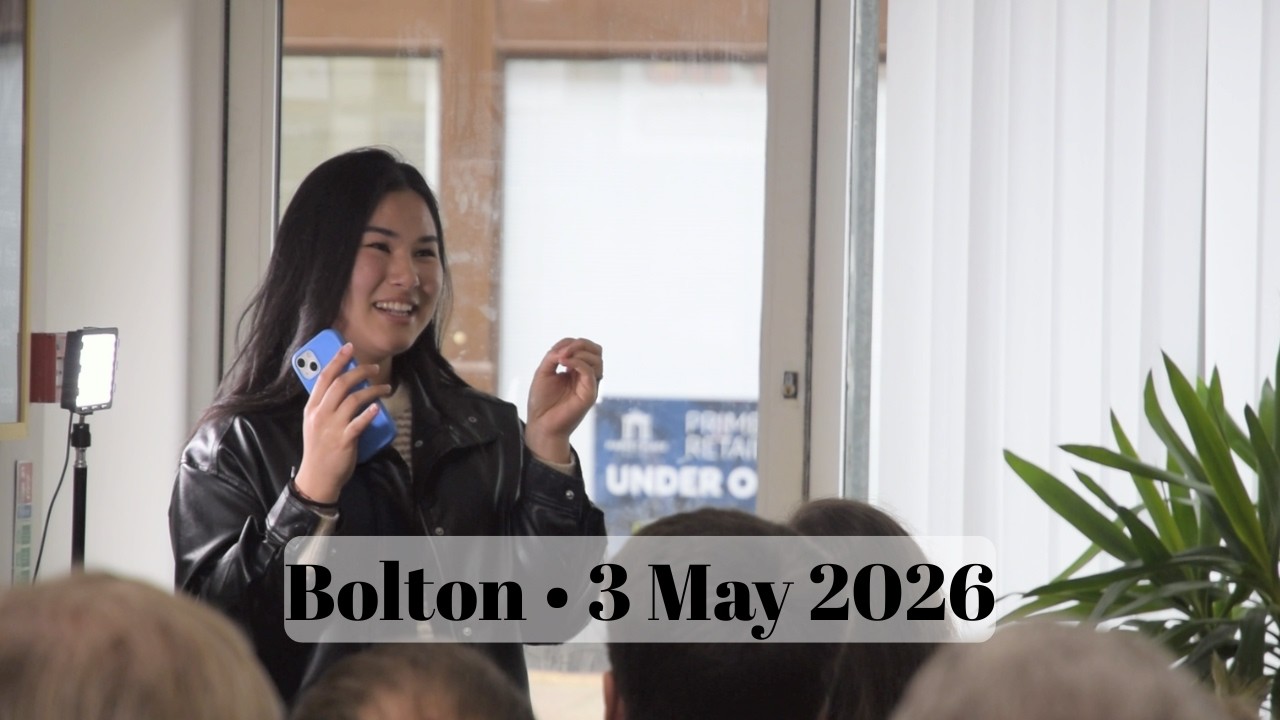
Gloria
Sunday Testimony from Gloria (3 May 2026)
YouTube · FFWPU North England · 19:49 · UK
Gloria recounts her faith journey in four stages, describing how a one-sided childhood relationship with God and the sudden deaths of two close friends in 2022 led her to drift away, until a workshop in Austria became the turning point of reconnection.
I wrote my life in four stages, so stage number one would be just growing up, my faith during that time, and how God has been working during that time. I always used to say that growing up I had a very good relationship with God, but the more I reflect about it, I think this is very common with a lot of people, especially teenagers — at least for me, my relationship with God felt very good because I was constantly talking with God, praying, things like that, I was just in the service. But through time I realised it was a very selfish relationship with God, it was very one-sided — maybe selfish is a very negative word to use, but it was very one-sided in terms of: I was always like, okay, God will help me, that's it, and I was never giving back. Maybe it looked like I was investing back, but to me, if I look deep down, I was always asking God for stuff, and I was always waiting for Him to provide. When it came to giving back or investing back, I never really took any action, or I never did it really actively.
When it came to the community, maybe I did some stuff, simple things, but I was always very scared, or I always thought that I was not capable of giving back — I always thought, just as a basic second gen, I feel like I cannot really do much. I grew up with my parents being national leaders, and us being very active in the community, but I was always just there, never really took so much action. At least I always felt like — or maybe I would compare myself to other second gens, and I'd be like, oh, but at least I have a good relationship with God, and I believe in True Parents, and I don't struggle with True Parents, or something like that — so I was always trying to tell myself I'm satisfied with where I am in life.
But eventually, because I wasn't really taking any responsibility for my faith, or I wasn't really investing so much, I started noticing — once I started getting friends in school, particularly around middle school time, maybe also high school time — I noticed I was living a very double life. For a second gen, it's a very basic term, but I would go to workshops, or go to school services, or just do everything with the community, and I would have this certain persona there, a certain character, and portray myself very much like this pure little second gen, and then outside in school, people wouldn't even know that I'm religious, people wouldn't even know that I have this whole other side of me. There was a lot of guilt accumulating from that — I always felt quite bad for it.
I was like, what am I supposed to do? I lacked a lot of confidence in my faith, so I never put in the effort to try to tell other people, or to act upon this guilt, or fix this, so I was just living this way. Uncle Brian's not here — he just left — but every time he sees me, he's very like, "Ah, such a happy, happy person," and even when we were with guests, last time I was giving introductions to a guest, and Uncle Brian stopped by, and he told the guest, "Ah, she's such a happy, happy person, you shouldn't stick around her" — and I really appreciate it, actually, every time he says this.
Because a few years back, if you knew me back then, I was actually quite the opposite. I was very — not negative, maybe pessimistic — about life. I always thought bad things were happening to me, and I was always trying to analyse every small problem in my life, and I made it a lot bigger than it was supposed to be. Later, reflecting on it, it was usually because I never tried to bring it to God, or I never tried to reach out to family, or community, or anybody — I was just always like, okay, let me try to fix this, but the problem was not even as big as I made it seem. This was the type of person I was, and I was living like this for a few years, up until around Corona time.
Then, in 2022, my life hit quite a low point. Two of my friends from high school, the same friend group, ended up passing away a month from each other, and both of these people were very close to me. It was quite a big shock to me, and to my friend group, and to my class. It was very confusing to deal with grief all of a sudden — it was very sudden — and nobody really knew how to go about it, how to deal with it.
When it happened, I tried to turn to God, but because I did value my relationship with God still — even though it wasn't very deep, I still valued it so much — I told God at the time: I know this is not you, I know that it's not your fault, I know it just happened because it happened, and I don't want to feel any negative emotions towards you, I don't want to blame you. So give me a little bit of time — I'll take a small break, I'll keep a bit of distance, and I swear, I promise I'll come back — just give me a little bit of time, I don't want to put it on you.
I distanced myself from God for a few months, and I distanced myself from my family, from my community. It wasn't a good reason to, but it was understandable — going through grief at the age of 18 is not easy, it's not simple, it was a very brain-altering experience. For a few months it's quite blurry, I don't actually remember much — I lost myself in a way. Since I was not really connecting to anybody, not connecting to God, I didn't really know how to go about it. Mentally, I never hit depression or anything, which I'm quite grateful for, but it was very confusing — how am I supposed to go about my life? It felt like every day for those months, everything had stopped. I felt like I was in a state of shock and I didn't really know how to go about it.
At the same time, there was a lot of guilt accumulating once again, because I kept making excuses to my family as to where I was, what I was doing — I wasn't reaching out, making excuses for why I didn't want to go to similar services or to different activities for the community or things like that. I'm very grateful to my family for the way they reacted during that time, because it gave me a lot of space. But once again, I felt very bad that I didn't know how to deal with it.
The turning point came a few months later, during summer, when my mum ended up asking me just this one thing: please do this one thing for me. She said there's a workshop happening in Austria — just five days, I really just want you to go, it will probably be good for you. I said, well, I have had good experiences from workshops, and maybe now I'm already at a point where it would be good for me to start reconnecting back. So I went.
The workshop — the organisers, it was their first time organising a workshop, so out of all the workshops I've been to, comparing to other ones, it was definitely not planned so well. But there was an activity we did. I feel like every workshop has this for second gens — there's always a day, or an evening, dedicated to connecting with God, some kind of prayer evening — and at that workshop they decided we're going to write letters to God. And I was like, oh my God, okay, let's see how this goes.
I remember I sat down, I got my piece of paper, I sat down in the corner of the big hall in Dachmann's — if anybody has ever been there — and I was just staring at that paper. I hadn't talked to God in a few months — probably at that point it had been about four months — and I didn't even know what to say. After about fifteen or twenty minutes, I was like, okay, I have to do something, so I might as well just start. And I started writing, and I was really honest.
I said, to be really honest, I didn't know what to say — I still felt like I was on this break, not at a point where I was ready to reconnect. But if I had to say something, I started asking questions: why did it have to happen, why was it these two specific people, why was it now? There were just so many questions. And eventually, somehow, when I was writing, it turned into me starting to apologise. I'm sorry for distancing myself — I should have come to you but I didn't know how. I'm sorry for pushing away my family, the community. Everything started coming out, and I started crying really hard, because I just felt so bad. All the guilt started pouring out, and I wrote probably two pages of just apologies.
And then I had this experience where all of a sudden I felt this — it's hard to describe, but it was a sudden whoosh over my body. My mind completely silenced, and all I could hear or feel was God telling me: "I don't care — everything that you're apologising for, I really don't care — because the only thing that matters to me is the fact that you reached out, and the fact that you took the step to say all these things. I've been here this whole time waiting for you to do that, and the fact that you did it now, finally, after so long — this is the only thing I care about, and I'm just so grateful that you did that." It was maybe the first time in my life — at eighteen — where I felt really deeply that God really loves me. Not "kind of" loves me — really loves me. The only thing He cares about is that I keep reaching out and investing in my relationship with Him.
After this experience, it still took me about a year to fully come back, reconnect, and get my relationship to where it used to be. It took a while, and it wasn't easy. But at least in the back of my head I could always come back to this experience, knowing that God doesn't care how much time I need, as long as I keep on trying. This really helps me, even now, up to this day — whenever I go through a period of lacking connection.
The year after was my last year of high school, ages eighteen to nineteen, and my mental state wasn't going to fix itself. I was still really struggling when it came to dealing with grief — my grades started going really down, and I was struggling especially with school, and still struggling in my relationships with family and community. That year I was able to get into therapy and find some help, and I reconnected with my family — but when it came to school, it just wasn't enough. I put in so much effort but didn't end up making it to my finals in the spring term, which meant I wasn't able to start university the next year.
I already knew I had to take a gap year, and I thought: oh my God, my whole life is falling apart. This past year had been literal hell, I put in so much effort, and what was I supposed to do? But my sister had done Empower the year before me, when it was still a three-month programme, and I had always known SDF was a thing — I had always admired people who went to SDF. After some time it became very naturally obvious that going to Empower was the only decision I had. I didn't know exactly what my purpose was for going, but I was going.
Empower itself is a very long story, so I'm not going to go into it all now. My first year was very much about rebuilding — or upgrading — my relationship with God, and my second year, being a teenager, was very much about learning how to work together with God for other people. I came away with three main lessons that I realised on a deeper level through my second year. The first was that True Parents Were Right: living for the sake of others is one of the most effective ways to feel God and to build your relationship with God.
The second was that being scared but still trusting God and doing it anyway is one of the highest forms of faith possible. This really helped me when I was struggling with fundraising especially — it was very intimidating — but repeating this to myself was what got me through. The third lesson was that having confidence in God has no meaning if you have no confidence in yourself, and God cannot work through you. You can say "God can take care of it," but if you don't believe that you yourself can do it, it eliminates whatever God can do.
After I finished Empower — the last stage of my life, my current stage — I really wanted to stay involved, especially on a European level when it came to second generation. I felt this strong calling to involve myself in that, but I wasn't sure how. I knew there was a youth department opening up, and Empower was still going on, so I was very lucky to get a part-time job at Empower and keep supporting in that way. Back in my community, we're a very small community and there's a big lack of second gen, which makes it hard to start things up the way they can here. I always had this pressure that I should do something more — help out in the community, go somewhere, do something. I was even thinking about joining the American Missionaries who came, for a month or something.
And then Uncle Dale ended up contacting me at just the right time, asking if I would be willing to come here. It felt immediately right — I had no doubts about it — so I said yes, sure, sounds great, why not? And something he said a few weeks back really changed my perspective: that pressure is a privilege, and the fact that you have the resources and the ability for God to ask you to give is a privilege. I had always thought: I want to do something, but maybe I'm not capable enough, or I'm not the right one, or I don't know how to go about it. But this helped me understand it differently.
The fact that I even have this feeling of wanting to give — even if I'm not sure how — means God sees it as valuable. He's asking, "Can you give even just a little bit?" He sees it as something worth offering, so can I at least offer that in some way? And maybe just to show some appreciation to you all — I was supposed to stay longer, but the team was doing so well, and my life was going in a different direction from the team's. But maybe I can say something about this community.
I've done mission in quite a few communities now, and something about this community — it feels the most homey. It's the most cosy or comfortable, very family-type of community. I feel like you guys just don't see it, or it's not as easy to see, since you've been living here for so long, but coming in as an outsider, it's definitely very welcoming. I felt very comfortable in this community.
As a person that comes from a small community where it's hard to do things because there's such a big lack of people, coming here I was like, wow — you guys have kind of everything that we don't have in our community. There's so much that can be done, because you have the people, you have the place, you have the resources. So maybe just think about that and appreciate that, and support the missionaries along the way.
Reflections about this person
Reflections are anonymous unless you put your name in. Every submission is reviewed before it appears.
Loading reflections…