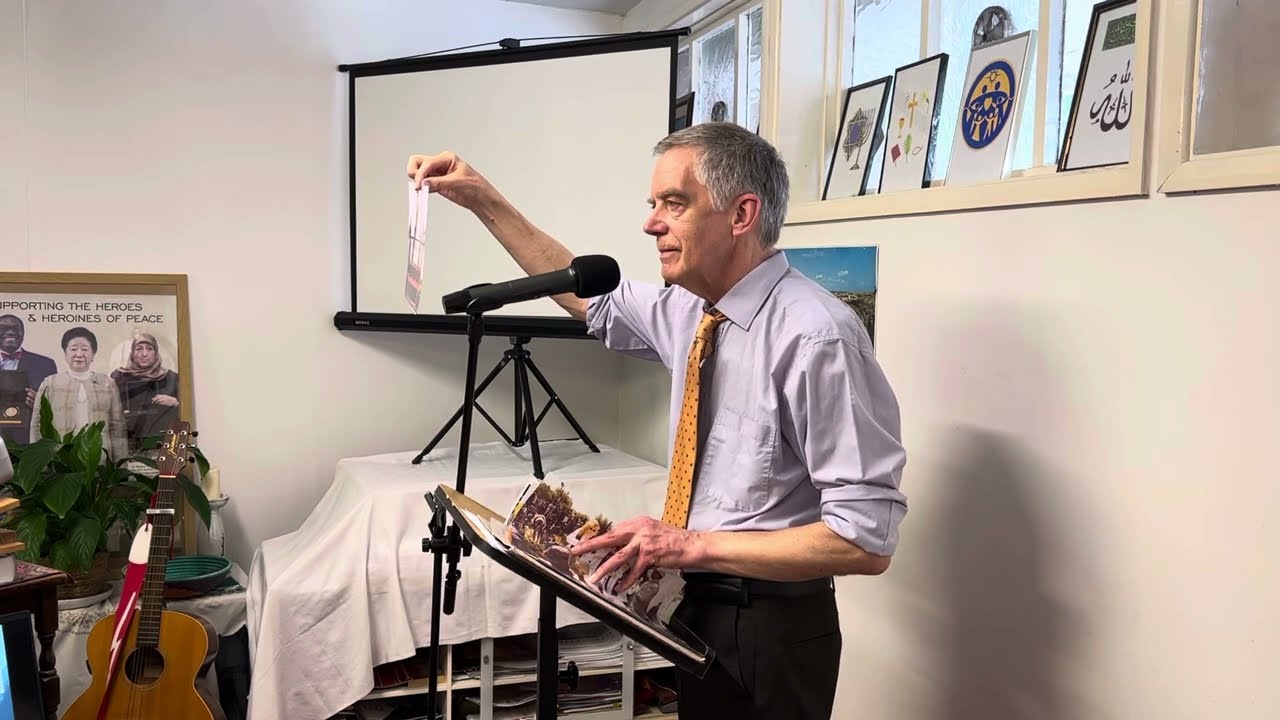
David and Patricia Earle
The Journey to Peace: A Learning Experience l 12th May l Birmingham
YouTube · W W W HolyCommunity · 36:31 · UK
David and Patricia Earle recount their seven peace initiatives in the Holy Land from 2003 to 2008, sharing stories of building Jewish, Muslim, and Christian friendships, meeting bereaved families, and learning that real peace begins with forgiveness in the heart.
ListenAI voice · kokoro-split:bm_daniel+bf_emma
David: We're going to focus today on the Holy Land, and as you all know, the circumstances there are incredibly tragic. We ourselves were part of a peace initiative our Peace Federation began in 2003, and continued until 2008. How many people in this room went on one or more of those initiatives? One, two, three, four, five, six, seven. We began during the Second Intifada, when there was incredible tension — bombs going off, people being shot, very tense times. Our first trip was in 2003, and I think there were two or three initiatives that year.
My first trip was with a group of about 50 or 60 of us from the UK. It was a steep learning curve, which is why we use the title "In Search of Peace: A Learning Experience." We were sitting at Stansted waiting to board a flight to Tel Aviv, when Israeli security came and asked: "Who's in charge?" Nobody put their hand up, so I somehow became in charge. One of the guys looked at everybody and asked me: "How do you know this person? How do you know this person?" Boom, boom, boom, like that. It really took me back. I learned that Israeli security has arguably the tightest systems in the world, and from that point on I had several more startling experiences that forced me to think quickly on my feet.
Our ethos in our Peace Federation is to bring people together, and be a force for goodness and peace. COVID has made us a bit distant physically from one another. Our Holy Land peace initiatives were called Heart to Heart. We tried to bring people from the Abrahamic faiths — Jewish, Muslim, and Christian — together to be a force for good. This is one group of ladies, part of 16 people of different faiths who went from Birmingham. Each time we arrived in Tel Aviv we had to pass heavy security, partly because of our Muslim brothers and sisters — we'd spend three, four, even five hours getting through, with phones checked and so on.
So in 2004 or 2005 I went to our friend Ruth Jacobs, who represents the Jewish community in the West Midlands, and asked her to write a letter for the Israeli security in Tel Aviv, explaining who we were, what we were doing, and why we were coming. She wrote it, and the Israeli Embassy in London agreed to back it. All 16 of our names were listed in Hebrew, and the letter was sent ahead of us to Tel Aviv. We went through security in 30 minutes. That taught me you need to make friends on all sides, if you really want to be a force for good.
When we held marches for peace in the Holy Land, on one occasion well over a thousand people came from all over the world — Jews, Muslims, Christians, rabbis, imams, Christian ministers from America. We wanted to walk through the narrow streets of Old Jerusalem. Israeli security said it wasn't possible in those tense times with that many people, so our rabbis negotiated. We made it to the Western Wall, and could pray there. The imams in our group had befriended the imams at Al-Aqsa, so we could go up onto Temple Mount, and all of us — Jews, Muslims, Christians, men, women — could go into Al-Aqsa Mosque together. It was absolutely breathtaking. A few months later that would have been impossible, because of another security crackdown. We could do together what we couldn't do separately. That's our ethos.
For our Christian brothers and sisters we went to Lake Galilee, to Gethsemane with an olive tree reputedly there when Jesus prayed, and to baptism in the Jordan. Then we walked together to Yad Vashem, the Holocaust Memorial Museum. Some of our Muslim brothers and sisters found it difficult to go and greet relatives of those who died in the Holocaust, but Rahana Sadiq laid a flower at the memorial, and greeted Jewish relatives. People were absolutely moved. Nasreen Suana did the same. On the Women's Bridge of Peace, overlooking Temple Mount from East Jerusalem, a Jewish lady and Rahana made friends with each other — in those difficult circumstances.
Patricia will speak about the Bereaved Families Forum, where Jewish and Muslim families who have paid the ultimate price work together. She'll also talk about fear. I realised through my experiences with Israeli security that a lot of how they are is motivated by fear — and that the harshness and rigidity comes from living in fear.
We met very prominent people, and very humble ordinary people. Here is Yasser Arafat, the leader of the Palestinian people — for me he was a grandfather figure, not just a political leader. There's Patricia meeting Ehud Barak, a former prime minister of Israel. And there is Bishop Riah, Bishop of Jerusalem and the Middle East Diocese at that time. We invited him to Birmingham. He met Margorie, a beautiful Jewish lady whose daughter was teaching in Ramallah, and who was so open. We also took him to the Council House, where he met the tallest Lord Mayor in Birmingham's history — Conservative Lord Mayor Randall Brew, who had just about the shortest wife in council history. He was so moved by Bishop Riah, that he arranged for him to speak in the Council House to about 200 people. Bishop Riah also met Christian leaders from St. Martin's Cathedral, and the president of the Methodist Church. We tried to give exposure and a platform — advocacy, giving people the chance to speak about what is going on over there.
We also tried to twin a Bethlehem baby hospital, Caritas Baby Hospital, with Birmingham Children's Hospital, again to make a link. Members of the hospital here went to Bethlehem, and got involved in some telemedicine and other assistance. There's also a story you may have heard, where the girls of a Christian family in Bethlehem took me into their garden, where they kept chickens, and gave me an egg. I promised to fry it in Birmingham, and send a picture. I had to get that egg through Israeli security, but I managed it — got it back intact, cooked it, and sent the photo. Small things like that keep connection. People are willing to take risks for peace, and we should be like that too.
Patricia: I went seven times to the Holy Land. The first trip was in early 2000, and I was so idealistic. I have many Muslim and Jewish friends here who all want to work for peace, and at that time it wasn't difficult. All my life I've wanted to do something for peace — it is my passion, and I'm really distressed by what's happening in the world. On my first trip my heart went to the Palestinians. They were so warm, so hospitable, and I really wanted to help on a humanitarian level. But I found nothing for the Jewish people. I felt they were harsh and severe, and in the end I felt I had failed my mission for peace — because to be a peacemaker you have to bring both sides together. Very challenging when your heart goes to one side. How do you do it?
I prayed, and remember vividly saying: "I'm so sorry, but I don't want to come back here." What happened next I will never forget. On the plane home, I was waiting for the toilet, and an elderly Jewish lady came up to me and said: "I'd like to speak to you." I didn't want to talk to anybody — I was blocked inside myself. But because she was elderly I felt I should show some respect. So coming back I sat down with her, and she said: "I wanted to talk to you because I saw you in my dream." I was shocked. I really felt God wanted me to listen to her, because my prayer had come from deep inside. That elderly lady didn't understand much about peace, but she talked about her fear, like David said. I had never imagined how much fear could take over a person — afraid to get up in the morning, afraid to go to the marketplace, afraid to send a child out and not know if the child would come back, afraid to take the bus. I finally felt her vulnerability, and how that fear becomes paranoia. When Israel is hit once, they hit a hundred times more. It's fear. God wanted to show me that. Tears came to my eyes, and I realised there's so much work to be done. So I went back, again and again — seven times in all — and had the most amazing experiences. I met wonderful people on both sides, like-minded people who wanted peace.
On that first trip we met an amazing group, the Bereaved Families Forum. These are people from both sides who lost their children to the conflict. They are amazing because they can swallow their pain, and turn it into a power of forgiveness and nonviolence. They don't want any more fighting. In Israel they go two by two to schools, to speak with young people about the impact of violence, and what it means to lose a child or a sibling. We sponsored two of them, Tamar and Ali, to come to Birmingham. Tamar was an elderly Jewish lady whose son was killed in a suicide bombing; Ali was a young Palestinian whose elder brother — like a father to him — was shot in the head at a checkpoint. They became like mother and son. They stayed ten days, going to schools, the synagogue, the mosque, even the University of Birmingham in Selly Oak. Young people need to find hope, because killing is not the solution. We continue to help the Bereaved Families practically.
At our peace meetings there is a lot of tension. People sit beside each other because they want peace — otherwise they would never come near each other. Muslim and Christian, Hindu and Muslim — tensions are real. I always say: "You have to try to look at the good, whatever the circumstance." We're all the same as human beings. At one peace meeting during the attack on Gaza, David mentioned Margorie, my Jewish friend who advocated for the Palestinians, and always apologised at peace meetings for what her people had done. We also had a special guest, Manal, from Gaza. She was in Coventry when she saw on television that two bombings had killed fifteen members of her family. She went crazy with bitterness and hatred. Her Jewish neighbour kept bringing her food every day, and she kept closing the door. Eventually she opened it, and they embraced.
At one point Manal tried to go to Gaza to pay tribute to her dead relatives, but as a citizen here she was not allowed. She started a project called Candles of Hope for Peace — a million candles — and told her followers on social media to light candles that day. She took candles to Israel, determined to visit her people. At the wall a soldier had orders not to let her through. She told her story, and it melted his heart. She placed her candles by the wall, and asked him to pray with her, and he did. As they prayed a rainbow came across the sky over the wall. She felt all her prayers had been carried over. That soldier had a realisation in his heart too, feeling the suffering of that mother. I'll never forget when she shared that with us. She is a real peacemaker.
Another story is of two women, Elena and Itaf. Elena is from Israel, and her son was a victim of a suicide bombing. As he lay dying in hospital she prayed that if he came through, she would work for peace. He came through. She then went to a conference at Caux organised by Initiatives of Change, and was housed with a Palestinian woman, Itaf. They became friends. She remembered her prayer and said: "Why don't we work together?" Because women can do that. They created Interfaith Women Encounter in Israel and Palestine, which is still going. It is the voice of women crying out for peace. They meet — sometimes dangerously, especially on the Palestinian side — and share their stories, and pray. They came to speak at our peace meeting in a convent, and many people came.
The last person I want to share is my friend Reem from Gaza, whom some of you have met. I've known her for 20 years. She came as a lawyer, struggled to find a job here, and did various things, but we have a very solid friendship. When all this began her heart was broken. I would visit, bring flowers, and listen. She lost 60 of her family members — mothers, children, cousins, nephews — and others are still in danger. Reem taught me a lot about how she copes. She came to speak at a peace meeting, and we were shocked and moved. She said the people of Gaza are very resilient, and have deep faith, leaving everything in God's hands. They will never complain. When she calls her relatives and asks how they really are, they won't talk about themselves — because if they begin to talk they collapse. It's their way of keeping going. Reem says: "We always have something to be grateful for." At first she was falling apart, but bit by bit she worked on herself, and she carries no resentment. She is grateful, and tries to be strong for her people. That is a real lesson, because mourning that turns into revenge only multiplies negative energy. When we left that peace meeting we said: how can we complain about anything?
Recently we organised a big iftar at the Al-Aqsa Institute during Ramadan, and many of you came. The Institute trusts our interfaith work, especially in times of conflict, when we go there and pray together across all the faiths. People came from many faiths to recognise each other's devotion, and share a meal. Even more amazing, I was helping Nim organise a big iftar at a synagogue. The synagogue opened its heart, invited Muslim refugees, and shared the iftar. Isn't that hopeful? There is real effort to open up, and show solidarity.
Finally, I want to speak about forgiveness. We talk about wars in the world, but we also have bitterness and revenge in our own hearts — towards a family member, or someone we can't get along with. We are at war in our souls. As Desmond Tutu wrote, when we hold on to that, we are prisoners and the enemy is the jailer. In our Women's Federation we have a programme called Leadership of the Heart, that includes emotional maturity and forgiveness. If we feel heavy in our heart, we have to decide: "I want to be free. I want to forgive that person." Then we need to find someone to share our pain with — probably not the person who hurt us, but someone who can really listen, understand, and apologise on their behalf. Then we find peace through nature, prayer, meditation, yoga, journaling, art, anything that brings God in to help us. With time we begin to understand why that person behaved that way. It's a process, not easy, but vital — otherwise we carry that pain, and pass it to the next generation. Sometimes there are deep hurts, so we escape into world events and play peacemaker abroad; but unless we also heal our personal life, where everything begins, we won't get far. Leadership of the Heart really helped me decide: "I don't want to continue like that." In every person there is something good and something bad, like in ourselves — if we look long enough we see the goodness, and the reasons.
I want to finish with this letter that moved me. A Jewish mother who lost her child wrote to her Muslim friend: "Dear neighbours, these are terrible days for us all. I am sitting in mourning for my beloved son, Yanai, 20 years old, a boy with kind eyes that saw every human being. My heart is sheltered into peace within this terrible grief and bereavement. I want to say to you that I see you. I know these are terrible days for you, days of fear and dread. I'm writing to tell you that I want only good for you, and that I'm worried about you, like I'm worried about us all. I wish you could be there with me during the mourning week to cry with me for Yanai, just as I wanted to come and cry with the Mahmoud family when Ahmed was killed. Ahmed, like my son, was young and beautiful, with kind eyes. I am in deep pain, but within this pain my heart is open to you. I hope this situation will somehow bring our two nations at last to learn how to live together with mutual respect, so there may be no more parents — Israeli and Palestinian — that must grieve for their sons and daughters. There is no other way."
If we could have a minute of silence, and pray for all that is going on in our world.
Reflections about this person
Reflections are anonymous unless you put your name in. Every submission is reviewed before it appears.
Loading reflections…