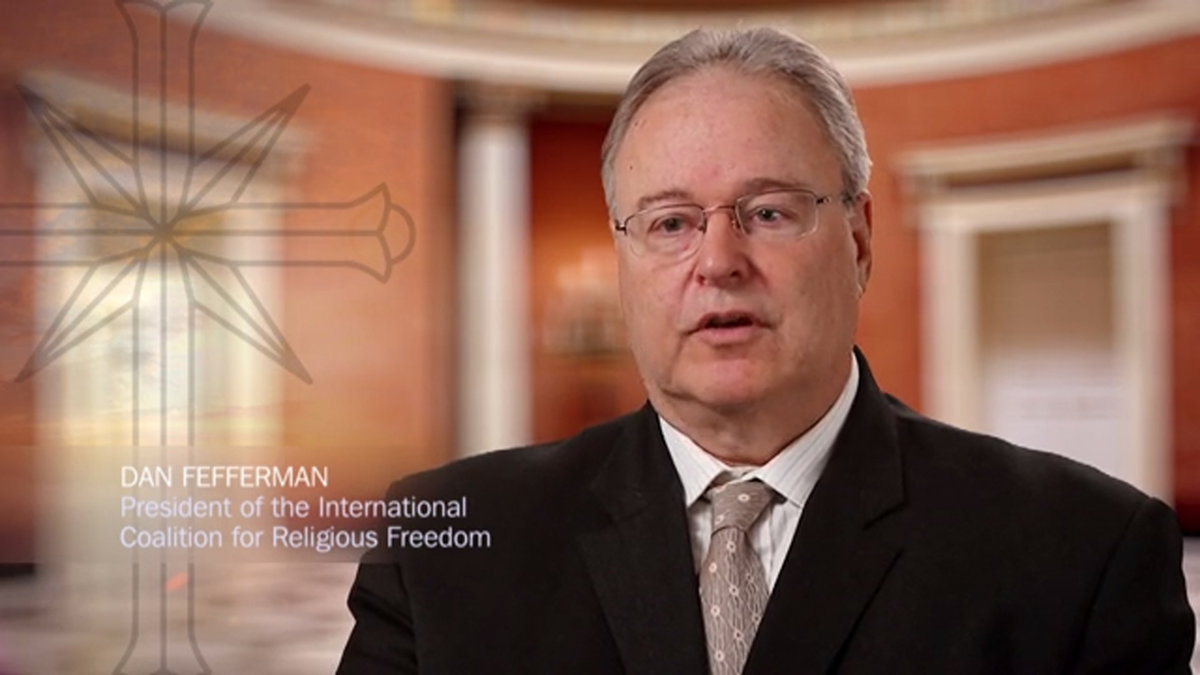
Dan Fefferman
Religious Freedom Fighter
Podcast · Why I Joined (FFWPU) · 56:16 · USA
Raised in a secular Jewish family in Los Angeles, Dan began consciously searching for God when he moved to Berkeley to attend the University of California, where he earned a degree in political science.
Hosts: Well, let's jump right in. Can you tell us a bit about your upbringing and your spiritual background? How were you raised in your family?
Dan: I come from a secular Jewish family, which means that we were culturally Jewish, but not religious. My dad was an atheist and my mom was an agnostic. I grew up in Los Angeles, which was a great place to grow up back then. We had the beach just 20 minutes away, the mountains an hour away, and a wonderful folk music scene that I got involved in in junior high school and high school. It was a really rich cultural environment, and I got to see a lot of blues musicians and bluegrass musicians up close and personal. I got involved in music at a really early age.
Hosts: That's really great. I love folk music, so it must have been incredibly rich to grow up right there with that live music.
Dan: Yeah, the Ash Grove was a real music mecca for people like Mississippi John Hurt, Doc Watson, Joe Monroe, all kinds of blues musicians and modern folk musicians like Buffy Sainte-Marie. We also had concerts at the big venues like the Hollywood Bowl, where I saw Bob Dylan and Joan Baez, James Brown. It was a great time.
Hosts: Is that where you'd say your love of music and your passion came from?
Dan: Yeah, I started playing guitar when I was 10. My dad brought me a guitar, and I listened to Elvis Presley and Harry Belafonte and all kinds of different influences — the Everly Brothers, Ricky Nelson early on. By the time I was 14, I'd become a pretty good guitarist and joined a bluegrass band and became a singer as well. That's where I got my start. Then I joined blues bands and played around in L.A., and continued on after I went to Berkeley.
Hosts: Could you talk a bit about religious traditions in your family? You say you grew up in a secular Jewish family, but was there any talk of God or religious practices at all?
Dan: Yeah, there was, mostly initiated by me. As a kid, I asked my parents where I came from, and they basically had the evolutionary, materialist view. But I also knew about what Christians believed, so I asked them about that, and they said, oh, we don't believe in that. There was a woman who took care of me when my parents were working named Elsie, and she was a Black Christian. She gave me different answers than my parents did. She told me, well, there's God and there's a devil. I began really wondering about those things. Then my dad had a heart attack when I was four, and I began to think about death a lot. That sent me on a little — I probably was the world's youngest philosopher.
Hosts: Four-year-old philosopher.
Dan: Right. I was asking all the important questions. What happens after I die, and is there a God, and where do I come from? I really wanted to believe in God, but my parents didn't. To make a long story short, I actually prayed and told God that I couldn't believe in him right now, because it was too big a thing for a four- or five-year-old boy to be in such a different world from his parents. Besides, we're supposed to obey our parents, right? My heart of filial piety. I told God I couldn't believe in him right now, but I would revisit the question. I said, when I grow up, maybe I'll believe in you.
Hosts: That's amazing that you were so cognizant of that at such a young age.
Dan: I carried that with me, but I kind of put it way in the background. When I went to school in those days, they had prayer in schools, but it impacted me negatively. My first-grade teacher asked the class, who here believes in God? I knew what she wanted — she wanted us to say yes — but me and my best friend back then both didn't. I remember dropping my pencil so I could go under my desk and not raise my hand. She even said, people who don't believe in God are going to hell. It was so inappropriate for a public school teacher. I have a very different attitude than a lot of my friends do about prayer in school, because for me, being at least consciously an atheist at the time, I felt really persecuted for that. It hardened me into being kind of a proud atheist and a rebel against authorities that tried to impinge on my religious freedom not to believe, shall we say.
Hosts: Interesting. Was that the start of your religious-freedom-fighter spirit, would you say? Was that your origin moment?
Dan: Yeah, it actually is, in a funny way. At the same time, I also was still really wondering about God. So that intensified the question as I went through life, but it wasn't until I was in my late teenage years that I began consciously looking for God again.
Hosts: I know you mentioned before we recorded that you were involved in the civil rights movement in high school. So there was something there. There was a passion for other people, for righteousness, for equality. A sense of justice.
Dan: My family was very much involved with that. I remember when I was still quite young, I had seen the pictures of the police dogs attacking the civil rights demonstrators and being really moved — crying and asking my mom, how could this happen in America? Being Jewish, we were very aware back then of the Holocaust and the persecution of the Jews. That gave us solidarity with the civil rights movement. My sister was five years older than me, and she was active in the civil rights movement when she was in high school. I got involved when I was in junior high school in the Congress on Racial Equality. I became the vice president of the Southern California chapter of the Student Congress on Racial Equality, CORE.
Hosts: Wow. What year was that?
Dan: That was in the early 60s.
Hosts: Right in the midst of that time period. It was all over the news at that time, right?
Dan: Right. I would go to the trainings where we would be trained in peaceful resistance and nonviolent protest. I read Martin Luther King, and seeing where he came from, being so committed by his religion as well as by his desire for social justice, that provided another gateway for me into thinking again about God. It also formed the background of my reaction against the radical wing of the civil rights movement. The Student Nonviolent Coordinating Committee became the one that was really the most radical, with Stokely Carmichael and those people that were saying that they had to fight. It was a paradox. But SNCC got taken over by that faction.
Hosts: Did you see your fellow civil rights activists divided?
Dan: Well, when I went to Berkeley and attended that Black Panther meeting that you mentioned, it was the first public Black Panther meeting. It was in the Oakland Coliseum. I went with a mixed group of friends, and it was so shattering. They made the white people sit in the back, in the balcony, to honor the Black people. Then this parade of well-known radicals like Stokely Carmichael and Rap Brown and Kathleen Cleaver — Eldridge was in jail at that point. It was just this parade of Marxist-Leninist hate, trying to whip up the people to fight against the pigs and off-whitey and all of this stuff. It was based on this ideology. I knew there was such a thing as Marxism, and that there was a difference between my friends who were pacifists and those who were more into peaceful, nonviolent protests. But this was an outright attempt to create a violent revolution in America. I said, I'm really not ready to provide an answer to the questions of social justice until I ask the most basic questions. What is justice, and is there a God, and is Martin Luther King the right way to go, or is Stokely Carmichael the right way to go? That was one of the things that set me on my internal search.
Hosts: That's incredible. Just the questions you were asking yourself — I'm sure that whole generation must have been really thinking about that too. Different people were led down different paths, but I'm in such admiration that you really dug deep to ask that question. What is real justice? Even to look at the different types of movements within the civil rights movement — for my generation and for younger folks, it's easy to look at that time period as, it was civil rights, there was this movement, it came up and fought for equality, and then it happened. To live in the midst of it and to really experience it, it's so incredible to hear you describe what it was like at that time.
Dan: The peace movement was another thing. I was also involved in the peace movement. A big change for me happened when I went with some friends down to the Oakland draft court to protest against the draft. Once again, I saw the radicals provoke the police intentionally. It was just as plain as day. They were intentionally provoking the police to start hitting them, and then they had people in the crowd who were egging us on, trying to turn it into a riot. It did turn into a riot. They shut down Oakland for three days. I left at that point, and I said, well, again, I've got to figure things out here. It's like that song that was so famous at the time: there's something happening here, what it is isn't exactly clear.
Dan: I started experimenting with psychedelic drugs, having spiritual experiences. It opened up a whole different way of looking at things. I can't recommend that to people, but in my case, I was looking for God. I wasn't doing it for kicks, and I found God.
Hosts: Can you share a little bit about that moment that you found God?
Dan: The first time was when the Beatles first came out with their Sgt. Pepper's Lonely Hearts Club Band album. Everybody was listening to it. I was listening to George Harrison's song called Within You, Without You. It's a mystical song about the world of illusion and the world of ultimate reality. I started having this experience where I left my body, and I went into another realm, which was so peaceful and so beautiful. It's hard to express with words, but it's like when people express what nirvana must be — a timeless, eternal, forever moment. I don't know how long I was gone, but I heard this voice telling me, you've got to go back. I didn't want to go back because it was so beautiful. There was kind of a warning tone that came later that said, you've got to go back, you're going to be in trouble. I reentered my body consciously. Then I started having all kinds of paranoid fantasies, or maybe they weren't fantasies, I don't know. I felt like people were talking about me all the time.
Dan: When I really started thirsting for God, I started listening to different preachers. The most important preacher for me was Aretha Franklin's father, C.L. Franklin. He was the greatest preacher I've ever heard. I would still say that he's the greatest preacher I've ever heard. I also liked his theology, and still do, because he emphasized the importance of a personal relationship with God more than just what you believe — having a personal relationship with God. It still left me with a lot of unanswered questions. When I would go to Christian ministers, they couldn't answer my questions. I didn't like theology. Coming from a Jewish background, it was hard for me to believe that Jesus is God the Son. I thought, yes, I can accept that he was the Messiah, but not God.
Dan: I wondered if perhaps maybe I was called. I thought I might be the Messiah. That sounds awfully arrogant, but it was not arrogant. It was very confusing. It was a very confusing time for me. I had several spiritual experiences with Jesus. I felt that I was being called. I had a sense that I had a mission. For almost a year, I went through that kind of a realm of being very much confused and searching, looking for answers. I had a feeling that a lot of it had to do with the way that sexuality was expressed. That also came from a spiritual experience, where I felt that sex and birth and growth were the most holy things, and yet they also were somehow tied up with all of the guilt and crime that exists in the world today. In terms of what the Divine Principle teaches, I was heavily prepared. I was asking all the right questions and really desperately seeking the answers.
Hosts: That's amazing. What was your first encounter like, then? How did you meet the Unification Church at that time? It seems like your experiences were already kind of leading you to some of these understandings before even hearing the teachings. What was it like when you met the Unification movement?
Dan: It was a relief. I had been going to different groups that were in the Berkeley area and on campus — Soka Gakkai and Hare Krishna, and I think there was Meher Baba, and Christian preachers. I went to a lot of them. I was actually looking to go to a different meeting that day. I think it was Meher Baba's group. They weren't open for some reason. I thought maybe it was a members-only meeting. Anyhow, I was sitting there on campus in the Student Union, and this woman comes up to me and she says, oh, hi, can I talk to you? I thought, oh, another one of these Soka Gakkai people, because I went to their meeting and they were so pushy. They wanted me to buy their book and buy their altar. I thought, wow, this is not for me. So I said, okay. She said, well, I'm with this group, this international group that's studying the teachings of a Korean Christian spiritual master named Sun Myung Moon. I'd never heard of him. Nobody had. And he's called to unite Christianity and Oriental religions. I said, well, it sounds like exactly what I'm looking for. She said, would you like to hear about it? I said, yeah. We can go down into the coffee shop and you can teach me.
Dan: So she took me down and taught me the first part of the Divine Principle right there in the coffee shop. I felt at that time like, wow, I've got to hear more. I really got to hear more, because this is right along what I'm looking for. I said, can I come and hear more? She said, yeah, sure. I said, can I come tomorrow? She said, not tomorrow, because we've got a prayer meeting. It's for members only. I said, oh, how about the next day? For the next couple of days, I heard the rest of the teaching from Farley Jones, who was the center director at that time. Then she said, well, what do you think? I said, well, I think we've got a lot of work to do.
Dan: Then I met Dr. Ong, Edward Ong, who at that time was a PhD student. He was sort of the older spiritual advisor to the center. He said, so are you ready to join? I said, yeah. He said, okay, go get your sleeping bag. I moved in, and at that time, we all slept on the floor in our sleeping bags. And I never looked back.
Hosts: What kind of conversations were you having with the other members? Where were they from? Who were they?
Dan: There were only seven people in the center at the time. Several of them were searchers, like I was, new members. One of them was Mike Leone. We joined right at the same time. We remained lifelong friends. Basically, I just talked to them about concepts. My main teacher was Dr. Ong, who's a Chinese man from Indonesia. He was very much into Confucian thought, and would talk to me about Confucian principles and Taoism, and how it related to the Divine Principle. He always emphasized, check everything by the principle. I was very spiritual in those days. I was hearing voices and getting revelations. He cautioned me. He said, I've had a lot of experience with people like you who have had these spiritual experiences. It's very easy for them to get off, because they kind of get blown in the wind. But if you really focus on principle, and don't go to extremes — he talked about how the mountain that lasts the longest is not the sharp mountain that juts up into the air, but the gradual incline. He talked about the golden mean. Shutting myself off from too many spiritual experiences, learning the principle, studying the principle, grounding the principle, checking everything by the principle, and not getting swayed by charismatic people so much, but really going by principle. That stuck with me. It's one of the reasons that I was able to keep my faith over the years.
Hosts: That's so interesting, because working in communications, I think that's really what people look at our movement and they believe — oh, these people are all just swayed by a charismatic leader. And yet what you're saying seems to be the very antithesis of that.
Dan: We didn't even know Reverend Moon in those days. Nobody except Dr. Ong had ever met him. This was 1968 when I joined. Then he came in '69, and I heard him speak and met Mrs. Moon as well. But it really wasn't about him so much. In a way it was, because we all believed that he was the one, that he was the one who was going to bring about this new movement to stimulate a big change in the world. But it was all about the principle, the teaching. That was the most important thing.
Hosts: What was the primary principle that struck you and still sticks with you?
Dan: The most important thing was the ideal of a family. This was something that I was looking for. How does God fit in with the family? I grew up with no Bible. We didn't have the Jewish Bible, I didn't have the New Testament. It was basically just figuring things out for myself. So I was influenced more by evolution, by Freudian thought, secular ideas, science. But when I heard the principle — the ideal of a family, that God wanted to work through the family — you don't even really see in the Bible. We talk about family values, but you don't see any ideal families in the Bible. You see families that were deeply dysfunctional in the Bible. People having several wives, Abraham getting ready to kill his son. What was that about?
Dan: The Divine Principle's theory of the fall of man is what really struck me. It talks about the fall of man being not a literal apple, but having to do with sexuality — inappropriate expression of sexuality in an immature way. That really expressed what I had intuited. I think that was probably the thing that hit me most. Taking that up into Jesus, the idea that Jesus was supposed to get married and form a model family — he was supposed to create that ideal family that you don't see in the Bible. That really, really inspired me, because that gave me a vision for what I could do with my life. Complete this mission that I felt called to, that had to do with the family — not literally saving the world, but starting with protecting myself, and then working in a relationship with my wife and my kids to form a good family. Like I said, it was a relief.
Hosts: That's a unique concept in our church, in our faith community — that salvation comes through the family and not only through the individual.
Dan: Absolutely.
Hosts: Since hearing the principle, you joined the center, and since then you've raised a family. Your degree is in political science. You were active in the civil rights movement. A lot of your work for the movement and your career has been in religious freedom. Can you talk a bit about that? When did that intersect?
Dan: In 1969, after Reverend Moon came here for the first time to America. At the end of that tour, he gave us the guidance that we should really try to form some kind of an educational group to educate young people about communism, because he saw that the young people, especially on campuses, had been so infected with Marxist ideology. The war in Vietnam was going on. So we started a study group first, and then we started doing work on the campus. In Berkeley, that was pretty exciting — to stand up against communism when all of the activity was on the radical left. We had some exciting times doing that. I was still in school at the time. Then I graduated and I was offered a job at the Freedom Leadership Foundation. We still called it a movement back then. We didn't change to being a church until 1971 or 1972. We called it the Unified Family. The Freedom Leadership Foundation had a bi-weekly international affairs journal called The Rising Tides. I became the editor of that and studied Marxism and its application more deeply, and helped develop a critique and counter-proposal to communist ideology. That was how that started. That continued on until about 1977.
Hosts: What did you see as the impact of that work?
Dan: There were certainly some exciting times, I can say that. When we would try to teach on the campuses, sometimes the various radicals — the SDS and the Weathermen, people like that — would come against us and overturn our tables and try to shout us down. I can't say that we won. We formed a lot of useful coalitions with people of different attitudes, whether they were conservatives. Back then, the democratic socialists were divided on the issue of the Vietnam War. The ones that supported the Vietnam War, many of them evolved into the neoconservatives. I've maintained relationships with a lot of them over the years, as well as the conservatives. It formed lasting relationships. It formed the persona of the movement. It tied up a lot with anti-communism.
Dan: We supported Richard Nixon, even though we had criticized a lot of his policies. We supported him when he was facing his impeachment. He issued a national statement, a public statement, with the theme of forgive, love, and unite. In a way, it was inspiring for me, but I could see it was going to have repercussions, because we were growing really rapidly in those days. The last thing we wanted to do in order to reach out to our primary demographic of potential joiners — young people who were searching — was to support Richard Nixon.
Hosts: You guys must have taken a lot of heat for that.
Dan: Not only us, but Reverend Moon became famous as the guy who wanted to forgive Nixon, and wanted America to forgive Nixon. He was painted with that brush from then on. He ended up being prosecuted by the leftists in the Congress, and eventually ended up in jail on what I think was a trumped-up charge of tax evasion.
Hosts: Could you speak a little bit to why the movement was really pushing this campaign to forgive, love, and unite with Nixon, especially at a time when the American people felt so betrayed by what had happened? What was the reasoning behind that?
Dan: I think a lot of it has to do with Reverend Moon's experience with communism in Korea. He had been imprisoned in North Korea for several years, almost lost his life. He knew the reality of communism. He knew that in a communist society, a Marxist society, there is no religious freedom. If the communists had won in Korea, he would have been killed. Our movement wouldn't exist. They don't have religious freedom in North Korea. There's no real Christian churches at all. That's where it comes from. He saw the Vietnam War through those eyes. There was a struggle between communism and democracy.
Dan: When I went to Vietnam — I went there twice on fact-finding tours — I came to the same conclusion. The peoples of South Vietnam did not want communism. They were fighting against it. They were fighting for America, for hope and for support. I was really sad when we pulled out the way that we did and basically abandoned the country to be taken over by the communists. I feel the same way about what we did in Afghanistan. We helped them free themselves from this terribly oppressive regime which stifled religious freedom and persecuted women. Now we've pulled out and people are just forgetting about it. I can't forget about it.
Hosts: You talked about fact-finding missions. What were those about?
Dan: The first one was in 1970. A group of us were invited to come to Vietnam and meet with different people — student groups, labor groups, political leaders, military leaders, just regular people, farmers. There were some very interesting religious groups there in Vietnam. One called the Cao Dai, which believed some of the same things that we believe about the coming of a new age and communications from the other world. They were terribly persecuted by the communists. We went to their temple and met with their leaders. We went to some Buddhist groups and met with them, Catholic nuns. One thing they all agreed on was that they didn't want the communists to take over. That motivated me to have the courage to stand up against the communists, who had gone to North Korea — like Jane Fonda — and stand on the banks and win. That's where it all started.
Hosts: Would you say that those experiences from those fact-finding tours — because it sounds like being very involved in social justice from a political standpoint bleeds over into the religious freedom aspect as well, right? I think a lot of people look at church and state and keep them separate and have nothing to do with each other, but it sounds like it was very much connected in the experiences that you've had.
Dan: As an American, the very basis of American democracy and the Constitution — the First Amendment to our Constitution — is that Congress shall make no law regarding the establishment of religion. Religious freedom is the key political issue in American democracy, and it's also the key issue in the struggle between communism and democracy, or at least Marxist communism and democracy. So it's very much at the root. Yes, separation of church and state is important, and it's crucial, and that's why we shouldn't allow the state to be a militantly atheist state. We have to fight against that ideologically and sometimes militarily as well.
Hosts: I know from the conversations that we've just had personally, your work in the International Coalition for Religious Freedom — a lot of that work that you did in that organization was even cited by the State Department in their state of religious freedom reports. What got you into that work, and when did that happen?
Dan: Well, that began in 1987. The immediate issue that we were dealing with at the time was that Reverend Moon was banned from entering Europe through an action of the German government to list him as a dangerous person, so that any country that belonged to the Schengen Group — which is a group of countries where they have their open borders with Germany — if any country lists somebody as undesirable, then that affects the whole area of Europe. So Reverend Moon was not allowed into Europe, and Mrs. Moon also as well, and also England was included in a separate listing. We got involved in trying to overturn that, and then of course there were other issues as well. As it was a coalition, I also got involved in trying to help other organizations that were facing persecution. The Hare Krishnas, for example, and Scientology as well, were banned in Russia, and we spoke out about that.
Dan: With regard to the State Department, we worked to try to influence the State Department to make some covered statements about that, and we were successful in that — both on the issue of Reverend Moon's entry into Europe, and more recently with the issue of so-called deprogramming in Japan. That was where parents had been educated by anti-unificationist groups in Japan to actually kidnap their own kids and hire people to hold them against their will for weeks and months — in one case even more than a year — in order to try to get them to leave the church. There were hundreds of these cases, but thank God we were able to change that over a period of years, and eventually it stopped happening so much. It's very rare that it happens anymore in Japan. But those same groups that were whipping up the sentiment against the church in order to justify this so-called deprogramming are the very ones that are now trying to get the government to shut down the church because of this guy that killed the former Prime Minister of Japan, which is crazy. He hates our church, so he kills the Prime Minister of Japan who somehow is friendly to us, and instead of blaming the attitude of this guy who hates our church, they're blaming the church. It's a classic case of blame the victim, and it's crazy. I hope we can get it changed somehow, because they're really facing a terrible time over there right now.
Hosts: I have a degree in journalism, and I studied it. The media has had a history of really leaning into sensationalism and kind of whipping up people into a frenzy. For me, as someone who works in communications, it's really disappointing to see the lack of real experts in the news media stories — that they're not going to religion academics to ask them, who have studied religions and can speak through qualitative research and scientific observation about what they understand about religious groups, instead of these kind of self-appointed cult experts. I use air quotes very liberally when I say that.
Dan: Everybody has an agenda, and I don't know what they're teaching in journalism schools anymore. Maybe it's not the schools, but the journalism institutions have gotten so much involved in politics, so that you turn on one channel to hear one side of the story, and you turn on another channel to hear the other side of the story, and nobody's covering both sides of the story.
Hosts: Or, like you said, inviting actual experts who don't have a bunch of talking points based on what political party they belong to. I have a personal theory about it.
Dan: Let's hear it.
Hosts: In my observation, I feel that a lot of people get into journalism because there is this hope and belief that they're doing this because they feel that they're contributing in a way to a better world — much the same way that we feel that we're contributing to a better world. It's just that the way that they do that is through writing and investigative journalism and things like that. I do think that there is a need for journalism as the fourth estate, quote unquote, to hold power to account, in a sense. But the hard part is that a lot of the way that stories are edited puts the fear in front, because that's what people are attracted to. It's human nature to be like, ooh, that looks juicy, what is that?
Hosts: I think that the result that we're seeing nowadays is that playing into fear is exacerbating the condition of mental health that we see in our country today. There's a rise in anxiety, there's a rise in depression and polarization, and people are not realizing that as an industry, in a sense, there is a contribution being made to that exacerbation of people's anxieties and fears, because they are capitalizing on that, in a sense. I think it's really hard, because the human condition is that so much of the decisions that we make are based off of fears and anxieties — ooh, I'm scared that this is going to happen, so I'm going to decide to play it safe, or do these things. It's challenging then to shift the dynamics of an entire industry to start writing in a different way where you play to the positives more. It's hard to create a successful financial model that supports that type of quality work.
Dan: I think you really hit it on the head there with the financial model in journalism. They've got to sell — we used to call it sell newspapers, now it's sell clicks. Everything is based on how many clicks you can get, and what gets the clicks is the sensational, or the things that appeal to people's fears, anxieties, hatred. It's addictive, because you get a rush out of this feeling that these guys are so bad and I'm so right and they're so wrong. It exacerbates the divisions rather than bringing about unity. The whole ideal of journalism — presenting the objective facts and letting people decide for themselves — is out the window.
Hosts: The industry itself makes it really difficult for journalists too. The time deadlines and the pressures and the churn-and-burn culture of, I need 10 stories by the end of the day, makes it really hard to put the time in to gather the information too. Having worked in the field, sometimes I also know that the headline writers don't always read the story that they're writing the headline for. They may read the first paragraph and come up with a headline that doesn't match the story, but will get people to at least click on it.
Hosts: You worked in this journalistic, political, social activism world, but I see a guitar behind you, and I know that there's also this other side of you — this songwriter, musician. Is there a soundtrack to your work?
Dan: There is definitely a soundtrack to my work, although most of it is not political. It's mostly spiritual and romantic. I've been writing a lot of songs lately that are based on biblical themes, trying to understand the heart of the people that were involved in these incredible dramas. When you read the Bible, it's written in a language that sometimes it's hard to get past, but there's some great stories there. I try to tell them through my music, and I also write some secular songs and some hymns. Some of them have become popular in our movement, and I'm hoping that some of them will become more popular, as I've been doing recording lately and also some videos — which is a good thing to do when you've got time on your hands, like a retired person does. So I've been honing my video-making skills. Marketing is unfortunately not my strength, but at least I'm producing these videos and putting them up on YouTube.
Hosts: I grew up with some of your songs, singing them in church and at summer camps. One of my favorites actually is The Lord Is One, where it starts with All My Brethren. It's like this chant. Some people might not know that Dan is the songwriter for many of the anthems and those really powerful, moving songs that we grew up with as second-generation Unificationists.
Dan: That song, The Lord Is One, actually comes from the most fundamental Jewish prayer, the Shema Yisrael, which goes: Shema Yisrael Adonai Eloheinu Adonai Echad — Hear, O Israel, the Lord your God, the Lord is one. Even in the New Testament, Jesus recites that prayer — I think it's the Gospel of Mark — when they ask him, what shall I do, what's the most important commandment? He starts with that, then he goes on to say, love your neighbor as yourself, and love God with all your heart. That's where that song came from. All of my songs have different influences. There's that, and there's also a melody that came from an old Appalachian hymn. Put it together — it's part of the creative process.
Hosts: What have been your favorite songs that the Unification movement has adopted?
Dan: The Lord Is One is definitely one of my favorites. I think probably the one that is sung most is The Generation of Righteousness, which is more of a militant anthem. I feel like I didn't even write it. I had just gotten back from Japan, and on my first trip to Japan I saw the strength of the Japanese movement, which was very powerful. I prayed to God. I said, God, would you give me a song — not just for me to sing, but for the whole movement to sing. I went up to the little study area in the attic of a house, and 15 minutes later this song was written. It's not a simple song. It's the most complicated song I've ever written. I don't feel like it was just me. I really felt like I had help on that one. I wouldn't call it one of my favorite songs, but it was certainly probably the most sung of my songs.
Dan: More recently I wrote a song for Mrs. Moon called She Stepped Up. That's one of my favorites, because I feel that I did something that really touched her personally, and also captured a moment in our movement's history — when Reverend Moon had died and Mrs. Moon had to step into his shoes and plant a flag for herself as a woman leader. She was opposed by so many men, even a couple of her sons. They had a very hard time. They're still getting through a hard time. I wrote this song called She Stepped Up, and I think I'm probably most proud of that one.
Hosts: Could you tell us the name of your YouTube channel, so that if people are interested to hear what you've been producing lately they can check that out for themselves?
Dan: They can probably just find it by putting my name in the search engine in YouTube. I don't know if it has an actual name, but it's my YouTube channel — Dan Fefferman.
Hosts: We'll be sure to include a link in the podcast episode on our website so that people can check that out, because the music that you produced over the years definitely left an impression on me growing up. Even Generation of Righteousness — I think on reflection now, I'm like, wow, we had such very military-influenced language even in our holy songs. Smash Satan, and Victoriously Marching. But when you're singing those kinds of songs together, it really creates the spirit of camaraderie, of feeling that you are working, actively working towards something so great and beautiful. I really love that about those songs that we sang growing up. I'm excited for new people to come into contact with your work and connect.
Dan: It's interesting sometimes for me to look back over my songwriting career and see songs that I wrote in the 70s. I could never write songs like that today, because my own outlook has changed very differently. I had a much simpler, black-and-white kind of faith back then. Now I'm definitely more mellow and not as absolute — more understanding that there's not just one way to find God, but there are many ways to find God.
Hosts: I love that. That resonates really deeply for me also, I think. Really feeling that in my own journey — yes, there's so many different ways to connect to God and to feel inspired. What resonates deeply is going to be very unique to each person. Thank you for sharing your story, Dan. You've had such a rich life and career, songwriting career that's ongoing. We just thank you for your time. It's been a real pleasure.
Dan: Thanks a lot.
Reflections about this person
Reflections are anonymous unless you put your name in. Every submission is reviewed before it appears.
Loading reflections…