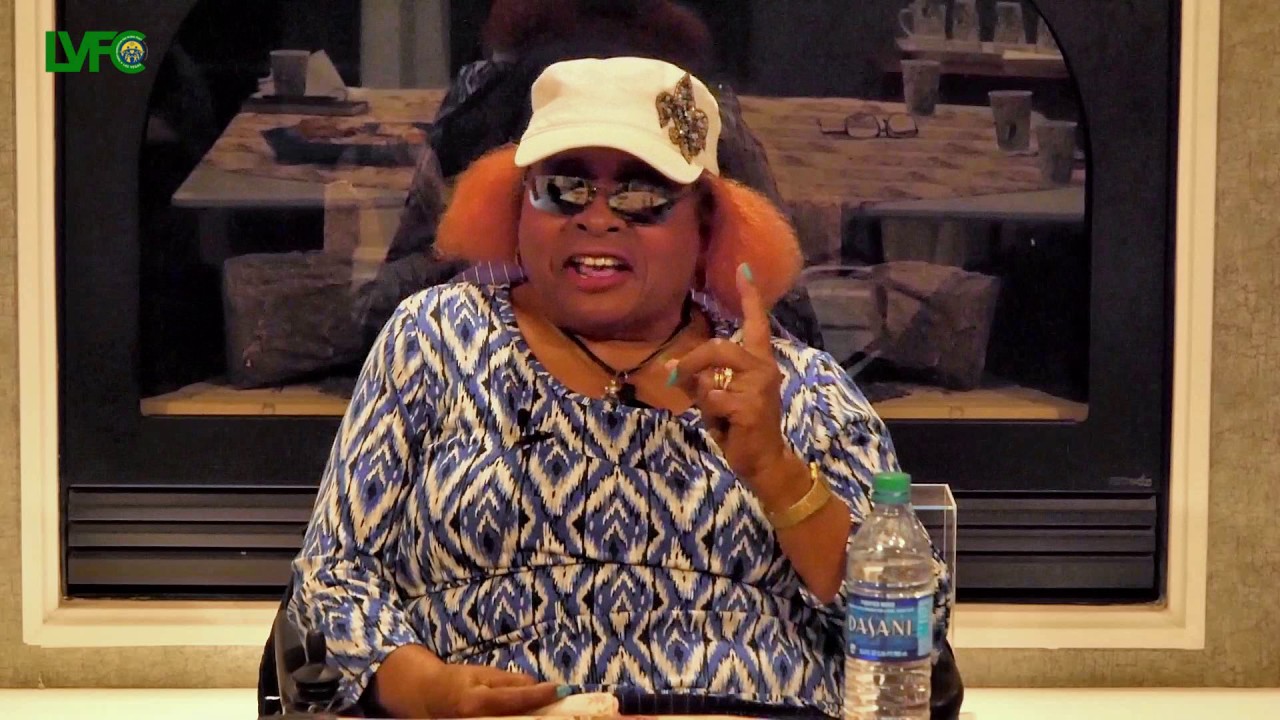
Beatrice Benson
The story of Ms. Beatrice Benson's life of faith
YouTube · LVFC Office · 45:03 · Zambia
Beatrice Benson recounts her childhood in segregated Texas, the harassment she faced as a young woman, leaving home at fifteen, and her hasty first marriage at seventeen.
I was born in Jacksonville, Texas in 1933. It's a little country town, and there was myself and my sister—we was the only two kids in my immediate family. But we had cousins that lived close by who was boys, and so they used to come to our house a lot. Across from the back of our house—they called them creeks—we used to go across the creek to another neighbor's house to get milk. It was boys there too, and their sister was our school teacher.
I didn't have a good life coming up as a young lady, because everyone said that I was pretty and everyone wanted to misuse me, and it didn't make any difference who it was. So these things happened, and at the age of seven we moved from there to Dallas, Texas, and the same thing happened even there. But this time we was having a lot of relationship with white people too. We rode the bus and we had to sit behind a sign that said "Colored" on one side and "White" on the other, and so it went from one extreme to the next.
I could be standing at the bus stop and someone could walk up—a white person—and they could be talking with me, and just as soon as another white person walked up, they would stop, just like they never spoke to me. And I always said, they may feel this way about me, but I know God created all of us, because they didn't come into this world a different way than I came in. So therefore, it's their problem, whatever is going on.
I wrote my mother a letter when I was fifteen and told her what was going on. My aunt—the one that I was named after—I asked her could I go and live with her, and she said yeah. So I went to live with her. While I was there, I used to help her husband fix fences and what have you around their property. And one day he told me he wanted to get a divorce from my aunt and marry me. I felt like—I left from one house with such craziness, and then came to another house, and somebody was talking about leaving my aunt and marrying me. I never would have married him, and I was saying, oh, I've got to get out of this.
So at the age of seventeen I said, the first person to come along and ask me to marry them, I'm going to marry them. And that's what I did. Well, it was the wrong thing to do, but I did it. After that we was together about a year, and then it just wasn't going good at all. My mother and father had come to Vegas because I had an uncle that was in service and he was stationed out here—that's the reason they came here. So one day my husband took me to work, and when I got to work I had told my grandmother and my sister what I was going to do. I told my boss, I said, I'm going to have to get my money and get me a ticket and come to Vegas. So they gave me my money, I got a ticket, and I came to Vegas. That's how I made it here.
All the time I used to have a dream that I was going to die at an early age. I never really understood it, but I always thought that I was going to die when I was young. I came here and I started going to Second Baptist Church, and then I met another man and I got married to him at the age of twenty-one. We stayed together for eight years. He used to go to the movies with me, but he wouldn't go to church with me. And then he stopped going to the movies with me, and he said he was doing that to get me. I said, well, you have to do it more so to keep me. After the eight years, I met someone else, got a divorce from him, and got married to the third husband. I stayed with him for eight years.
After we got a divorce, I was working at the Thunderbird Hotel, and that's where I met Helen Danby, who was my spiritual mother. She didn't say come to my church—she was Canadian, white hair just like yours—and she said, I want you to come over sometime. So I said okay. I said, you come over to my church, and then I'll come to yours, because I had had that happen before—I'd invite people and something would always come up that they couldn't come. So I said, well, if she comes to my church, then I have to go to her church.
And when I got to church that Sunday, her head was the first one I saw among all those Black people there. So I said, well, now I've got to go to her church. I had gone to many people's churches before—all kinds of religion. I used to go to the Seventh Day Adventist church with a friend of mine and go to my church on a Sunday. But this time, I prayed. I prayed to God that whatever I was getting into, it was of Him, because I didn't want to get into anything that wasn't of God.
And so I went there and started hearing the Divine Principle. Everything that I was hearing—the answers that I had been asking for inside of me—I was always saying, well, I guess I'll find out about it when I go to spirit world, that God would tell me about it then. And to be able to get these answers then, I knew it had to be from God, and that this had to be His truth that He had sent to this earth to us. So I was hooked—sinking, lying, whatever you say.
Then I started doing all kinds of conditions: getting up in the morning, walking, praying, taking cold showers. And I just hate cold water on me, but I was taking cold showers—everything that I could—because I wanted to get free from Satan as fast as I could. My mother was staying with me at the time, and I had her going with me on these walks, and I had her hear the Divine Principle, although she didn't understand it that much. Whenever I would have a revelation of something, I would tell her about it. One day she said, "I am tired of hearing about the Divine Principle." And I said, oh my goodness—I don't want my mother to not want to hear about the Divine Principle. I realized that she wasn't able to receive these things as fast as I could, so I tried to slow down on telling her about it.
Anyway, the center came over—everyone from the center came over on her birthday, and she cooked the meal for them. She liked the members and everything. And then it came a time that they combined all the centers to seven states, and they sent the center from Las Vegas to Los Angeles, and sent the center from Los Angeles—I think it was either to New York or some other state. So I sold my house and told my mother she could come with me. And she said she didn't want to leave her grandkids—my sister had two kids, so she wanted to stay with them. I said okay: if you stay with her, whatever happens, I won't be able to come back here to help you or anything, so she'll have to do whatever has to be done for you. And she said okay.
So I sold the house, took as much of my furniture as I could with me, sold the rest of it, and went on to L.A. At that time I had a Mercury Cougar—a '70 Cougar. By me selling my house, I could cook and witness and what have you, and I could help with the rent and everything. Then they sent a lot of people from Oakland or San Francisco to join our center in L.A. At one point Mrs. Arms was there with us, and they sent a group of us fundraising to Oakland and around different places—I was among that group. I signed my car over to the center there, and I was one that could sell things pretty good.
So Father had the ones that had made the highest amount of money come to Belvedere. We went there, and Father put us on a special task force team, and then we went around other places that I would never have made it to if I hadn't been in the Church. We fundraised, and at that time I was doing pretty good, but I wasn't making a lot of money. Then Yankee Stadium and Washington Monument came up, and I helped with that. After all of those things took place, I went back to Manhattan and was working in the Manhattan building.
So the president there—what was his name? Salonen? No. The Jewish man—Mose Durst. Anyway, I'll probably think of it in a few minutes—as well as I know his name, and I can't even think of it now. Well, anyway, he said he had some place for me to go, and he took me to Belvedere to work. And so I was there at Belvedere for ten years, as you all know—I was cooking and I was fundraising. And I got so good, I was driving a van with a trailer hooked onto it, and in this trailer I had helium balloons and some dolls that I had made up, and I was selling flowers. So it was just like a little store that I had.
Beatrice: I would cook, and then I would get ready and go out fundraising. And I would fundraise until 11 or 12 o'clock at night, and then I'd go back home. And I would say, God, you're the only one that I would be doing all this for, because all my life I've always worked on a job, never fundraised. And then with this fundraising, I've been standing on the corner selling something to someone and would go off to sleep standing there waiting on them to get the money out, and they'd stand there waiting on me to wake up. I mean, I've had some very funny experiences like that, just going around in circles and going off to sleep, being so tired and all.
Beatrice: But I had really good experience working at Belvedere, because I would get to see True Parents. They would come over, and they would walk around the property, and we'd walk around the property with them, and we'd sit down, and Father would talk to us and all. And then we would go over to East Garden and go into the pool, and we got to go to all the True Children's birthdays and everything. So it was really a nice experience I had working there.
Host: What age were you when Helen Danby approached you — when you joined?
Beatrice: When I joined, I was 37. Because that's very unusual. I was 37. I was the oldest person that was in the church, because the rest of them was like 20, 21, 22. And I was just like their mother, trying to talk them to stay in the church. So many came in the church, and they left.
Beatrice: I got one young lady to come in the church. She was 18, and she stayed three years. I said that her ancestors must really had a hard time with White, because True Father used to say that he would bless some to White and what have you, and she said she couldn't be blessed to no White person. So she said, I got to leave from here. I don't know how you can stay here. And I was so heartbroken, because that was the only person that I had got to come into the church, and for her to leave after three years, it was really hard to be able to witness to anyone else.
Beatrice: At Second Baptist, I got a minister and two deacons to hear all the Divine Principle. And after they moved this center to L.A., when we came back, we couldn't get — I mean, they would speak to me, but that's all, they wouldn't come nowhere to the church. So it was just like these people had been in the church for 30, 40 years and more, and then you give them God, and then you take them away, and they haven't even had time to even catch hold to the Principle and everything. I guess during that time, Satan could really work with them, and so they didn't want to have nothing else to do with the church.
Host: How were you able to overcome your resentment toward white people?
Beatrice: I never had any resentment toward them. That's it, because I just always said, I know God created us all, so I never resented them. I just felt they're my brothers and sisters, and what they was feeling towards me wasn't my feeling towards them, so I didn't have any resentment.
Beatrice: And I've been here working ever since. I worked for nine years until 2000, and at that time, I was having so much problem with my knees and all, and I had to get them replaced because all the cartilage was gone out of them. Then I had to get my hips replaced and all that. And I had made it past the retirement age anyway, so I just went on and retired, because they wouldn't lighten my workload. Oh, Lordy. She wanted me to tell you about my cocktail working — I used to work as a cocktail waitress.
Host: And you were cleaning dressing rooms for a magician, weren't you?
Beatrice: I was cleaning the powder room. In 1960, the NAACP said that they had to start — because when I moved here, we couldn't even go to the hotels. All you could do was just work there. You couldn't go to the casinos or nothing. So in 1960, they said that they had to start giving jobs to the people, other than just working as the maids and what have you and whatever. And so I was working in the ladies' room, and after they said that, I went to the bartender, and I asked him how could I get into cocktail.
Beatrice: So he said, if you got a friend, have her to show you how to mix the drinks and everything. And he said, I would be happy to hire you, but I have to hire through the union. Well, I was already in the union, and I know Al Bramlet, so I went and told him, and he said, I'm happy that they are giving the people that's working for them already a chance. So he made out the paper for me to go, and then I went to him, and he said, well, B, I don't have no opening right now, but just as soon as I do, I will hire you. So he did. And so I was the first black cocktail waitress at the Thunderbird Hotel, and the first in Las Vegas. 1960.
Speaker 2: She's a pioneer.
Beatrice: Yeah, I pioneered many things. I even was an inspector in one of the hotels that I worked in, inspecting other people's work. And it's really bad — in a way — because when I was young, my grandmother gave me a whipping once. She had me mopping the floor, and I didn't do it right, and she gave me a whipping, and I had to do it again. So I learned from that day, whatever you do, you do it right the first time, and you won't have to do it again. So that's the way I was with working.
Beatrice: And then when I was inspector, they had me going around inspecting the ladies' rooms, and I had to send them back to do things in there. And I had some of them to really quit working because they didn't want to do it. And I said, well, I'm not going to do it for them, because they have to make their living too, and I'm not going to lose my job because I won't have them to go back and do the work right. That's the reason I got a very keen eye for things. If anything is out of order, I can see it right away, and I have grown up with it, I guess. And so it's really hard, not being able to do things for myself, because I'm so used to having everything just spick and span.
Beatrice: And a central figure — once they left the church and they wanted me to leave with them — I said, no, I can't leave. I can't leave this church, because I've heard the truth and that's what I've been searching for all my life, and to leave with somebody? No, I can't do that. And so in 1972, when True Father came here, I said, if everybody leaves from this church, I will be here. I will never leave. And so I'm still here, and so many, so many people that I was in the church with has gone. So many.
Beatrice: And it was one girl that came in — you know how the spirit world just sends people, and then they just keep going? She was going to India. I said, you got all the truth that you need and you're going to India? I can't believe it. So it was just people, the spirit world was just bringing in and out just like that.
Speaker 2: Some seed falls on hard ground and some falls on fertile soil.
Beatrice: Yeah.
Host: Did you ever have opportunity to ask True Father anything in the times you all met? Sometimes he would ask for questions for people, right?
Beatrice: I just told him that when I came back to America, I was coming back to work, to send money. And so he told me he thought that was good, that I was coming back to work to send money to help Africa. But I never really asked any question, because I remember a time that I had a dream about a Blessing that was coming up or something, and I can't remember what True Father said to me in this dream — it's been so long ago I've forgotten. But I always said that people that was having dreams about True Father, they needed that to stay. I didn't need anything — a dream or nothing — to keep me, because I had the truth there. So that's all I needed. I was anchored.
Beatrice: And I remember the time that my aunt was saying, those people going to take your money away from you and kill you. Oh, God. Just everything to try to keep me from being in the church. And all the time that when I was reading the Bible, I was saying, this is what Jesus was talking about. Would you give up everything to follow him? And I was willing to give up everything to follow him. Because I didn't have to give up anything when I joined the Christian church.
Beatrice: I know this was the time that the Bible was talking about. I was there, really anchored deep. Mother took us all out to buy some clothes, and they were saying that when they bought clothes for us, it was like they were buying clothes for the world—we were like the representative of the world to them. When I was at Belvedere, I used to prepare the room they would be in and fix the water and everything for them to drink. True Mother had come and laid on my bed, and I had some gum at one time—I don't know if I still have it—where she put it on my table. I had such good memories of the True Children.
Beatrice: I talked to one of the sisters who was working at Belvedere, and she said someone had told her we couldn't even be around the True Children. I told her we were around the True Children all the time—it was always over at Belvedere with different ones. I don't know how someone would think we didn't have any communication with the True Children. I remember one day I had cooked one of those lemon upside-down cakes, and True Mother and the others came through and got a piece. She had one of the sisters from East Garden help me make one for East Garden, and I made it and sent it over the next day. Priceless.
Host: How many of your family live here in Las Vegas?
Beatrice: We had 40 members in the center here, and all the kids' parents would come on Sunday before they moved from here, before we went to L.A. Forty members—we weren't families then, we were all singles.
Host: But who is here with you?
Beatrice: Perry Cordill, Sam Pell, Jack and Gladys Korthuis were our central figures—and Bonnie Hylton. I know Jack and Gladys and Perry were singing, but Bonnie, maybe that was before her time. Mike Smith joined here; his dad lives here. David Lowe was here too—his father had a business here, and he's in the San Diego area now. And Sydelle was here. Oh, I used to have to talk to Sydelle every day, every day, trying to get her connected. She was always ready to leave. I said, "No, Sydelle, you've got to stay here." She's Jewish.
Reflections about this person
Reflections are anonymous unless you put your name in. Every submission is reviewed before it appears.
Loading reflections…