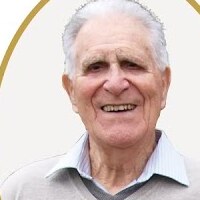
Henry Masters
d. 2020
An architect who lived in humility and gave generations of inheritance to his faith.
Projects by Henry Masters
- The Eye of the Needle
Autobiography, written in his last years
- Born
- Stanton Fitzwarren, England
- Passed away
- 23 May 2020
Eulogy
Community tribute — FFWPU-UK.
Henry Masters ascended to the Spirit World on Saturday 23rd May 2020. He was truly a very special person who gave so much to support the Messiah's work on this earth. Mr Masters dedicated his life to God's will, freely offering generations' worth of inherited property to help pursue True Parents' teachings, following absolutely the lessons taught through the Divine Principle.
Despite coming from a great background, he lived a life of humility and brought happiness with his warm, welcoming, and understanding heart towards everyone he approached.
His life itself was his message to us all to love each other and restore this world for God. We can't express enough how special he was.
From the Seonghwa ceremony
A community remembrance, distilled from the recorded ceremony.
Henry Arthur Corbett Masters was born on July 16th, 1926 in Roarton near Swindon, the second of three children to William Arthur and Rosalie Masters. When Henry was about two, his father died suddenly of thrombosis, leaving his mother to raise three young children and care for an invalid grandmother on greatly reduced means. The family moved to a small house in Dorset, where the holidays unfolded under his mother's spirited tutelage: camping, climbing and exploring caves, the children's tents and pots strapped to a trailer behind her bicycle. Considered a handful, Henry was packed off to a weekly boarding school at six, ferried on the back of that same bicycle. Prep school was unhappy until he arrived at King's School, Bruton, where everything shifted the day he discovered a large red-bound book on the excavation of the Minoan palace at Knossos. He built a cardboard model of the palace from cornflakes packets, and when he later arrived at the Architectural Association with no drawings, only suitcases of cardboard models, the principal admitted him on the strength of Knossos alone. He bounded across Bedford Square and hugged his waiting mother in victory.
Called up at eighteen, he was enlisted in the Royal Engineers and shipped to India just as the war ended, to his mother's relief. He bicycled on his days off to temples of every faith, once sharing army rations with an ancient goatherd on a hillock in exchange for apples. He felt such kinship with the people there that he half-wondered if Indian blood ran in his veins; he was, all his life, blind to colour and race. He served on in Burma and West Africa, then returned home in 1949 to inherit Stanton Fitzwarren from his uncle John, an estate entailed for four hundred years to which Henry was the last heir. He opened an architectural practice in Swindon, served as warden and lay reader of the parish, and once shook hands with Princess Margaret at the opening of a youth hostel he had designed.
He proposed to Averil on bended knee in a railway carriage; arriving at Victoria Station they walked straight into Westminster Cathedral to give thanks. They married in their village church on August 23rd, 1952, having known each other since the age of two, when, family legend held, he had chased her trying to kiss her, though his sister Ellen insisted he was more likely pulling her hair. On a chosen site in the village they built their dream home, Hassel Lane, an open-plan house influenced by Henry's student travels in Sweden, with a view across the valley to a wood he loved to walk through, children perched on his shoulders, sometimes returning with fistfuls of wildflowers. They had three children, Rosalind, Priscilla and James, and in time six grandchildren and two great-grandchildren.
At Christmas 1972, Henry first read the Divine Principle, and over the following days he and Averil read together, feeling they had found what they had long been searching for. In 1973 the family joined the Unification Church; James's school fees at King's Bruton were paid in advance so his education could continue undisturbed. At precisely 6 p.m. on the 6th of June 1975, four hundred years to the moment since his ancestors had received Stanton Fitzwarren, Henry signed the entire estate over to the Sun Myung Moon Foundation. The following year he and Averil were blessed at Belvedere. In 1974 Reverend Moon planted the first of six oak trees in the form of a cross on the land; Henry planted the sixth at the foot. Vandalism would later claim four, but Moon's tree and Henry's still stand.
In 1978 Reverend Moon told Henry that an architect who could design buildings could design boats, and sent him to a bookshop to buy Amateur Fibreglass Boat Building. With the engineer Brian Hill, whose loyalty and resourcefulness Henry praised as without equal, he began the ocean providence. From the East Sun building in New York, 120 days from a standing start, the first 28-foot "Good Go" boat launched on July 10th, 1980 — someone had pinned the word "Noah" to his office door as a joke, though as Henry noted, Noah had taken 120 years. For twenty-six years he designed fishing vessels in Mississippi, Alabama, New Jersey, North Carolina and Korea. At seventy he and Averil were appointed national messiahs to Cuba, travelling in via Jamaica and basing themselves in Miami. They returned to Stanton Fitzwarren in 2007, his final 32-foot boat completed and launched in the company of a school of leaping dolphins.
In his last years Henry wrote his autobiography, The Eye of the Needle. He left behind a small piece of prose called The Skylark, set in the field at North Farm called Koons, recalling himself at thirteen lying in the grass searching the sky for that tiny singing speck, and wondering whether, when everything else has changed, the song would still be heard. Friends remembered him with a particular tenderness: his trick birthday candles in Alabama in 1980, which he eventually crouched eye-level with the cake to defeat; his quiet, diesel-steady humour at sea; his godson's dedication of Schumann's Widmung in his honour; his grandson Henry junior's letter from Italy recalling the safeness of his hands. Mother Moon's calligraphy hung above his coffin, naming him the first and only Englishman so commended; Father Moon had often called him simply a true English gentleman. The ceremony closed with Amazing Grace, three sunflowers for his three children laid at the centre of his coffin, and Averil still among us, his queen yet to come.
Seonghwa Ceremony
Sources
Reflections about this person
Reflections are anonymous unless you put your name in. Every submission is reviewed before it appears.
Loading reflections…